


Self-Efficacy Shows No Independent Link to Heart Rate Variability in Healthy Adults
A secondary analysis of healthy adults found that initial associations between general self-efficacy and resting heart rate variability were attenuated ...
A secondary analysis of healthy adults found that initial associations between general self-efficacy and resting heart rate variability were attenuated ...

A four-domain operational analysis reveals that mobile health algorithms compound sensing errors across patient care unless institutional governance mandates subgroup ...

Researchers have introduced a privacy-focused Internet of Things architecture that combines lightweight facial emotion recognition and physiological pulse sensing for ...

A prospective multicenter study shows that smartwatch-based artificial intelligence analyzing photoplethysmography and accelerometry waveforms can opportunistically detect hypertension without cuff ...

A study of preschool children links trait-level interoceptive capacity to post-activity cardiac recovery and closer alignment between perceived and physiological ...

In a prospective single-center study conducted at Singapore General Hospital, researchers demonstrated that brief facial video recordings can provide modest ...
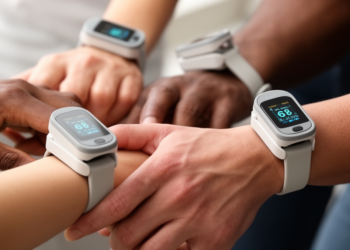
A controlled laboratory study evaluating four consumer pulse oximeters found that measurement agreement shifted significantly across resting and walking conditions ...
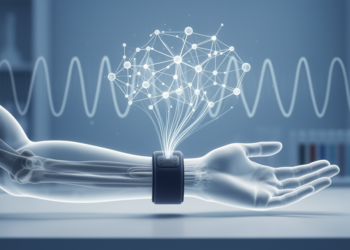
A pilot study of five healthy adults shows that embedding a personalized BP–PPG sigmoidal relationship into a dual-output neural network ...

A cross-sectional study of 1,163 cardiology outpatients identifies ten photoplethysmographic features that differ between adults under and over 65 across ...

A physics-constrained arterial-pressure twin candidate built from photoplethysmography showed no reconstruction benefit, weak forecasting, and uninformative uncertainty under locked, subject-disjoint ...


Embark on a thrilling journey of discovery with Scienmag.com—your ultimate source for cutting-edge breakthroughs. Immerse yourself in a world where curiosity knows no limits and tomorrow’s possibilities become today’s reality!