


Machine Learning Model Predicts Steel Crack Arrest Toughness from Historical Literature
Researchers developed a composite neural network that mines historical literature data to predict crack arrest fracture toughness in structural steels ...
Researchers developed a composite neural network that mines historical literature data to predict crack arrest fracture toughness in structural steels ...

A constrained variational framework resolves two-dimensional interacting crack networks by combining distributed Burgers-density fields with Karush–Kuhn–Tucker optimization and local propagation ...

A computational framework representing cracks through distributed Burgers-density fields captures multi-crack evolution, junction mechanics, and fragmentation transitions in finite elastic ...

Researchers developed an automated machine learning framework using the Tree-based Pipeline Optimization Tool to predict mode-I fracture toughness degradation in ...

Two-dimensional numerical modeling reveals that mining-induced stresses alone can generate curviplanar coal fractures and shell structures ahead of underground excavation ...

A critical narrative review establishes a regime-based framework for selecting valid polymer fracture toughness parameters and evaluating dissipation mechanisms across ...

Researchers have demonstrated that high-density electric current pulses drive discrete, pulse-synchronized crack propagation through repulsive Lorentz forces in thin aluminum ...
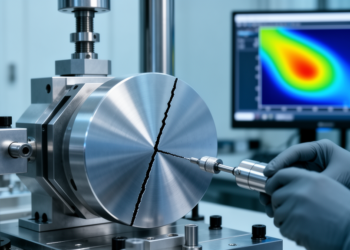
Researchers have introduced a new weight function representation that builds accurate stress intensity factor solutions for radial edge cracks in ...
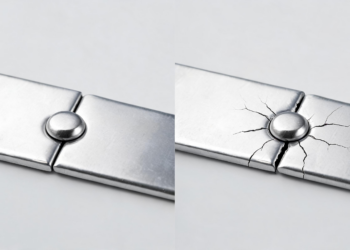
New experiments on riveted dissimilar aluminum joints show that alloy pairing dictates whether cracks grow slowly, stall, or trigger sudden ...


Embark on a thrilling journey of discovery with Scienmag.com—your ultimate source for cutting-edge breakthroughs. Immerse yourself in a world where curiosity knows no limits and tomorrow’s possibilities become today’s reality!