

Cosmic acceleration without dark energy? Two bold alternatives put to the test
A new review presents two dark-energy-free models, one based on the Milky Way's hyperbolic motion and one on a modified ...
A new review presents two dark-energy-free models, one based on the Milky Way's hyperbolic motion and one on a modified ...
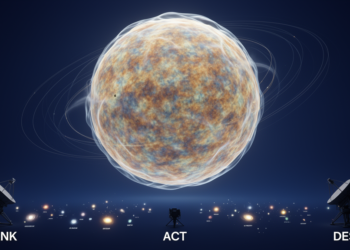
A new analysis combining Planck, ACT DR6, DESI DR2 and PantheonPlus data finds the CMB lensing amplitude deviating from the ...
Applying the dipole fitting method to 313 X-ray galaxy clusters for the first time, researchers find faint hints of a ...
A new Bayesian analysis combining DESI DR1 and DR2 baryon acoustic oscillations with supernova, cosmic chronometer and CMB data finds ...
A modified CLASS model and neural-network optimization found that two finite-temperature quantum-gravity parameters improved agreement with the 2018 Planck CMB ...
A new joint analysis using DESI DR2 baryon acoustic oscillations, supernovae, cosmic chronometers and CMB priors finds only weak support ...
A new dynamical systems analysis shows that a generalised Brans-Dicke theory with a non-canonical scalar field can reproduce the background ...
A new comparative analysis using DESI DR2 baryon acoustic oscillations, supernovae, and cosmic chronometers finds that holographic dark energy models ...
A new Bayesian analysis combining DESI DR2, supernova, and Planck data shows that bulk viscosity in a dark energy fluid ...
A new scalar-vector-tensor theory of gravity unifies dark energy and dark matter while offering a mathematically consistent route to easing ...


Embark on a thrilling journey of discovery with Scienmag.com—your ultimate source for cutting-edge breakthroughs. Immerse yourself in a world where curiosity knows no limits and tomorrow’s possibilities become today’s reality!