


Oxide Clusters Bind Lithium Polysulfides Stronger Than Molecular Salts
A new computational study reveals that metal oxide clusters bind lithium polysulfides significantly stronger than molecular salts, offering a framework ...
A new computational study reveals that metal oxide clusters bind lithium polysulfides significantly stronger than molecular salts, offering a framework ...

Researchers have developed a molecular electrolyte design that doubles iodine electron transfer to increase the energy capacity of safer aqueous ...

An anode-free sodium battery design using a 1,3-dioxane-based electrolyte retained about 80% capacity after 1,400 cycles in 300-mAh pouch cells.
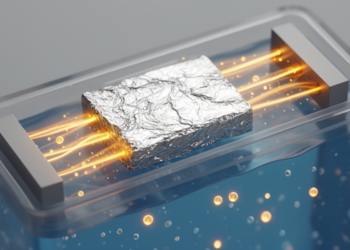
Researchers in China have made the tin(IV)/tin(II) redox couple reversible in water by adding iodide to tin chloride electrolytes, enabling ...
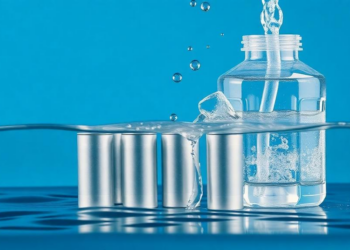
Researchers report that a trimethyl phosphate cosolvent, optimized at 40 percent volume fraction, simultaneously suppresses hydrogen evolution and corrosion while ...

A new review in Ionics synthesizes recent advances in electrode materials, interfacial chemistry, and stabilization strategies that could unlock longer-lasting, ...

A combined spectroscopy and machine-learning simulation study has captured the electrical double layer restructuring in real time during hydrogen evolution, ...
A free-chloride-rich ionic liquid electrolyte enables a reversible three-electron sulfur redox in lithium–disulfur dichloride batteries, lifting the operating voltage to ...


Embark on a thrilling journey of discovery with Scienmag.com—your ultimate source for cutting-edge breakthroughs. Immerse yourself in a world where curiosity knows no limits and tomorrow’s possibilities become today’s reality!