

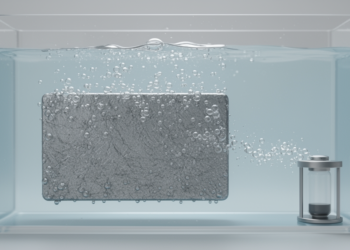
Zinc Chemistry Breakthrough Turns Metal into a Reusable Hydrogen Battery
Researchers have used machine learning to discover that lactate ligands unlock reversible zinc oxidation, enabling a safe, circuit-free carrier that ...
Researchers have used machine learning to discover that lactate ligands unlock reversible zinc oxidation, enabling a safe, circuit-free carrier that ...

A University of Waterloo team combined electrochemical experiments with neural networks and genetic algorithms to predict aluminum anode corrosion in ...
A new review collection in Frontiers in Batteries and Electrochemistry shows battery research converging on safer interfaces, smarter manufacturing, computational ...
Researchers converted a sprayed nickel sulfate precursor directly into crystalline nickel oxide on nickel foam using a CO₂ laser, producing ...
Researchers in India have converted Vigna mungo seed skin, a waste byproduct of black gram milling, into KOH-activated porous carbon ...
Researchers in Türkiye have developed a PVC membrane potentiometric sensor using a naphthoquinone ionophore that detects lead ions in water ...
Researchers at Jilin Normal University show that precisely timed microwave irradiation can generate MXene quantum dots on a vanadium carbide ...
Researchers in India report that lanthanum-doped nickel-cobalt layered double hydroxide nanosheets grown hydrothermally achieve a specific capacity of 390.3 mAh/g ...
Brazilian researchers used guaraná seed extract to synthesize silver nanoparticles that showed diffusion-influenced electrochemical responses to a commercial deltamethrin formulation ...
Researchers synthesized copper ferrite nanoparticles using Pemphis acidula leaf extract via a hydrothermal method, achieving high specific capacitance and strong ...

Embark on a thrilling journey of discovery with Scienmag.com—your ultimate source for cutting-edge breakthroughs. Immerse yourself in a world where curiosity knows no limits and tomorrow’s possibilities become today’s reality!