

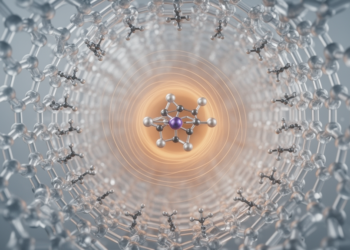
Magnetic probes reveal chemical environments inside molecular framework pores
A magnetic-probe and electron spin resonance method revealed differences in water-attracting and water-repelling environments inside covalent organic framework pores.
A magnetic-probe and electron spin resonance method revealed differences in water-attracting and water-repelling environments inside covalent organic framework pores.

Chemists have programmed continuous chemical gradients into crystalline covalent organic framework membranes using a diffusion-limited topotactic conversion strategy, enabling directional ...

Researchers at the National University of Singapore have developed a reusable benzimidazole hydrogen-bonding catalysis strategy that produces high-crystallinity covalent organic ...

Hydrogen has long been celebrated as the carbon-free energy carrier of the future, capable of storing renewable electricity at scale ...

A new review details how tunable porous and conjugated polymers are challenging platinum catalysts in electrochemical hydrogen production, with some ...

A new review argues that metal-organic and covalent organic frameworks must meet five evidence-qualified dimensions—material, spatial, temporal, mechanistic, and translational ...

A new review details how covalent organic frameworks with built-in metal centers merge molecular catalytic precision with heterogeneous durability for ...

A new review in Advanced Science details how porphyrin-based porous materials, including metal–organic frameworks, covalent organic frameworks, hydrogen-bonded frameworks, and ...

A new review in Ionics argues that inorganic fillers, from inert oxides to garnet ceramics and porous frameworks, are the ...

Researchers have developed a dual-drive strategy that converts covalent organic framework powders into large, defect-free 2D and 3D membranes capable ...


Embark on a thrilling journey of discovery with Scienmag.com—your ultimate source for cutting-edge breakthroughs. Immerse yourself in a world where curiosity knows no limits and tomorrow’s possibilities become today’s reality!