

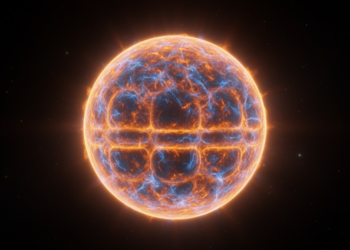
Well-Balanced Numerical Methods Keep Simulated Stars in Perfect Balance
A new review explains how well-balanced numerical schemes preserve hydrostatic equilibrium to machine precision, transforming simulations of stars, atmospheres and ...
A new review explains how well-balanced numerical schemes preserve hydrostatic equilibrium to machine precision, transforming simulations of stars, atmospheres and ...

A Bayesian marginalization technique promises sharper, more reliable ground-based solar images with far less manual tuning.
A new theoretical study maps the equilibrium solutions of self-gravitating Bose–Einstein condensates, showing how particle number, boson mass, and self-interaction ...
The MEGATRON collaboration's new simulations of the first stars and galaxies provide a physical bridge between James Webb Space Telescope ...
A major review surveys the physical models and three-dimensional hydrodynamic simulation techniques used to unravel common-envelope evolution, the violent stellar ...
A comprehensive review traces six decades of computational innovation—from Fokker–Planck models to GPU-accelerated direct N-body simulations—that now allows astronomers to ...
Three-dimensional radiation-hydrodynamics simulations with the CO5BOLD and Athena++ codes are revealing how giant convective cells, shock waves and pulsations drive ...
A new review charts the computational techniques that decode the spectra of supernovae and kilonovae, the cosmic explosions that forge ...
A new comprehensive review explains how large eddy simulations and subgrid-scale models are making cosmic turbulence computable, from stellar explosions ...
A new comprehensive review maps the numerical algorithms, computational challenges and distinctive wave phenomena that define the rapidly evolving field ...

Embark on a thrilling journey of discovery with Scienmag.com—your ultimate source for cutting-edge breakthroughs. Immerse yourself in a world where curiosity knows no limits and tomorrow’s possibilities become today’s reality!