

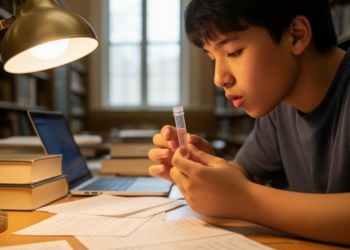
Stress Leaves a Chemical Signature in the Saliva of Stressed College Students
A study of 637 undergraduates found over 90 percent reported moderate-to-high stress, with salivary biomarkers revealing sympathetic, hormonal, circadian, and ...
A study of 637 undergraduates found over 90 percent reported moderate-to-high stress, with salivary biomarkers revealing sympathetic, hormonal, circadian, and ...

A new rat study shows the chemotherapy drug cyclophosphamide accelerates ovarian aging by depleting riboflavin kinase, destabilizing FAD-dependent cryptochrome clock ...
New field and laboratory research shows that the bamboo borer Dinoderus minutus emerges around 14:00 and takes flight around 16:00, ...
A large cross-sectional study of Turkish preclinical medical students finds that chronotype shows no significant link to academic achievement, while ...
A new study reports that the circadian clock gene BMAL1 and the cell cycle checkpoint regulator WEE1 are significantly downregulated ...
A randomized controlled trial found that the dual orexin receptor antagonist lemborexant did not improve daytime sleep duration in night ...
The charophyte alga Chara braunii shows circadian branchlet movements that persist under dim continuous light but are suppressed at higher ...
A new review in the Archives of Dermatological Research proposes that melatonin, through antioxidant, DNA-repair, and circadian mechanisms, may serve ...
A new CMAJ analysis argues that if Canada ends the twice-yearly clock change, the health evidence favors adopting permanent standard ...
A new editorial in BMC Environmental Science warns that exponentially increasing artificial light at night is disrupting circadian biology in ...

Embark on a thrilling journey of discovery with Scienmag.com—your ultimate source for cutting-edge breakthroughs. Immerse yourself in a world where curiosity knows no limits and tomorrow’s possibilities become today’s reality!