

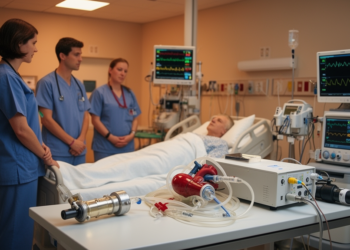
Cardiogenic Shock Device Choice Depends on Phenotype and Destination
A 2026 mini review finds that mechanical circulatory support in cardiogenic shock should be matched to ventricular and respiratory phenotype, ...
A 2026 mini review finds that mechanical circulatory support in cardiogenic shock should be matched to ventricular and respiratory phenotype, ...

A multicenter German study of 595 patients shows that takotsubo syndrome carries sharply different risks depending on its trigger, with ...
Researchers in Marburg found that interleukin-6 levels measured 72 hours after implantation of a microaxial flow pump independently predict 30-day ...
A case report from BMC Pediatrics describes how a malignant left main coronary artery anomaly caused exertional chest pain, pulmonary ...
A new review argues that the right ventricle and tricuspid valve form a single functional unit whose failure determines outcomes ...
A porcine study shows that combining moderate therapeutic hypothermia with mechanical left ventricular unloading preserves function, mitochondria, and calcium handling ...
A study of 775 SFTS patients shows that a six-biomarker panel and early biomarker trajectories can identify patients at high ...
A new computational study reveals that hydraulically efficient suction-type micro-axial heart pumps can inflict more blood damage than their discharge-type ...
Japanese physicians report using an axillary Impella 5.5 microaxial flow pump to stabilize a man in septic and cardiogenic shock ...
Three University of Michigan studies show that well-designed electronic health record alerts can prompt faster, guideline-based treatment decisions for critically ...

Embark on a thrilling journey of discovery with Scienmag.com—your ultimate source for cutting-edge breakthroughs. Immerse yourself in a world where curiosity knows no limits and tomorrow’s possibilities become today’s reality!