


Solar-Activated Quaternary Nanoparticles Degrade Persistent Congo Red Dye in Wastewater
Hydrothermally synthesized Cu2NiSnS4 nanoparticles degraded 96 percent of persistent Congo Red dye under natural sunlight while achieving 63 percent total ...
Hydrothermally synthesized Cu2NiSnS4 nanoparticles degraded 96 percent of persistent Congo Red dye under natural sunlight while achieving 63 percent total ...

A comprehensive scientific review published in Frontiers in Environmental Engineering has identified tattoo studio wastewater as an overlooked and largely ...

A comprehensive review analyzes how graphene oxide and reduced graphene oxide heterojunctions accelerate the photocatalytic mineralization of persistent synthetic dyes ...

A comprehensive scientific review details how diverse bacteria, fungi, and specialized enzymes deploy bioleaching, biosorption, and biotransformation to remediate toxic ...

Engineered laccase enzymes and functional carrier materials can efficiently degrade stubborn textile dyes, but most evidence still comes from laboratory-scale ...
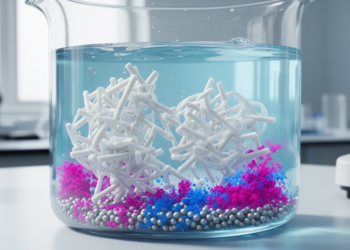
Researchers have created a ZIF-8/chitosan/ZnO nanocomposite that adsorbs up to 490 milligrams of azo dye per gram and then degrades ...
A new review in Environmental Science and Pollution Research synthesizes recent evidence showing that synthetic textile dyes persist in water, ...

A new study shows that a UV/hydrogen peroxide advanced oxidation process can remove up to 99.8 percent of two azo ...

A new review in Discover Biotechnology charts how microbial fuel cells convert organic waste, from cassava effluent to azo dyes, ...

New triazine-benzothiazole azo dyes synthesized and screened with DFT show narrow band gaps, balanced charge transport and hyperpolarizabilities several times ...


Embark on a thrilling journey of discovery with Scienmag.com—your ultimate source for cutting-edge breakthroughs. Immerse yourself in a world where curiosity knows no limits and tomorrow’s possibilities become today’s reality!