

If you mix fossil fuel with a little oxygen and add a spark, three things are produced: water, climate-warming carbon dioxide, and lots of energy. This fundamental chemical reaction takes place in every combustion engine, whether it runs on gasoline, petrol, or kerosene. In theory, this reaction can be reversed: with the addition of (renewable) energy, previously released CO₂ can be converted back into a (synthetic) fuel.

Credit: Empa
If you mix fossil fuel with a little oxygen and add a spark, three things are produced: water, climate-warming carbon dioxide, and lots of energy. This fundamental chemical reaction takes place in every combustion engine, whether it runs on gasoline, petrol, or kerosene. In theory, this reaction can be reversed: with the addition of (renewable) energy, previously released CO₂ can be converted back into a (synthetic) fuel.
This was the key idea behind the ETH Board funded Joint Initiative SynFuels. Researchers at Empa and the Paul Scherrer Institute (PSI) spent three years working on ways to produce synthetic fuels – known as synfuels – economically and efficiently from CO₂. This reaction, however, comes with challenges: for one, CO₂ electrolysis does not just yield the fuel that was previously burned. Rather, more than 20 different products can be simultaneously formed, and they are difficult to separate from each other.
The composition of these products can be controlled in various ways, for example via the reaction conditions, the catalyst used, and the microstructure of the electrodes. The number of possible combinations is enormous and examining each one individually would take too long. How are scientists supposed to find the best one? Empa researchers have now accelerated this process by a factor of 10.
Accelerating research
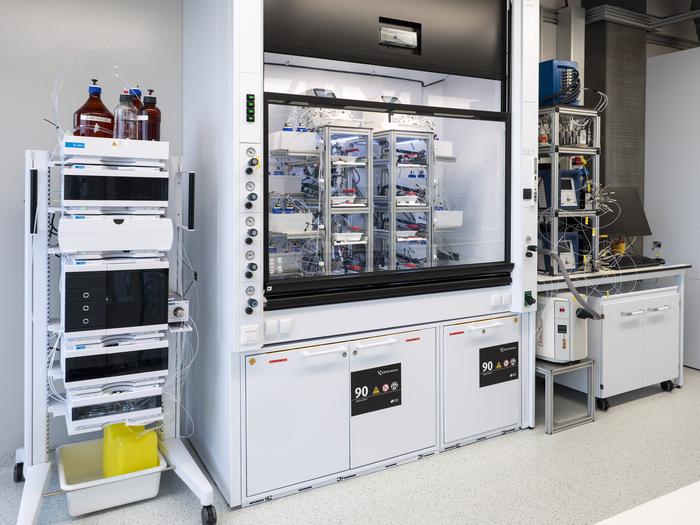
As part of the SynFuels project, researchers led by Corsin Battaglia and Alessandro Senocrate from Empa’s Materials for Energy Conversion laboratory have developed a system that can be used to investigate up to ten different reaction conditions as well as catalyst and electrode materials simultaneously. The researchers have recently published the blueprint for the system and the accompanying software in the journal Nature Catalysis.
The system consists of ten “reactors”: small chambers with catalysts and electrodes in which the reaction takes place. Each reactor is connected to multiple gas and liquid in- and outlets and various instruments via hundreds of meters of tubing. Numerous parameters are recorded fully automatically, such as the pressure, the temperature, gas flows, and the liquid and gaseous reaction products – all with high temporal resolution.
“As far as we know, this is the first system of its kind for CO₂ electrolysis,” says Empa postdoctoral researcher Alessandro Senocrate. “It yields a large number of high-quality datasets, which will help us make accelerated discoveries”. When the system was being developed, some of the necessary instruments were not even available on the market. In collaboration with the company Agilent Technologies, Empa researchers co-developed the world’s first online liquid chromatography device, which identifies and quantifies the liquid reaction products in real time during CO₂ electrolysis.
Sharing research data
Conducting experiments ten times faster also generates ten times as much data. In order to analyze this data, the researchers have developed a software solution that they are making available to scientists at other institutions on an open-source basis. They also want to share the data itself with other researchers. “Today, research data often disappears in a drawer as soon as the results are published,” explains Corsin Battaglia, Head of Empa’s Materials for Energy Conversion laboratory. A joint research project between Empa, PSI and ETH Zurich, which bears the name PREMISE, aims to prevent this: “We want to create standardized methods for storing and sharing data,” says Battaglia. “Then other researchers can gain new insights from our data – and vice versa.”
Open access to research data is also a priority in other research activities of the Materials for Energy Conversion laboratory. This includes the National Center of Competence in Research NCCR Catalysis, which focuses on sustainable chemistry. The new parallel CO₂ electrolysis system is set to play an important role in the second phase of this large-scale national project, with both the data generated and the know-how made available to other Swiss research institutions. To this end, the Empa researchers will continue to refine both the hardware and the software in the future.
Journal
Nature Catalysis
Method of Research
Experimental study
Subject of Research
Not applicable
Article Title
Parallel experiments in electrochemical CO₂ reduction enabled by standardized analytics
Article Publication Date
26-Jun-2024

