

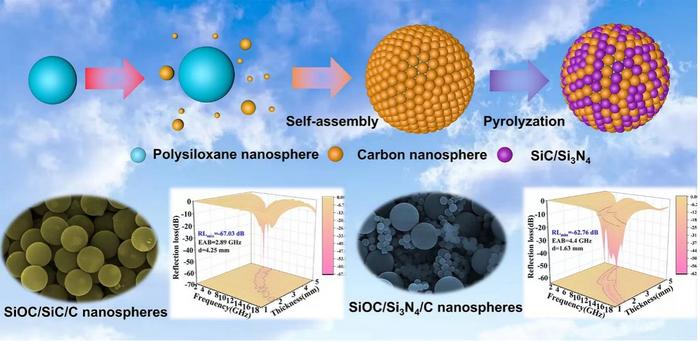
In recent years, microwave technology has dramatically progressed, marked by the arrival of the 5G era, owing to the advantages of electromagnetic waves in long-distance, wireless, and high-speed transmissions. However, electromagnetic wave pollution problems such as electromagnetic wave interference and electromagnetic wave radiation are becoming increasingly serious. Electromagnetic wave pollution not only affects the normal operation of electronic equipment, greatly threatens the information security of the scientific community, but also endangers human health and is a possible cause of cancer and sensitized diseases. SiOC precursor ceramics have great application potential in electromagnetic protection because of their advantages such as lightweight, high-temperature resistance, and molecular designability. The main challenge of polymer-derived ceramic-based composites for electromagnetic wave absorption is the single loss mechanism, resulting in inferior electromagnetic wave attenuation ability. Although the electromagnetic wave absorption performance of PDC-SiOC ceramic has been considerably improved in previous works, the reported manufacturing processes are complex and require expensive equipment.

Credit: Journal of Advanced Ceramics, Tsinghua University Press
In recent years, microwave technology has dramatically progressed, marked by the arrival of the 5G era, owing to the advantages of electromagnetic waves in long-distance, wireless, and high-speed transmissions. However, electromagnetic wave pollution problems such as electromagnetic wave interference and electromagnetic wave radiation are becoming increasingly serious. Electromagnetic wave pollution not only affects the normal operation of electronic equipment, greatly threatens the information security of the scientific community, but also endangers human health and is a possible cause of cancer and sensitized diseases. SiOC precursor ceramics have great application potential in electromagnetic protection because of their advantages such as lightweight, high-temperature resistance, and molecular designability. The main challenge of polymer-derived ceramic-based composites for electromagnetic wave absorption is the single loss mechanism, resulting in inferior electromagnetic wave attenuation ability. Although the electromagnetic wave absorption performance of PDC-SiOC ceramic has been considerably improved in previous works, the reported manufacturing processes are complex and require expensive equipment.
Recently, two teams of material scientists led by Yongqing Wang and Xiaojun Zeng from Jingdezhen Ceramic University, China reported the synthesis of SiOC@C ceramic nanospheres with tunable electromagnetic wave absorption performance by liquid phase method and precursor transformation method. This work not only explains the relationship between atmosphere, phase composition, microstructure, and absorption performance, also obtains the SiOC@C ceramic nanospheres with the minimum reflection loss value of -67.03 dB.
The team published their work in Journal of Advanced Ceramics on July 19, 2024.
“In this report, we synthesized a series of SiOC@C ceramic nanospheres containing SiC/Si3N4, free carbon, and amorphous SiOC through rational control of the heat-treatment temperature and atmosphere” said Junjie Qian, teacher at School of Materials Science and Engineering at Jingdezhen Ceramic University (China), whose research interests focus on the field of electromagnetic wave absorption material.
“Although the electromagnetic wave absorption performance of PDC-SiOC ceramic has been considerably improved in previous works, the reported manufacturing processes are complex and require expensive equipment.” said Junjie Qian.
“The SiOC@C ceramic nanospheres obtained in the Ar atmosphere consisted of SiC nanocrystalline, graphite phase carbon, amorphous carbon, and amorphous SiOC. The RLmim value of SiOC@C-3-30% was -45.23 dB at a matching thickness of 1.5 mm, and its EAB could cover the entire C, X, and Ku bands by adjusting the sample thickness.” said Junjie Qian.
“The SiOC@C ceramic nanospheres obtained in the N2 atmosphere consisted of Si3N4 nanocrystalline, graphite phase carbon, amorphous carbon, and amorphous SiOCN. The RLmin value of SiOC@C-4-30% was -62.76 dB at a matching thickness of 1.63 mm. The RLmin value of SiOC@C-5-30% was -60.54 dB at a thinner matching thickness of 1.57 mm” said Junjie Qian.
However, more delicate research works are still needed to explore the antibacterial activity of SiOC ceramics. In this regard, Qian also put forward several major development directions may be pursued in future works including antibacterial activity, antiseptic property and oxidation-resistant property.
Other contributors include Dandan Ma, Huoming Liao, and Shaohua Wang from the School of Materials Science and Engineering at Jingdezhen Ceramic University in Jingdezhen, China; Xiaoling Zhou from the School of Mechanical and Electronic Engineering at Jingdezhen Ceramic University in Jingdezhen, China; Qingliang Shan from the School of Materials Science and Engineering at Zhejiang Sci-Tech University in Hangzhou, China.
This work was supported by the National Natural Science Foundation of China (52360018).
About Author
Junjie Qian, Jingdezhen Ceramic University, School of Materials Science and Engineering, Doctor graduated from South China University of Technology in July 2023. In the same year, he joined Jingdezhen Ceramic University, mainly engaged in the preparation and performance research of electromagnetic wave-absorbing materials and precursor ceramics.
Yongqing Wang is a professor of the School of Materials Science and Engineering of Jingdezhen Ceramic University, a Ph.D of South China University of Technology. mainly engaged in the preparation and performance research of ceramic membranes.
Xiaojun Zeng is a professor of the School of Materials Science and Engineering of Jingdezhen Ceramic University, a Ph.D of Beijing University of Aeronautics and Astronautics, and University of California, Riverside (UCR), and postdoctoral of University of California, Santa Barbara (UCSB), mainly engaged in the preparation and performance research of electromagnetic functional materials and energy catalytic materials.
About Journal of Advanced Ceramics
Journal of Advanced Ceramics (JAC) is an international academic journal that presents the state-of-the-art results of theoretical and experimental studies on the processing, structure, and properties of advanced ceramics and ceramic-based composites. JAC is Fully Open Access, monthly published by Tsinghua University Press, and exclusively available via SciOpen. JAC’s 2023 IF is 18.6, ranking in Top 1 (1/31, Q1) among all journals in “Materials Science, Ceramics” category, and its 2023 CiteScore is 21.0 (top 5%) in Scopus database. ResearchGate homepage:
About SciOpen
SciOpen is an open access resource of scientific and technical content published by Tsinghua University Press and its publishing partners. SciOpen provides end-to-end services across manuscript submission, peer review, content hosting, analytics, identity management, and expert advice to ensure each journal’s development. By digitalizing the publishing process, SciOpen widens the reach, deepens the impact, and accelerates the exchange of ideas.
Journal
Journal of Advanced Ceramics
Article Title
Synthesis of SiOC@C ceramic nanospheres with tunable electromagnetic wave absorption performance
Article Publication Date
19-Jul-2024

