

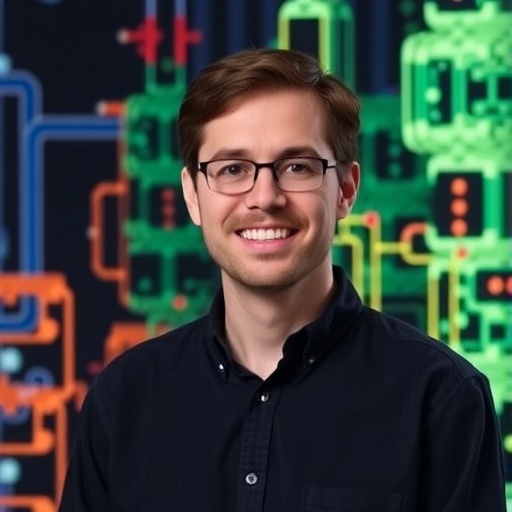
In a remarkable breakthrough poised to revolutionize the future of quantum computing, Dr. Dominic Williamson, a quantum physicist at the University of Sydney, has developed an innovative approach to quantum error correction that could drastically reduce the physical qubit overhead needed for fault-tolerant quantum computers. This development is a critical step forward in overcoming one of the most formidable obstacles in realizing large-scale, practical quantum systems capable of solving problems beyond the reach of classical computers.
Quantum computers harness the peculiar properties of quantum mechanics, such as superposition and entanglement, to perform computations that can exponentially speed up certain classes of algorithms. However, the fragility of quantum states—the ease with which they decohere or collapse into classical states upon interacting with the environment—remains a fundamental barrier to building reliable and scalable quantum machines. Preserving quantum information in such volatile conditions necessitates robust error correction methods, which have traditionally imposed staggering resource demands.
Dr. Williamson’s pioneering work introduces a novel quantum error correction scheme inspired by the sophisticated mathematical framework of gauge theory, a pillar of modern theoretical physics. Gauge theory governs the fundamental forces and particles in nature by reconciling local interactions with global symmetries. By cleverly adapting this concept, the research provides an elegant mechanism to track global quantum information without forcing the fragile quantum states to collapse locally, thereby overcoming some central challenges of maintaining coherence in logical quantum operations.
The essence of this technique involves encoding quantum information in a way that errors can be detected and corrected collectively across many physical qubits rather than individually. Standard error-correcting codes often require an increasing number of physical qubits as computational tasks grow, leading to impractical scaling. In contrast, Williamson’s design capitalizes on what are effectively “quantum hard drives,” where the overhead grows proportionally with the amount of stored information rather than the complexity of the computation, a theoretical step-change made feasible through advanced error correction.
Crucially, this new method addresses the next hurdle—performing logical computations directly on the efficiently stored quantum information without compromising these efficiency gains. In conventional quantum architectures, executing logical gates can significantly increase error rates and resource consumption. The incorporation of “gauge-like” degrees of freedom within the quantum system means that logical processors can interact with the quantum memory while preserving its coherence and integrity.
The architecture utilizes expander graphs, highly connected mathematical structures known for their remarkable properties in network theory and error correction, to maintain efficient scaling. These graphs facilitate robust connections between physical qubits, enabling error correction to operate with fewer additional qubits and less frequent interventions. This mathematical underpinning is vital for creating practical fault-tolerant quantum computers capable of handling real-world, complex problems.
This work is not merely theoretical. During his sabbatical at IBM’s Quantum Information Theory and Error Correction group in California, Dr. Williamson contributed directly to refining the design principles that IBM has integrated into its roadmap for building scalable quantum hardware. His approach aligns with and enhances industry efforts to develop quantum computers that move beyond laboratory curiosities to machines capable of transformative applications in cryptography, materials science, and complex system modeling.
Quantum computers’ promise lies in their capacity to simulate quantum systems naturally and factorize large numbers with unprecedented speed, among other feats unattainable by classical counterparts. These abilities hinge on the preservation of quantum coherence through every computational step. By innovating new ways to protect and manipulate this delicate quantum data structure, Dr. Williamson’s research opens pathways to more economically feasible and scalable designs — a crucial leap towards commercially viable quantum technology.
Gauge theory’s introduction into quantum error correction signals a profound convergence between high-energy physics and quantum information science. This multidisciplinary synergy reflects an evolving landscape where abstract theoretical tools inform practical engineering solutions. Dr. Williamson’s insight into applying coordinate transformations—central to understanding physical laws—to local quantum states enables a flexible framework where local operations do not disrupt global informational coherence.
The implications extend beyond reducing qubit overhead; this approach promises enhanced robustness across the entire quantum computation cycle. By embedding global logical information within gauge-like synthetic degrees of freedom, the system can maintain integrity against errors while still permitting accurate and efficient logical operations. This balance is fundamental for realizing the dream of fault-tolerant quantum computation, which until now has been severely constrained by hardware limitations.
The research represents a thoughtful collaboration between academia and industry, supported by IBM, with no declared competing interests, highlighting the shared commitment to overcoming quantum computational challenges. The publication in Nature Physics underscores the breakthrough’s significance and opens avenues for further exploration, integration, and eventual commercial deployment.
As the quantum computing race intensifies globally, with diverse error correction protocols vying for supremacy, Dr. Williamson’s gauge-theory-based framework stands out. Its promise to reduce required physical resources while maintaining—or even enhancing—logical performance marks a crucial milestone in the quest for scalable, efficient quantum architectures. If successfully implemented at scale, this advancement could catapult the field into a new era where quantum computers become practical tools for scientific discovery and technological innovation.
Subject of Research: Quantum error correction and fault-tolerant quantum computation
Article Title: Low-overhead fault-tolerant quantum computation by gauging logical operators
News Publication Date: April 2, 2026
Web References:
- Dr Dominic Williamson profile at University of Sydney: https://profiles.sydney.edu.au/dominic.williamson
- Nature Physics Journal: https://www.nature.com/nphys/
- IBM quantum roadmap integration: https://www.ibm.com/quantum/blog/large-scale-ftqc
- DOI: http://dx.doi.org/10.1038/s41567-026-03220-8
References:
Williamson, D. and Yoder, T. ‘Low-overhead fault-tolerant quantum computation by gauging logical operators’ (Nature Physics, 2026). DOI:10.1038/s41567-026-03220-8
Image Credits: The University of Sydney
Keywords: Quantum computing, Quantum error correction, Fault-tolerant quantum computation, Gauge theory, Quantum memory, Qubits, Quantum information, Expander graphs, IBM quantum research, Scalable quantum architecture


