


SAN ANTONIO — April 22, 2024 —Teams led by Southwest Research Institute successfully executed two groundbreaking experiments — by land and air — collecting unique solar data from the total eclipse that cast a shadow from Texas to Maine on April 8, 2024. The Citizen Continental-America Telescopic Eclipse (CATE) 2024 experiment engaged more than 200 community participants in a broad, approachable and inclusive attempt to make a continuous 60-minute high-resolution movie of this exciting event. A nearly simultaneous investigation used unique equipment installed in NASA’s WB-57F research aircraft to chase the eclipse shadow, making observations only accessible from a bird’s eye view.
“Total solar eclipses are relatively rare, offering unique opportunities for scientists to study the hot atmosphere above the Sun’s visible surface,” said Dr. Amir Caspi, principal investigator of both projects. “But more than that, through CATE 2024, the eclipse offered a bonding experience between scientists and communities along the path, sharing in this incredible awe-inspiring event. We hope the public experienced a new interest in, and appreciation of, the Sun and its mysteries.”
Total solar eclipses allow scientists to view the complex and dynamic features of the Sun’s outer atmosphere in ways that aren’t possible or practical by any other means, opening new windows into our understanding of the solar corona. The faint light from the corona is usually overpowered by the intense brightness of the Sun itself, and some wavelengths of light are blocked by Earth’s atmosphere.
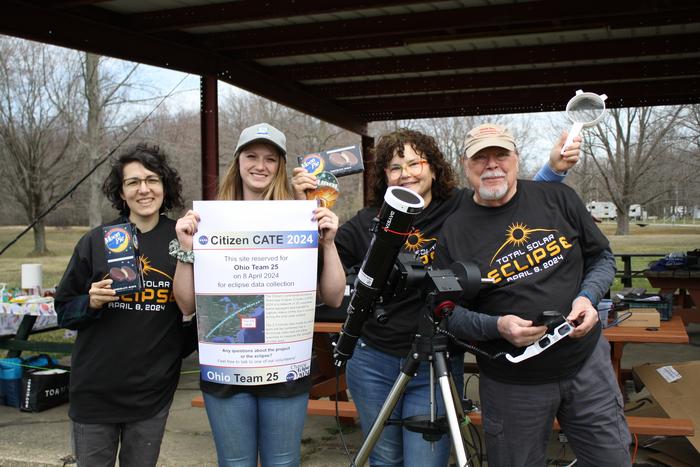
CATE 2024 deployed a network of 35 teams of community participants, or “citizen scientists,” representing local communities along the eclipse path, deploying a “bucket brigade” of small telescopes following the eclipse’s cross-country path. CATE 2024’s scientific objectives required measuring the polarization of light, or the orientation of oscillating light waves, in the corona.
“You are familiar with this because sometimes you wear a polarizing filter right on your face — sunglasses that filter out certain angles of polarized light,” Caspi said. “The Citizen CATE 2024 telescopes have a polarizing filter baked onto every pixel of the sensor, allowing us to measure four different angles of polarization everywhere in the corona, providing a lot more information than just measuring the brightness of the light.”
Caspi also led an airborne project to observe the corona during the eclipse from 50,000 feet. These high-altitude observations both provide measurements that can’t be made from the ground and avoid any weather-related risks. Caspi’s team deployed a new suite of sensitive, high-speed, visible-light and infrared imagers, built by the SCIFLI team at NASA’s Langley Research Center, installed in the nose cone of a WB-57 jet.
Looking at complex motion in the solar corona, at new wavelengths and with new polarization measurements, will help scientists understand why it is so hot. The corona is millions of degrees Celsius, hundreds of times hotter than the visible surface below, a curious paradox that is a longstanding scientific mystery. The corona is also one of the major sources of eruptions that cause geomagnetic storms around Earth. These phenomena damage satellites, cause power grid blackouts and disrupt communication and GPS signals, so it’s important to better understand them as the world becomes increasingly dependent on such systems.
“Combining the airborne mobile data with the CATE 2024 hour-long string of observations will provide a more complete picture of the Sun’s mysterious corona,” said SwRI co-investigator Dr. Dan Seaton, who serves as the science lead for both projects.
“Both experiments required an enormous effort and precise timing to get the data we need,” Caspi said. “I am honored and in awe of the exceptionally talented teams that worked so diligently together. I can hardly wait to dig into the data we collected.”
The SwRI-led airborne team includes scientists from the National Center for Atmospheric Research High Altitude Observatory, NASA Langley Research Center, and Predictive Sciences Inc., with collaborators at the Smithsonian Astrophysical Observatory. The SwRI-led CATE 2024 project, funded by NSF and NASA, includes scientists from the National Center for Atmospheric Research, the National Solar Observatory, the Laboratory for Atmospheric and Space Physics at the University of Colorado, and the Space Science Institute, with collaborators at New Mexico State University and the Livelihoods Knowledge Exchange Network, community leaders at Rice University, Indiana University Bloomington, and the University of Maine, and over 200 community participants in 35 communities along the eclipse path.
For more about these projects, please see: or https://eclipse.boulder.swri.edu.
For more information, visit https://www.swri.org/heliophysics.

Credit: Southwest Research Institute/Citizen CATE 2024
SAN ANTONIO — April 22, 2024 —Teams led by Southwest Research Institute successfully executed two groundbreaking experiments — by land and air — collecting unique solar data from the total eclipse that cast a shadow from Texas to Maine on April 8, 2024. The Citizen Continental-America Telescopic Eclipse (CATE) 2024 experiment engaged more than 200 community participants in a broad, approachable and inclusive attempt to make a continuous 60-minute high-resolution movie of this exciting event. A nearly simultaneous investigation used unique equipment installed in NASA’s WB-57F research aircraft to chase the eclipse shadow, making observations only accessible from a bird’s eye view.
“Total solar eclipses are relatively rare, offering unique opportunities for scientists to study the hot atmosphere above the Sun’s visible surface,” said Dr. Amir Caspi, principal investigator of both projects. “But more than that, through CATE 2024, the eclipse offered a bonding experience between scientists and communities along the path, sharing in this incredible awe-inspiring event. We hope the public experienced a new interest in, and appreciation of, the Sun and its mysteries.”
Total solar eclipses allow scientists to view the complex and dynamic features of the Sun’s outer atmosphere in ways that aren’t possible or practical by any other means, opening new windows into our understanding of the solar corona. The faint light from the corona is usually overpowered by the intense brightness of the Sun itself, and some wavelengths of light are blocked by Earth’s atmosphere.
CATE 2024 deployed a network of 35 teams of community participants, or “citizen scientists,” representing local communities along the eclipse path, deploying a “bucket brigade” of small telescopes following the eclipse’s cross-country path. CATE 2024’s scientific objectives required measuring the polarization of light, or the orientation of oscillating light waves, in the corona.
“You are familiar with this because sometimes you wear a polarizing filter right on your face — sunglasses that filter out certain angles of polarized light,” Caspi said. “The Citizen CATE 2024 telescopes have a polarizing filter baked onto every pixel of the sensor, allowing us to measure four different angles of polarization everywhere in the corona, providing a lot more information than just measuring the brightness of the light.”
Caspi also led an airborne project to observe the corona during the eclipse from 50,000 feet. These high-altitude observations both provide measurements that can’t be made from the ground and avoid any weather-related risks. Caspi’s team deployed a new suite of sensitive, high-speed, visible-light and infrared imagers, built by the SCIFLI team at NASA’s Langley Research Center, installed in the nose cone of a WB-57 jet.
Looking at complex motion in the solar corona, at new wavelengths and with new polarization measurements, will help scientists understand why it is so hot. The corona is millions of degrees Celsius, hundreds of times hotter than the visible surface below, a curious paradox that is a longstanding scientific mystery. The corona is also one of the major sources of eruptions that cause geomagnetic storms around Earth. These phenomena damage satellites, cause power grid blackouts and disrupt communication and GPS signals, so it’s important to better understand them as the world becomes increasingly dependent on such systems.
“Combining the airborne mobile data with the CATE 2024 hour-long string of observations will provide a more complete picture of the Sun’s mysterious corona,” said SwRI co-investigator Dr. Dan Seaton, who serves as the science lead for both projects.
“Both experiments required an enormous effort and precise timing to get the data we need,” Caspi said. “I am honored and in awe of the exceptionally talented teams that worked so diligently together. I can hardly wait to dig into the data we collected.”
The SwRI-led airborne team includes scientists from the National Center for Atmospheric Research High Altitude Observatory, NASA Langley Research Center, and Predictive Sciences Inc., with collaborators at the Smithsonian Astrophysical Observatory. The SwRI-led CATE 2024 project, funded by NSF and NASA, includes scientists from the National Center for Atmospheric Research, the National Solar Observatory, the Laboratory for Atmospheric and Space Physics at the University of Colorado, and the Space Science Institute, with collaborators at New Mexico State University and the Livelihoods Knowledge Exchange Network, community leaders at Rice University, Indiana University Bloomington, and the University of Maine, and over 200 community participants in 35 communities along the eclipse path.
For more about these projects, please see: or https://eclipse.boulder.swri.edu.
For more information, visit https://www.swri.org/heliophysics.
Cite Scienmag News
Grant Pearson. (April 22, 2024). SwRI-led eclipse projects shed new light on solar corona. Scienmag. https://scienmag.com/swri-led-eclipse-projects-shed-new-light-on-solar-corona/
Grant Pearson. "SwRI-led eclipse projects shed new light on solar corona." Scienmag, 22 April 2024, https://scienmag.com/swri-led-eclipse-projects-shed-new-light-on-solar-corona/. Accessed 4 September 2026.
Grant Pearson. "SwRI-led eclipse projects shed new light on solar corona." Scienmag. April 22, 2024. https://scienmag.com/swri-led-eclipse-projects-shed-new-light-on-solar-corona/

