


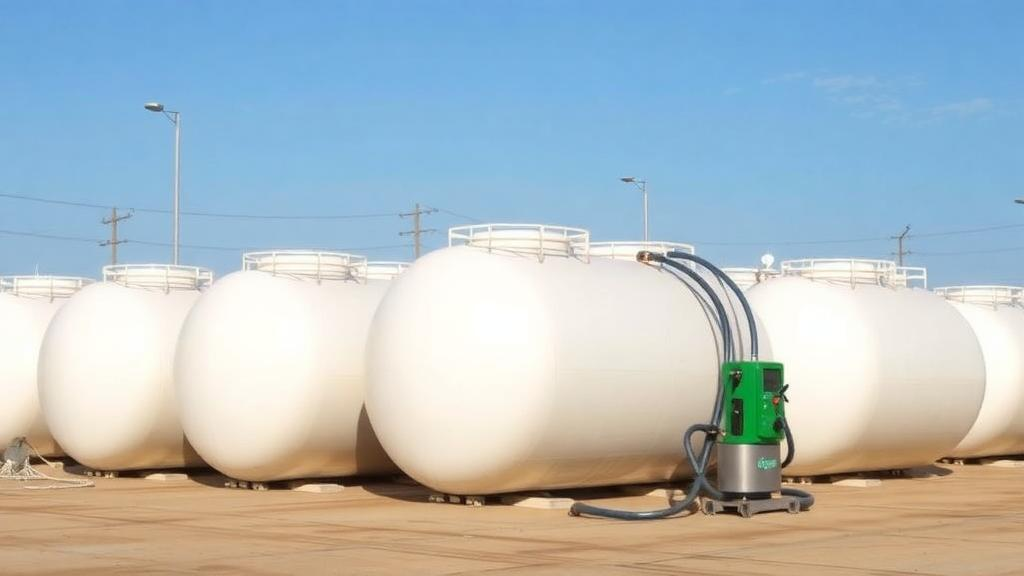
Hydrogen fuel cell vehicles promise fast refueling and long range, but the infrastructure to serve them has struggled to escape a classic chicken-and-egg dilemma. Drivers hesitate to buy hydrogen cars when refueling stations are scarce, and investors hesitate to build stations when there are no customers. Now a feasibility study published in iScience by William Forshaw, Timothy Mays, Alfred Hill and Tom Fletcher of the University of Bath proposes a radical alternative to the familiar pump-and-hose model: instead of dispensing gas into a fixed onboard tank, stations would simply swap out empty hydrogen cylinders for full ones, in much the same way that battery-swapping services in India and China replace depleted electric vehicle packs. The analysis suggests that such a swappable hydrogen refueling system, or SHRS, could cut the energy required to deliver and dispense hydrogen by 58 percent while lowering the capital cost of each station.
To understand why the researchers looked beyond the conventional station, it helps to grasp how awkward hydrogen is as a road fuel. On a mass basis it is superb, packing roughly 120 megajoules per kilogram at its lower heating value, far more than gasoline. On a volume basis it is terrible, with a volumetric density more than a hundred times lower than diesel. Compression solves the storage problem but creates new ones. Above roughly 100 bar, hydrogen departs sharply from ideal gas behavior, and past 500 bar the returns diminish so much that the real density deviates nearly 50 percent from what the ideal gas law would predict. Every additional increment of pressure therefore demands stronger, heavier, more expensive containment while yielding less fuel than expected.
Thermal management compounds the difficulty. When hydrogen is dispensed rapidly into a vehicle tank, the gas compresses and, because of hydrogen’s negative Joule-Thomson effect at ambient conditions, heats dramatically, with tank temperatures potentially reaching 470 kelvin. To protect the carbon fiber reinforced polymer tanks used in production cars, stations pre-cool the fuel to 233 kelvin, a step that consumes at least 1.08 megajoules per kilogram and adds about 50 US cents per kilogram in equipment cost. Worse, by Charles’s law the warm, expanded gas becomes less dense, so once it cools the final pressure drops and fewer moles of hydrogen actually end up in the vehicle. To compensate, dispensers typically deliver at around 950 bar even though the target storage pressure is 700 bar, wasting further energy and stressing equipment.
Distribution is equally thorny. Hydrogen has no national pipeline network, so most stations either generate fuel on-site with an electrolyzer or receive it by tube trailer. Steel tube trailers carry up to about 350 kilograms at 200 to 500 bar, a payload so small that at high station utilization the traffic of delivery trucks could become unmanageable. Composite trailers at higher pressures would carry more, but bespoke large composite vessels for transport remain prohibitively expensive. The Bath team’s insight was that the same standardized 700-bar Type-IV composite tanks destined for vehicles could double as the distribution medium, manufactured at scale and shuttled between a central filling facility and stations in modular racks.
The conceptual system they benchmark is elegantly simple. A car arrives at a swap station, a robotic attendant removes the depleted cylinder and inserts a full one, and the driver leaves with 4.1 kilograms of hydrogen, enough for an estimated 360 kilometers in a second-generation Toyota Mirai. Because a 70-kilogram tank is far too heavy to lift by hand, automation handles the exchange. Empty tanks sit in movable racks that are hauled by trailer to a central compressor station, potentially co-located with a hydrogen production plant or pipeline outlet, where they are refilled. Crucially, a single vessel carries the hydrogen from production to the vehicle, eliminating the cascade of buffer tanks, chillers and high-pressure dispensers that clutter a conventional station.
The energy accounting is where the concept shines. Treating hydrogen as a real gas using the NIST REFPROP equation-of-state database and assuming 70 percent compressor efficiency with intercooling between stages, the researchers calculated that delivering and dispensing one kilogram of hydrogen through a swappable route requires 9.83 megajoules, versus 23.82 megajoules for the conventional pathway, a saving of 58 percent. The dominant factor is transport: a swappable trailer carrying 420 tanks delivers 1,722 kilograms of hydrogen per trip at a gross weight of about 42,400 kilograms, whereas a conventional steel tube trailer manages only 350 kilograms at roughly 40,000 kilograms gross. Similar trailer masses and fuel consumption, but nearly five times the payload, mean the swappable route needs roughly one-fifth of the transport energy per kilogram delivered, and over five times fewer truck trips per week at comparable station capacities.
The capital picture also favors swapping, at least at scale. A conventional medium-to-large station with 850 kilograms of dispensing capacity was estimated at 1,383,000 pounds in equipment, or 1,627 pounds per kilogram of capacity, with the compressor alone costing 320,000 pounds and easily exceeding one million dollars at larger throughputs. A swappable station of similar capacity, built around robotics, ramps, storage racks and a fractional share of a centralized compressor spread across five stations, came to 1,182,400 pounds, or 1,386 pounds per kilogram. The savings hinge on shared infrastructure achieving economies of scale that compartmentalized conventional stations cannot match. Reliability is another advantage: European station data show that dispensers, compressors and chillers account for roughly 63 percent of downtime, and a swappable station eliminates most of that machinery from the forecourt entirely.
The study is candid about the obstacles. Swapping demands standardization across automakers, a tall order for a competitive industry. A functioning system requires n-plus-one tanks in circulation, with spare cylinders parked at stations, and carbon fiber composite tanks are costly with limited service life and poor recyclability. Robust automated handling equipment for safety-critical pressure vessels does not yet exist commercially, although quick-connect fittings already proven at refueling stations could be adapted, and out-of-vehicle tanks could be inspected non-destructively at regular intervals rather than relying on periodic vehicle checks. Partially filled returned tanks would also erode efficiency, prompting the authors to suggest smart matching algorithms or incentives so that drivers swap only when necessary. The researchers frame this as a potential tank-as-a-service model in which minimizing the fleet of circulating cylinders and maximizing their lifespan would be paramount.
Context matters for the headline numbers. Hydrogen production remains the overwhelming energy sink, with an 80 percent efficient electrolyzer consuming 36.34 megajoules per kilogram before any fuel moves, dwarfing the distribution and dispensing losses either system incurs. The swappable advantage is also distance-dependent: sensitivity analysis shows it becomes significant beyond roughly 50 kilometers of haulage, while beyond 150 kilometers on-site electrolysis may win on energy grounds, and very large countries might favor other distribution modes. The authors stress that their estimates are deliberately conservative, that real-world conventional stations suffer additional inefficiencies from electrolyzer duty cycles, compression heating and chiller overheads, and that a prototype would be needed to validate the findings. Still, with proposed UK hydrogen hubs typically sitting within 50 kilometers of major population centers, the study argues that swapping deserves a seat at the table while station designs are still on the drawing board, offering a cheaper, leaner and more reliable path out of hydrogen’s infrastructure deadlock.
Subject of Research: Feasibility of swappable hydrogen tank refueling infrastructure for road vehicles
Article Title: Swappable hydrogen storage for road vehicles
Article References: Forshaw, W., Mays, T., Hill, A., & Fletcher, T. (2026). Swappable hydrogen storage for road vehicles. iScience, 29(10), Article 117655. https://doi.org/10.1016/j.isci.2026.117655
Image Credits: AI Generated
DOI: 10.1016/j.isci.2026.117655
Keywords: hydrogen, refueling infrastructure, swappable tanks, fuel cell vehicles, tube trailers, gas compression, energy efficiency, technoeconomic analysis, Type-IV composite tanks, battery swapping, decarbonization, transport
Cite Scienmag News
Faith Mcneil. (October 1, 2026). Swappable Hydrogen Tanks Could Slash Refueling Energy by More Than Half. Scienmag. https://scienmag.com/swappable-hydrogen-tanks-could-slash-refueling-energy-by-more-than-half/
Faith Mcneil. "Swappable Hydrogen Tanks Could Slash Refueling Energy by More Than Half." Scienmag, 1 October 2026, https://scienmag.com/swappable-hydrogen-tanks-could-slash-refueling-energy-by-more-than-half/. Accessed 4 October 2026.
Faith Mcneil. "Swappable Hydrogen Tanks Could Slash Refueling Energy by More Than Half." Scienmag. October 1, 2026. https://scienmag.com/swappable-hydrogen-tanks-could-slash-refueling-energy-by-more-than-half/


