


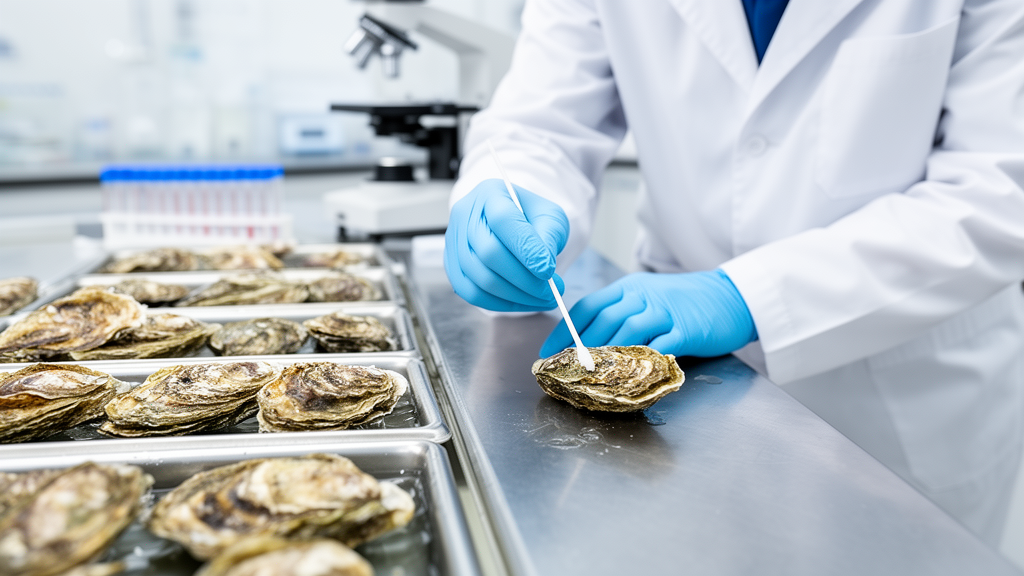
Every oyster breeding program faces the same awkward problem: the animals that carry the most valuable genes are locked inside a shell that is difficult to open without harming them. As genomic selection becomes a practical reality in shellfish aquaculture, researchers need DNA from hundreds or even thousands of candidate broodstock, and they need it quickly, cheaply, and without killing or injuring the very animals they hope to breed. A new study published in Frontiers in Aquaculture suggests that the solution may be as simple as a swab. By comparing several non-lethal DNA sampling methods in Eastern oysters (Crassostrea virginica) and Pacific oysters (Crassostrea gigas), a team from the USDA Agricultural Research Service, Oregon State University, and the University of Louisiana at Lafayette found that benignly brushing the internal tissues of an anesthetized oyster produces genotype data essentially as accurate as DNA taken from the adductor muscle, the standard tissue that requires lethal sampling.
The stakes are considerable. Molluscan shellfish aquaculture is now the third largest group of farmed aquatic animals after finfish and crustaceans, and cupped oysters alone produced 6.2 million tons in 2022, making them the second largest farmed aquatic species group by weight globally. Selective breeding for commercially desirable traits such as growth, meat quality, and disease resistance has become a central component of industry growth, and genomic selection sits at the forefront of these efforts. The approach relies on inexpensive, high-throughput genotyping of large numbers of broodstock candidates to calculate a genomic estimated breeding value for each animal. Until now, that calculation has been bottlenecked by the laborious and potentially injurious step of extracting tissue from live oysters, which requires anesthesia to induce incomplete paralysis of the adductor muscle, followed by careful removal of gill or mantle tissue with scissors and forceps. Gaping varies among individuals, tissue excision can cause stress or mortality, and breeding programs often operate at a scale that requires sampling by less experienced personnel such as interns, raising the risk of injury to valuable animals.
The research team designed a series of experiments to test whether gentler alternatives could match the genotyping quality of the adductor muscle reference. In the Eastern oyster experiments, oysters from the Choptank River in Maryland were relaxed in 5 percent magnesium sulfate in aerated seawater for four to eight hours until they gaped. Researchers then sampled DNA in three ways: a cytology brush swab rotated briefly against the adductor muscle and mantle, a mantle tissue clip excised from the edge of the shell, and environmental DNA collected by filtering water in which individual oysters had been housed for eight hours. After the non-lethal sampling, oysters were shucked and adductor tissue was taken as the reference genotype. In a second experiment, the cytology brush was compared to two cheaper alternatives: a cotton-tipped swab costing roughly four cents and a disposable nylon eyelash brush costing about two cents per swab. Eastern oyster samples were genotyped on a 66K single nucleotide polymorphism (SNP) array, while Pacific oyster samples were evaluated using PCR-based genotyping-by-sequencing with amplicon panels of 592 and 288 loci.
The DNA yields told an interesting story. Cytology brush swabs produced the highest DNA concentrations in the first Eastern oyster experiment, averaging 423.2 nanograms per microliter, far exceeding adductor muscle at 77.3, mantle tissue at 50.8, and eDNA at 18.9 nanograms per microliter. In the second experiment, where swabs were stored in ethanol for several weeks before extraction, the two brush swabs still outperformed the cotton swab, with mascara brushes averaging 151.3 and cytology brushes 121.7 nanograms per microliter, compared to 28.3 for cotton tips. DNA quality, assessed by molecular weight on agarose gels, was variable among swab types, with adductor samples showing the most consistently high molecular weight extracts. Yet this apparent difference in quality had little impact on the ultimate genotyping outcome, a finding the authors attribute to the relatively short probes used on the SNP array, which are only about 20 to 60 base pairs long and can still hybridize effectively to fragmented DNA.
Genotype concordance, the key measure of whether a non-lethal sample produces the same genetic calls as the lethal reference, was remarkably high across the board. An average of 57,300 SNPs were assessed for concordance in the Eastern oyster experiments, and the mean non-concordance rate across all sample types was just 0.56 percent. The mascara swab recorded the lowest rate at 0.30 percent, the cytology brush came in at 0.58 percent, and mantle clips produced 0.82 percent. There was no statistically significant difference in non-concordance among tissue and swab types, and no relationship between DNA molecular weight category and concordance rate. Cotton swabs produced less consistent results, with four of ten samples failing quality control, while eDNA samples performed poorly overall, with more than half failing QC and only four of ten producing a usable call rate. The authors suggest that the eight-hour incubation was insufficient to accumulate enough oyster DNA for array genotyping, noting that a previous study of European flat oysters achieved high concordance with eDNA only after 72 hours of incubation, a residence time that presents substantial logistical challenges for breeding programs requiring rapid sampling.
The Pacific oyster experiments extended the findings to sequencing-based genotyping. In the first experiment, 48 animals were swabbed with PurFlock Ultra swabs and genotyped on a 592-locus amplicon panel. Twelve samples failed quality control, and after removing these poor performers, no significant difference in genotype call rate existed between swab and adductor samples. SNP genotype concordance was high, with only samples that failed QC showing greater than 1 percent non-concordance. All mismatching cases involved a homozygote and heterozygote pair, with no cases of reference homozygote to alternate homozygote, and no strong bias toward either genotype class within a single sample type, suggesting that PCR amplification did not preferentially amplify one allele but had a random chance of amplifying either allele within heterozygotes.
A microhaplotype analysis, which examines multiple linked SNPs together as a single haplotype allele, produced slightly higher non-concordance rates averaging 3.3 percent in the first experiment and roughly 4 percent in the second. However, the vast majority of these mismatches involved a homozygote-to-heterozygote discrepancy in which the missing allele was actually present in the raw sequencing data. In the second experiment, 537 of 547 homozygote-to-heterozygote mismatches had the missing allele identified in the sequence data, most often as the second-ranked allele. The authors conclude that rudimentary genotype calling parameters, rather than true biological or sampling errors, are likely driving the higher error rate, an unsurprising outcome given the nascent implementation of microhaplotypes in aquaculture research and the ongoing development of the panels. As calling methods improve, non-concordance rates are expected to drop to those observed in SNP genotyping or lower.
Survival and tag retention were also evaluated in the field. In the second Pacific oyster experiment, 100 oysters each were assigned to cytology brush, microbrush, mantle clipping, and control treatments, tagged with paired glue-on tags, and deployed subtidally in Yaquina Bay, Oregon, from early July to early August 2025. After 27 days, mean survival across all replicates was 93.25 percent, with no statistical difference between any DNA sampling method and the control. Control treatments survived at 100 percent and 84 percent in the two basket stacks, microbrush at 96 percent in both, cytology brush at 94 and 86 percent, and mantle clipping at 100 and 90 percent. No oysters lost both tags, and only three lost a single tag during the deployment. While 27 days is a relatively short observation period, the authors note that potential broodstock candidates in a genomic selection program are likely to be brought onshore for artificially induced maturation within a few months of sampling, making the high survival and tag retention over the first month promising for scalable, high-throughput application.
The practical implications are significant. Brush swabs are faster and easier to implement than tissue excision, and less experienced staff are less likely to seriously injure animals when using a softer swab compared to clipping tissue with sharp implements. The mascara swab is roughly tenfold cheaper than the cytology swab, and the choice among brush types will likely be predicated on cost, availability, and user preference. The finding that genotyping-by-sequencing appears robust to variability in sample quality is particularly important, because it means that when swabbing occurs for large numbers of animals in a short time period, samples with poorer genotyping call rates can be treated as reliable rather than more error prone. The authors suggest that non-lethal swab DNA collection provides genotype data equivalent to mantle or adductor tissue-derived data while likely causing less acute stress to the animal, and that the method is amenable to large-scale DNA capture efforts often undertaken by volunteers or less experienced personnel in breeding program operations.
As genomic selection becomes increasingly applied in shellfish breeding programs to advance commercially desirable phenotypes, efficient and rapid methods for non-lethal biopsy are essential for generating the high-quality genotype data needed for accurate breeding value estimation. This study demonstrates that multiple swab types can generate high-quality DNA for sequencing and genotyping on multiple commonly used platforms, from SNP arrays to amplicon sequencing panels. The high post-sampling survival, genotype concordance, and tag retention suggest that swabbing can serve as an effective, high-throughput, and relatively benign method for obtaining the DNA necessary to generate genomic estimated breeding values. For oyster restoration and production aquaculture alike, the simple act of brushing DNA from between the shells may prove to be an important step in bringing advanced genetic tools to the animals that feed a growing global demand for bivalve seafood.
,
Subject of Research: DNA sampling between the shells: evaluating non-lethal DNA sampling methods in oysters for high-throughput genotyping
Article Title: DNA sampling between the shells: evaluating non-lethal DNA sampling methods in oysters for high-throughput genotyping
Article References: Plough, L. V., Young, M. E., Schwartz, L., Pandelides, A. F., Stauffer, B., & Thompson, N. F. (2026). DNA sampling between the shells: evaluating non-lethal DNA sampling methods in oysters for high-throughput genotyping. Frontiers in Aquaculture, 5, Article 1848821. https://doi.org/10.3389/faquc.2026.1848821
Image Credits: AI Generated
DOI: 10.3389/faquc.2026.1848821
Keywords: oysters, genotyping, genomic selection, non-lethal sampling, DNA swabbing, SNP array, genotyping-by-sequencing, microhaplotype, aquaculture, broodstock, Crassostrea virginica, Crassostrea gigas
Cite Scienmag News
Juliet Wilcox. (October 17, 2026). Swabbing Oysters for DNA Could Transform Shellfish Breeding. Scienmag. https://scienmag.com/swabbing-oysters-for-dna-could-transform-shellfish-breeding/
Juliet Wilcox. "Swabbing Oysters for DNA Could Transform Shellfish Breeding." Scienmag, 17 October 2026, https://scienmag.com/swabbing-oysters-for-dna-could-transform-shellfish-breeding/. Accessed 17 October 2026.
Juliet Wilcox. "Swabbing Oysters for DNA Could Transform Shellfish Breeding." Scienmag. October 17, 2026. https://scienmag.com/swabbing-oysters-for-dna-could-transform-shellfish-breeding/


