


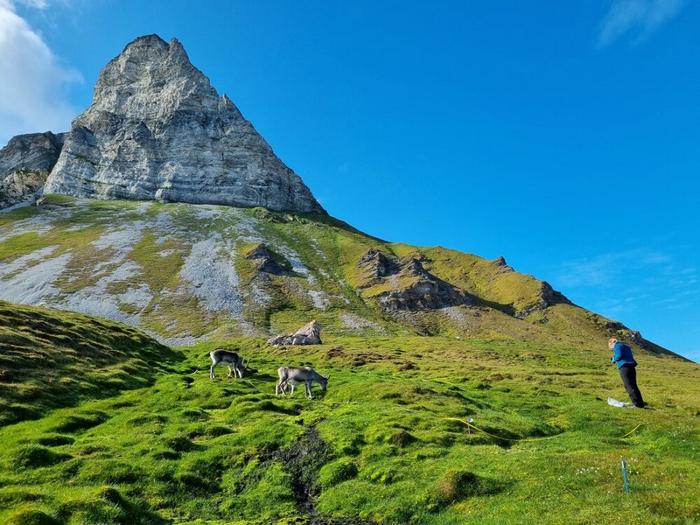
New, non-native plant species are constantly being discovered in Svalbard, and researchers are working to ascertain what threat these species pose to the native plants.

Credit: Photo: Kristine Bakke Westergaard, NTNU
New, non-native plant species are constantly being discovered in Svalbard, and researchers are working to ascertain what threat these species pose to the native plants.
So far, the Arctic has managed to avoid one of the most serious threats to biodiversity on Earth. This is also true for Svalbard, but things could change very quickly, and researchers want to find out how to counteract this threat.
“Increased human activity heightens the risk of new plant species being introduced. And climate change increases the risk of invasive species establishing themselves,” says Kristine Bakke Westergaard.
She is an associate professor at the Department of Natural History, which is part of the University Museum at the Norwegian University of Science and Technology (NTNU).
No checks on arrival to Svalbard
New species can outcompete the plants already present in Svalbard. Non-native species are spreading across large parts of the globe and can disrupt the established balance between species in a certain area.
Human activity is to blame for the spread of new, non-native species to new areas. Svalbard is particularly at risk because of its popularity as a destination for cruises and other tourist activities. However, upon arrival in Svalbard, visitors are not checked to see if they are carrying any biological stowaways. For example, no one checks whether air passengers or cruise tourists have contaminated shoes, or whether imported soil contains seeds.
On the other side of the globe in Antarctica, there are much stricter requirements and checks to prevent these types of introductions. The lack of biosecurity routines in Svalbard worries researchers.
The warmer climate supports new species
Currently, only the hardiest species are able to survive in Svalbard. However, the archipelago has become much warmer in recent years, enabling more species to establish themselves.
“We have developed models to map 27 non-native plant species and their potential to find new habitats and suitable climates in Svalbard,” says James Speed, a professor at NTNU’s Department of Natural History.
Currently, all of these species are only found in the inhabited parts of Svalbard. The researchers mapped out which areas of Svalbard have the optimal combination of temperature and precipitation for these species, both now and in the future.
“In relation to the current climate, we have identified three species that have particularly high potential to find new habitats in Svalbard. If they manage to spread to these areas, they could pose a threat,” says James Speed.
The three species that could spread the most are:
- Tufted hairgrass (Deschampsia cespitosa)
- A species of meadow buttercup (Ranunculus subborealis subsp. villosus)
- Alpine saw-wort (Saussurea alpina)
All areas of Svalbard could be at risk
The models show that almost all areas of Svalbard will develop a suitable climate for many of these non-native plants. The uninhabited islands of Edgeøya and Barentsøya to the east, as well as the island of Bjørnøya with its manned meteorological station to the south, are most at risk. However, things can change quickly.
“In the future, as the climate warms, most of the non-native species we investigated have the potential to spread throughout Svalbard. Many of the species that do not belong in Svalbard may be able to spread over a much wider area than they are currently able to do,” says Westergaard.
Factors other than temperature and climate also play a role in preventing new species from spreading. Among other things, limited access to nutrient-rich soil has kept their prevalence to a minimum. This, however, also seems to be changing.
Urgent intervention required
The researchers are of the opinion that the environmental authorities must act quickly if they are to limit and prevent these invasive non-native species from spreading beyond the areas where they already exist.
In addition, the researchers say society must prioritize preventing new non-native species from spreading to Svalbard before the threat to the Arctic ecosystem becomes too great and unmanageable.
This study is part of the Biodiversa project ASICS (ASsessing and mitigating the effects of climate change and biological Invasions on the spatial redistribution of biodiversity in Cold environmentS). The Norwegian team is funded by the Research Council of Norway. Other contributors include the South African National Research Foundation and the Millennium BASE Institute.
References: Speed JDM, Pertierra LR, Westergaard KB (2024) The potential area of occupancy of non-native plants across a warming high-Arctic archipelago: Implications for strategic biosecurity management. NeoBiota 93: 157-175.
Journal
NeoBiota
Method of Research
Observational study
Subject of Research
Not applicable
Article Title
The potential area of occupancy of non-native plants across a warming high-Arctic archipelago: Implications for strategic biosecurity management
Article Publication Date
6-Jun-2024
Cite Scienmag News
Patricia Pace. (July 25, 2024). Svalbard: Non-native species are threatening vulnerable plant life. Scienmag. https://scienmag.com/svalbard-non-native-species-are-threatening-vulnerable-plant-life/
Patricia Pace. "Svalbard: Non-native species are threatening vulnerable plant life." Scienmag, 25 July 2024, https://scienmag.com/svalbard-non-native-species-are-threatening-vulnerable-plant-life/. Accessed 4 September 2026.
Patricia Pace. "Svalbard: Non-native species are threatening vulnerable plant life." Scienmag. July 25, 2024. https://scienmag.com/svalbard-non-native-species-are-threatening-vulnerable-plant-life/

