

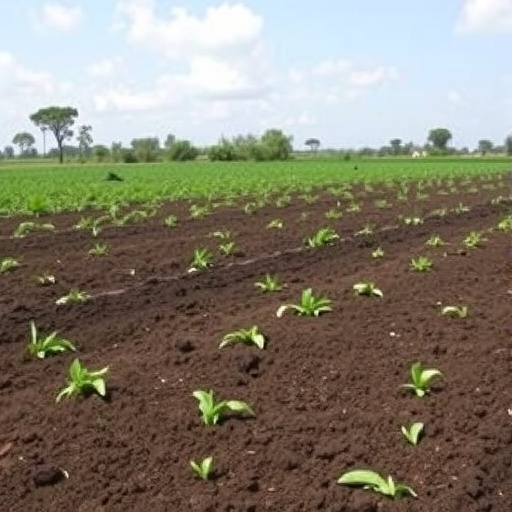
In recent years, the chaos of environmental degradation resulting from mining activities has become an alarming reality in many countries, particularly in Ghana. The intricate balance of ecosystems and the sustainability of land use have come under severe threat due to extensive mining operations. A pivotal study conducted by Oduro Appiah and Larbie offers a unique insight into this pressing issue, specifically focusing on how such activities affect soil moisture content in these degraded landscapes. By employing geospatial analysis, the researchers unveil the extent to which mining has impacted soil properties, providing vital information for future land management strategies.
Understanding soil moisture content is crucial for managing agricultural practices, especially in areas where agricultural viability is closely tied to water availability. In mining-impacted regions of Ghana, the disruption of soil layers and structural integrity significantly affects moisture retention capabilities. Appiah and Larbie’s research highlights that the identification and mapping of these changes can be instrumental in directing sustainable land use practices. Their findings emphasize the necessity for targeted interventions to rehabilitate land that has been stripped of its natural resources through mining.
The geospatial methods employed by the researchers offer a sophisticated approach to analyzing the physical landscape. This technology allows them to visualize and quantify changes in soil moisture across different sites affected by mining. By integrating tools such as remote sensing and Geographic Information Systems (GIS), the study provides a comprehensive overview of how moisture levels vary spatially in these environments. Furthermore, it indicates that these variations can lead to significant ecological disturbances, affecting not only the soil itself but also the broader ecosystems that rely on these resources.
The implications of the study are far-reaching, emphasizing the urgent need for a strategic approach to land use that considers the ecological impacts of mining. As climates change and agricultural needs increase, the management of soil moisture becomes ever more critical. The findings suggest that through careful monitoring of moisture levels, it may be possible to devise better land management techniques that would support both agricultural productivity and ecosystem restoration. For policymakers and land managers, the research provides a solid foundation upon which to base decisions that could benefit not only local communities but also the nation’s economy.
Moreover, the study’s emphasis on sustainability opens a broader dialogue regarding the balance between natural resource extraction and environmental stewardship. As Ghana continues to face the ramifications of mining activities, innovative land use strategies that prioritize sustainability are essential. The research illustrates how geospatial analysis can bridge the gap between environmental science and practical land management, supporting initiatives aimed at environmental restoration and sustainability.
By focusing on soil moisture content as a critical variable in this equation, Appiah and Larbie make a compelling case for the adoption of advanced technological solutions in environmental monitoring. The utilization of satellite imagery and drones equipped with sensors can provide real-time data and insights that are invaluable for understanding changes in soil health and moisture retention. Such approaches present an opportunity for researchers and policymakers to adopt a scientific framework that can lead to more informed decision-making.
The urgency of addressing these issues within the context of sustainable development cannot be overstated. As Ghana moves forward, it is imperative that the lessons learned from this research are integrated into a national strategy for land use that prioritizes rehabilitation of mining-affected areas. Embracing a scientific approach, as outlined by Appiah and Larbie, will significantly contribute to the efforts required to mend the ecological fabric of the land while ensuring that agricultural pursuits remain viable.
Furthermore, local communities should be intimately involved in discussions surrounding land use and resource management. Engaging these stakeholders not only empowers them but also leads to more sustainable and culturally pertinent solutions. With agricultural practices often handed down through generations, combining traditional knowledge with scientific research could result in innovative approaches to managing soil moisture and improving agricultural efficiency post-mining activities.
In conclusion, the study conducted by Oduro Appiah and Larbie serves as a clarion call to address the ecological challenges posed by mining in Ghana. It underscores the significance of integrating advanced geospatial technologies into environmental monitoring and land management frameworks. As the world watches this critical intersection of mining, agriculture, and sustainability unfold, it serves as a reminder that the delicate balance of our ecosystems is only as strong as our commitment to preserve them.
The future of land use in mining-affected landscapes hinges on the lessons drawn from this research. By prioritizing sustainable practices and understanding the vital role of soil moisture, Ghana can chart a path towards ecological recovery and resilience. The ripple effects of these practices extend beyond national borders, potentially setting a benchmark for other nations grappling with similar dilemmas caused by resource extraction.
As awareness grows around the impacts of mining, the hope is that the findings from this research will inspire broader global initiatives, fostering collaboration and innovation to combat environmental degradation. The focus on sustainable land use, combined with rigorous scientific analysis, lays a foundation for a future where ecosystems thrive, and communities flourish alongside their natural environments.
Subject of Research: Impact of mining on soil moisture content in Ghana
Article Title: Towards sustainable land use: A geospatial analysis of soil moisture content in a mining-induced degraded landscape of Ghana
Article References:
Oduro Appiah, J., Larbie, R. Towards sustainable land use: A geospatial analysis of soil moisture content in a mining-induced degraded landscape of Ghana.
Environ Monit Assess 198, 142 (2026). https://doi.org/10.1007/s10661-026-14989-9
Image Credits: AI Generated
DOI: https://doi.org/10.1007/s10661-026-14989-9
Keywords: soil moisture, mining impacts, geospatial analysis, sustainable land use, Ghana


