


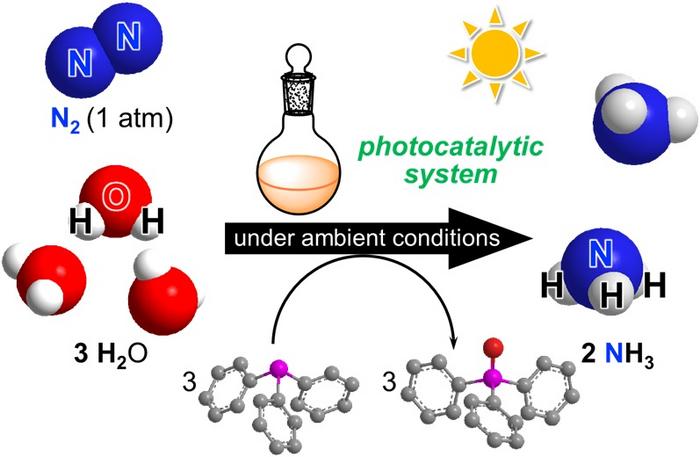
In a groundbreaking advancement poised to reshape the future of sustainable agriculture and chemical manufacturing, a team of scientists led by Professor Yoshiaki Nishibayashi at the University of Tokyo has unveiled a novel method to produce ammonia using only atmospheric nitrogen, water, and sunlight. This innovation, which harnesses the power of photocatalysis through the synergy of two specialized catalysts, provides a promising alternative to the energy-intensive Haber-Bosch process that dominates ammonia production today. Scientists anticipate this leap forward could drastically reduce the carbon footprint associated with ammonia synthesis, a critical step toward global decarbonization efforts.
Ammonia, an indispensable compound for fertilizer production and various industrial processes, is currently produced at an enormous scale—nearly 200 million tons annually across the globe. However, this widespread synthesis comes with a substantial environmental cost: it consumes about 2% of the world’s total energy and generates commensurate carbon dioxide emissions. This unsustainable energy demand has driven chemists and engineers for decades to design cleaner, more energy-efficient pathways to produce ammonia. The University of Tokyo team’s breakthrough introduces an artificial photosynthetic system that emulates nature’s elegant strategies for nitrogen fixation, potentially transforming industrial practices.
The newly developed system utilizes visible light energy to power the reaction, representing a major departure from conventional methods that rely on high temperature and pressure. Central to this approach are two distinct molecular catalysts: one based on molybdenum, a transition metal known for its role in natural nitrogenase enzymes, and the other using iridium, which facilitates the photochemical activation of water and tertiary phosphines. By orchestrating these catalysts together under sunlight, the reaction effectively converts dinitrogen (N₂) and water (H₂O) into ammonia (NH₃) and oxygen, closing a vital chemical cycle with minimal energy input.
Professor Nishibayashi explained the underlying mechanics of the photocatalytic process: “Upon sunlight absorption, the iridium catalyst achieves an excited state that oxidizes tertiary phosphines. These phosphines, in turn, bond to water molecules, extracting protons through a carefully controlled chemical interaction.” This delicate proton generation is critical because ammonia synthesis requires a source of protons to reduce atmospheric nitrogen. “Then, the molybdenum catalyst facilitates the nitrogen activation, enabling it to combine with these protons and form ammonia,” he added. This mechanistic dance mimics the natural biological nitrogen fixation occurring in symbiotic bacteria associated with plants.
Beyond the elegant design of catalysts, the production scale achieved in this study is particularly remarkable. The reaction was successfully carried out at a volume approximately ten times larger than prior experiments of its kind, signaling readiness for further scaling toward practical applications. However, challenges remain that must be addressed to ensure safety, efficiency, and sustainability. Specifically, the tertiary phosphines used in the process, while stable, possess potential toxicity risks if improperly handled or ingested. The research team is exploring ways to manufacture these organic compounds using solar energy or recycle them from phosphine oxides, striving to close the material loop and minimize environmental hazards.
This discovery also symbolizes the successful translation of a fundamental biological process into an artificial system. In natural ecosystems, ammonia is produced through biological nitrogen fixation conducted by nitrogenase enzymes in certain bacteria, which work symbiotically with plants. This reaction is intricately linked to photosynthesis, which supplies the electrons and protons necessary for the conversion of nitrogen gas to ammonia. The University of Tokyo’s system replicates this concept, using sunlight as the energy source and water as the proton donor, achieving what can be thought of as “artificial photosynthesis” of ammonia at a molecular level.
Technically speaking, the use of visible light rather than ultraviolet opens up new avenues for practical energy harvesting and reaction efficiency. The iridium photocatalyst’s absorption of visible wavelengths permits it to operate under sunlight conditions more akin to real-world settings, circumventing the energy limitations of previous systems reliant on more high-energy wavelengths. This not only enhances the energy efficiency of ammonia synthesis but also bolsters the prospect of integrating such a system into existing solar fuel technologies.
The dual catalyst mechanism is particularly ingenious, as it tackles two chemical obstacles simultaneously. While molybdenum excels at cleaving the notoriously strong bond in atmospheric nitrogen—one of the hardest chemical bonds to break—the iridium complex addresses the challenge of water activation, a necessary step for proton and hydrogen atom generation. The tertiary phosphines bridge these processes, mediating electron transfer and facilitating bond formation between phosphorus and water molecules to liberate protons. This advanced orchestration allows for a highly selective and efficient pathway to ammonia, outperforming prior attempts using similar photocatalytic methods.
From an industrial perspective, the implications of this technology stretch far beyond just cleaner ammonia production. The process’s reduced energy requirements hint at a future where decentralized, small-scale ammonia factories could operate remotely or even on farms, reducing transportation emissions and input costs. Moreover, because ammonia is not only a fertilizer feedstock but also a potential fuel carrier and hydrogen storage medium, efficiently producing ammonia using sunlight and abundant resources like air and water could open a suite of clean energy applications.
Despite the excitement, the research team is mindful of scaling hurdles. The exact lifecycle impacts of the catalysts, particularly the long-term stability and recyclability of iridium and molybdenum complexes, warrant further investigation. Additionally, securing a safe handling protocol for tertiary phosphines and developing sustainable synthetic routes remain high priorities. Addressing these issues will be necessary to transition this technology from laboratory success to practical, commercial deployment.
The findings, published in the prestigious journal Nature Communications, represent a milestone in sustainable chemistry. By demonstrating that photocatalytic ammonia synthesis using atmospheric dinitrogen and water is achievable with visible light and dual catalysts, this research ushers in a new era of green chemistry. As the world seeks to decarbonize and meet increasing fertilizer demands to support a growing population, such innovative routes for ammonia production could become vital tools in global environmental stewardship.
The University of Tokyo team’s work continues to deepen our understanding of how molecular catalysts can be designed and combined to harness solar energy for challenging chemical transformations. It also exemplifies the power of interdisciplinary research, merging ideas from inorganic chemistry, photochemistry, and biology to confront pressing environmental challenges. The prospect of “artificial photosynthesis” producing more than just oxygen but a vital feedstock chemical promises a bright horizon for sustainable industrial chemistry.
As this exciting technology advances toward practical use, further research will explore alternative catalysts to replace precious metals, optimize reaction conditions, and integrate this ammonia-synthesis approach with existing renewable energy infrastructures. The ultimate vision is to establish a fully solar-driven ammonia production cycle that minimizes ecological impact while meeting global demands, offering hope for a cleaner and more sustainable future.
—
News Publication Date: 22-May-2025
Web References: http://dx.doi.org/10.1038/s41467-025-59727-w
References: Yasuomi Yamazaki, Yoshiki Endo, Yoshiaki Nishibayashi, “Catalytic ammonia formation from dinitrogen, water, and visible light energy”, Nature Communications, DOI: 10.1038/s41467-025-59727-w
Keywords
Green ammonia, photocatalysis, nitrogen fixation, molybdenum catalyst, iridium catalyst, visible light energy, artificial photosynthesis, sustainable chemistry, ammonia synthesis, tertiary phosphines, atmospheric nitrogen, water activation
Cite Scienmag News
Bethany Barker. (May 22, 2025). Sunlight Drives Green Ammonia Revolution. Scienmag. https://scienmag.com/sunlight-drives-green-ammonia-revolution/
Bethany Barker. "Sunlight Drives Green Ammonia Revolution." Scienmag, 22 May 2025, https://scienmag.com/sunlight-drives-green-ammonia-revolution/. Accessed 4 September 2026.
Bethany Barker. "Sunlight Drives Green Ammonia Revolution." Scienmag. May 22, 2025. https://scienmag.com/sunlight-drives-green-ammonia-revolution/


