


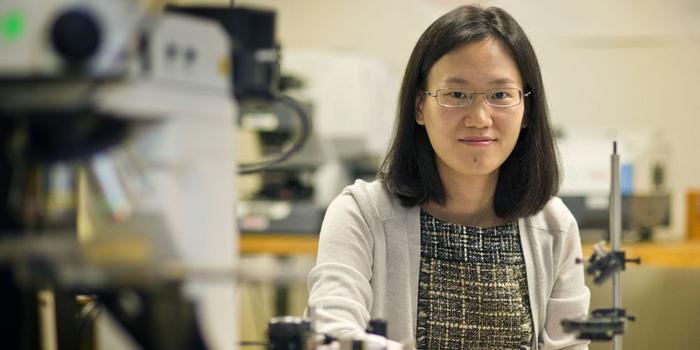
Yuze “Alice” Sun, an electrical engineering professor at The University of Texas at Arlington (UTA), has recently been honored by her election to the institution’s prestigious Academy of Distinguished Researchers. This accolade recognizes her groundbreaking contributions to the development of advanced technologies that play a pivotal role in health care, environmental monitoring, and national defense. Renowned for her multidisciplinary approach, Sun’s work merges principles of photonics, nanotechnology, and biochemical sensing to innovate at the frontier of scientific discovery and practical application.
The Academy of Distinguished Researchers, formerly known as the Academy of Distinguished Scholars, represents the highest honor bestowed by UTA for research and scholarly achievement. Membership is reserved for faculty members who have demonstrated unparalleled excellence and influence in their respective domains. Sun’s election into this elite body underscores her status as a trailblazer whose research not only advances academic understanding but also yields tangible benefits to society at large.
Since joining UTA in 2013, Dr. Sun has spearheaded a portfolio of pioneering research projects, often integrating semiconductor photonics with biosensing technologies to tackle complex problems. Among her notable achievements is the development of innovative semiconductor lasers that leverage nanoscale engineering to enhance the precision and efficiency of medical imaging systems. These lasers, characterized by their compact footprint and tunable emission properties, enable higher resolution and more accurate diagnostics in clinical settings, thereby improving patient outcomes.
Another cornerstone of Sun’s research is the creation of wearable gas analyzers, devices equipped with sensitive photonic components capable of real-time chemical detection. These analyzers represent a significant advance in environmental monitoring technology, providing a portable, non-invasive means to detect hazardous gases or biomarkers linked to respiratory and cardiovascular diseases. By incorporating nanoengineered sensing elements, these devices achieve unprecedented sensitivity and specificity, opening new avenues for personalized health monitoring and environmental safety.
Additionally, Sun’s work encompasses the development of biosensing platforms that manipulate light-fluid interactions at the microscale—a field known as optofluidics. Her designs utilize the controlled interplay between photons and biological fluids to rapidly detect molecular signals, including cancer biomarkers and infectious agents. Such systems employ intricate nanostructures fabricated through state-of-the-art lithography techniques, allowing for the miniaturization of laboratory-grade diagnostics into handheld or implantable formats with enhanced speed and accuracy.
Dr. Sun’s research portfolio reflects a synthesis of multiple scientific disciplines, elucidating the intersection between device physics, materials science, and biomedical engineering. Her scholarly output is robust, comprising more than 90 peer-reviewed journal articles, authoritative book chapters, and impactful conference presentations. Her contributions have not only advanced the theoretical underpinning of photonic sensing devices but have also driven practical innovation by securing three issued patents related to her novel sensing technologies.
Funding for Sun’s research has been consistently strong, surpassing $8 million in external awards from eminent agencies including the National Science Foundation (NSF), the Department of Energy, the Defense Advanced Research Projects Agency (DARPA), and the Army Research Office. The sustained financial backing by these highly competitive institutions reflects the strategic importance and visionary nature of Sun’s research agenda, which aligns closely with national priorities in health technology, environmental stewardship, and defense readiness.
The impact of Dr. Sun’s work extends beyond the laboratory through her mentorship of the next generation of scientists and engineers. She has guided eight doctoral candidates and seventeen undergraduate students, many of whom have gone on to distinguished careers in academia and industry. Her commitment to education is complemented by her role in curriculum development, where she has introduced cutting-edge courses in nanotechnology and photonics, consistently inspiring students with rigorous training and exposure to frontier research.
Recognition of Sun’s scientific excellence includes prestigious honors such as the NSF CAREER Award, UTA’s University Award for Outstanding Research Achievement and Creative Accomplishment, and the College of Engineering Lawrence Stephens Award for Outstanding Research. These accolades not only celebrate her innovative contributions but also affirm her leadership in fostering collaborative research networks both within the university and at international venues, promoting the global exchange of ideas and technological advancement.
Her work has been featured in leading scientific journals like ACS Applied Materials & Interfaces and Sensors, which highlights the interdisciplinary and application-driven nature of her research. The in-depth technical detail and experimental rigor evident in these publications demonstrate her ability to translate fundamental science into solutions with real-world utility—spanning applications from cancer diagnostics to telecommunications infrastructure and space exploration technology.
Looking ahead, Dr. Sun’s research trajectory promises to continue reshaping multiple industries by harnessing advances in photonics and nanotechnology to drive sustainable innovations. As health care systems seek increasingly precise diagnostic tools, environmental agencies require robust monitoring solutions, and defense sectors pursue next-generation safety technologies, Sun’s pioneering work stands at the nexus of these critical domains, driving transformative change.
The University of Texas at Arlington, celebrating its 130th anniversary in 2025, provides a vibrant research ecosystem that nurtures such transformative scientific endeavors. As a Carnegie R-1 institution serving over 41,000 students, UTA is among the nation’s elite research universities, prioritizing innovation and economic impact within the Dallas-Fort Worth metroplex. The election of faculty like Yuze “Alice” Sun to its Academy of Distinguished Researchers exemplifies UTA’s commitment to advancing science that profoundly affects society, health, and security.
In conclusion, Yuze “Alice” Sun’s distinguished career reflects a harmonious blend of groundbreaking engineering research, impactful scholarship, and dedicated mentorship. Her pioneering advancements in semiconductor lasers, wearable gas analyzers, and biosensing devices illuminate a path toward enhanced health outcomes, environmental sustainability, and fortified national defense. Her election to the Academy of Distinguished Researchers not only celebrates her past accomplishments but also heralds her ongoing influence in shaping the future landscape of technology and innovation.
News Publication Date: 2024-06-XX (Exact date not specified in text)
Web References:
- https://www.uta.edu/academics/faculty/profile?user=sun
- https://www.uta.edu/research/administration/vp-for-research-and-innovation/academy-of-distinguished-scholars
- https://www.uta.edu/news/news-releases/2024/01/09/uta-team-exploring-new-semiconductor-photonics-technology
- https://www.uta.edu/news/news-releases/2022/08/05/sun-nsf-gas-device
- https://www.uta.edu/news/publications/inquiry-magazine/2023/device-quickly-analyze-gas
- https://pubs.acs.org/doi/full/10.1021/acsami.0c05967
- https://www.mdpi.com/1424-8220/17/8/1861
Cite Scienmag News
Courtney Benton. (April 23, 2025). Sun Receives UTA’s Prestigious Top Research Award. Scienmag. https://scienmag.com/sun-receives-utas-prestigious-top-research-award/
Courtney Benton. "Sun Receives UTA’s Prestigious Top Research Award." Scienmag, 23 April 2025, https://scienmag.com/sun-receives-utas-prestigious-top-research-award/. Accessed 5 September 2026.
Courtney Benton. "Sun Receives UTA’s Prestigious Top Research Award." Scienmag. April 23, 2025. https://scienmag.com/sun-receives-utas-prestigious-top-research-award/


