

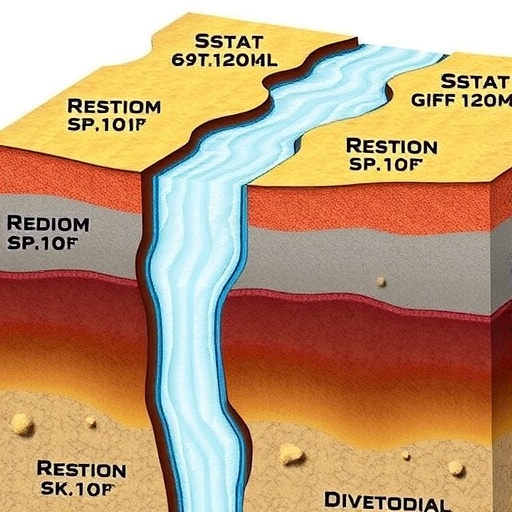
A groundbreaking study has recently emerged from the research team led by Li, Y., Huang, P., and Peng, W., shedding new light on the intricate behaviors of sulfate evolution and radon migration within fractured rock seepage systems. This research, published in Environmental Earth Sciences, promises to reshape our understanding of geochemical and radioactive processes occurring underground, with profound implications for environmental monitoring, hazard assessment, and hydrogeology.
Sulfate evolution within fractured rock environments is a complex process influenced by various physicochemical variables, including water chemistry, rock mineralogy, fracture flow dynamics, and microbial activity. The research team employed novel experimental setups that simulate realistic fracture seepage scenarios, enabling them to observe sulfate transformation mechanisms under controlled conditions. Their findings suggest that sulfate concentration changes are not merely passive outcomes but active, dynamic processes driven by interactions between seepage flow and the geochemical environment.
Concurrently, the study explores radon migration—a radioactive noble gas emanating from the decay of uranium in rock—and its behavior within these fractured seepage zones. Radon is well-known as both a health hazard and a tracer for subsurface fluid flow, yet its migration pathways and influencing factors within fractures had remained underexplored in naturalistic settings. By coupling experimental data with advanced analytical techniques, the researchers identified key variables affecting radon’s capacity to migrate through subterranean fractures.
One of the most fascinating revelations from the experiments is the interdependence between sulfate evolution and radon transport. The chemical transformations influencing sulfate concentrations often alter fracture water chemistry in ways that subsequently impact radon mobility. For instance, changes in water pH and redox potential brought on by sulfate reactions can modify radon’s solubility and adsorption characteristics, thus affecting how far and fast radon migrates within the rock matrix.
The methodology underpinning this study integrates a suite of sophisticated tools, including high-resolution spectrometry for tracking sulfate ion concentration and alpha spectrometry techniques for radon detection. The experiments were meticulously designed to replicate fracture apertures and seepage velocities found in natural environments, conferring exceptional ecological validity to the results. Such methodological robustness ensures that the insights gained are not just theoretical but practically applicable in environmental management and geological assessment.
Beyond the laboratory, the implications of this research extend to real-world challenges such as groundwater contamination, mine safety, and radon health risk mitigation. Understanding the coupled behavior of sulfate and radon in fractured rocks aids in developing more accurate predictive models for radionuclide dispersion and groundwater chemistry alteration. This data can inform monitoring strategies near uranium mining areas, geothermal installations, and fault zones prone to seismic activity.
The experimental results indicate that sulfate concentrations in seepage waters do not evolve linearly but follow complex, nonlinear trajectories influenced by factors like microbial sulfate reduction and oxidation of sulfide minerals. This nonlinearity implies that environmental conditions can trigger sudden shifts in sulfate levels, which may have downstream effects on water quality and rock stability. These findings challenge previous assumptions that sulfate dynamics in fractured rocks are relatively steady over time.
Radon’s migration pathways were found to be highly sensitive to fracture geometry and seepage flow rates. Narrow fractures with slow flow encourage radon accumulation, leading to higher localized concentrations, whereas broader fractures with fast-moving fluids facilitate rapid radon dispersal and dilution. Such nuances underscore the need for detailed characterization of fracture networks when assessing radon exposure risks at potential living or working sites.
The study also underscores the critical role of redox conditions in shaping both sulfate chemistry and radon behavior. Under oxidizing conditions, the researchers observed enhanced sulfate production from the oxidation of sulfide-bearing minerals, which in turn affected the ionic strength and pH of the seepage water. These geochemical shifts influence radon’s solubility and interaction with mineral surfaces, offering a clearer picture of how environmental parameters modulate radon migration.
Moreover, the research contributes to a deeper understanding of the timing and rates of geochemical reactions in fracture seepage systems. By correlating sulfate evolution with radon migration, the team was able to postulate kinetic models describing the simultaneous progression of chemical transformations and radioactive gas transport. These models are vital for predicting future changes in subterranean water quality and radionuclide distribution, which holds significance for environmental engineers and geoscientists alike.
The practical applications of this study are broad and multifaceted. For instance, it provides novel insights for the design of radon mitigation techniques in underground spaces, such as basements or coal mines, by illustrating how changing water chemistry might affect radon levels. It also aids hydrologists in interpreting geochemical signals in groundwater, enabling more effective tracing of subsurface flow paths and contaminant transport.
Furthermore, this experimental approach sets a benchmark for future research on coupled geochemical-radionuclide processes. By integrating multi-disciplinary techniques and focusing on fracture-scale dynamics, the research opens avenues for more comprehensive environmental risk assessments that consider both chemical and radiological factors. This holistic view can improve the safety and sustainability of infrastructure projects interacting with fractured rock systems.
This study is poised to energize further experimental and computational endeavors aimed at unraveling the complex feedback mechanisms at play in subsurface environments. Researchers may now explore how environmental changes like climate variation, anthropogenic activities, or seismic events influence the delicate balance between sulfate evolution and radon migration. Such knowledge is crucial for devising adaptive management strategies for natural resources and public health protection.
The findings also highlight the importance of monitoring long-term changes in subterranean geochemistry rather than relying on steady-state assumptions. Fluctuating sulfate concentrations coupled with variable radon fluxes suggest that ongoing, dynamic processes govern fracture seepage zones, which must be accounted for in environmental regulation and land-use planning.
In addition to the scientific breakthroughs, this work underscores the value of collaborative international research efforts combining geochemistry, radiology, hydrology, and environmental science. The multidisciplinary approach enriches the depth of analysis and enhances the translational potential of results toward practical solutions for environmental challenges posed by fractured rock systems.
As the study gains attention, it could catalyze policy dialogues around groundwater safety standards and radon exposure guidelines, particularly in regions where fractured rock aquifers supply drinking water or where radon incursions pose health risks. The nuanced understanding of sulfate and radon interplay provides vital empirical evidence supporting more informed decision-making frameworks.
To summarize, the experimental study led by Li, Huang, and Peng marks a significant leap forward in deciphering the response mechanisms governing sulfate evolution and radon migration in fracture seepage environments. Their meticulous experimental design and insightful analyses provide a robust foundation for transforming subterranean hydrological and radiological science while offering practical pathways to mitigate environmental and health hazards.
Subject of Research: Response mechanisms of sulfate evolution and radon migration in fractured rock seepage environments.
Article Title: Experimental study on response mechanisms of sulfate evolution and radon migration in fracture seepage.
Article References:
Li, Y., Huang, P., Peng, W. et al. Experimental study on response mechanisms of sulfate evolution and radon migration in fracture seepage. Environ Earth Sci 85, 36 (2026). https://doi.org/10.1007/s12665-025-12776-2
DOI: https://doi.org/10.1007/s12665-025-12776-2
Image Credits: AI Generated


