


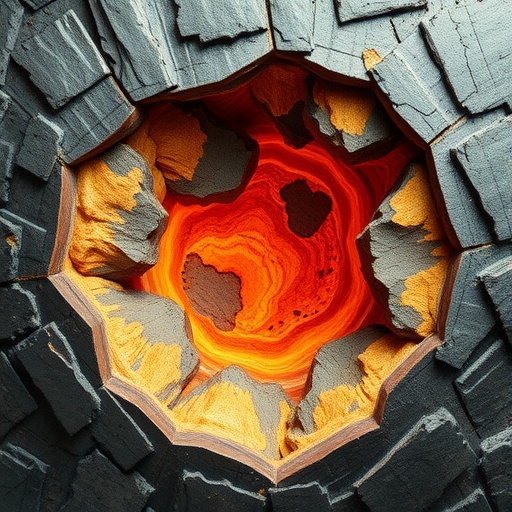
In a groundbreaking study published in Nature Communications, researchers have unveiled compelling evidence that the Earth’s sub-arc mantle—a crucial reservoir beneath volcanic arcs—has maintained a surprisingly oxidized state since the Neoproterozoic oxygenation event, some 800 million years ago. This revelation challenges longstanding assumptions about the redox evolution of the deeper Earth and has profound implications for our understanding of mantle geochemistry, volcanic activity, and the cycling of volatile elements through Earth’s interior.
The mantle, constituting the vast majority of our planet’s volume, exhibits variations in oxygen fugacity (fO₂) that critically influence the behavior of elements and volatiles such as carbon, sulfur, and hydrogen. These redox conditions dictate not only the types of minerals stable at depth but also control the speciation and mobility of key volatiles that fuel mantle melting and volcanic degassing. While the oxidation state of the convecting mantle has been a subject of intense debate, direct constraints on the redox evolution of the localized mantle beneath subduction zones have been sparse until now.
By employing innovative analytical techniques on mantle-derived materials—specifically, arc-related volcanic rocks—the team led by Liu et al. has provided unequivocal geochemical signatures indicating that the sub-arc mantle has remained consistently oxidized since the Neoproterozoic era. Their work meticulously integrates high-precision measurements of Fe3+/Fe2+ ratios in mantle peridotite minerals, trace element concentrations, and isotopic compositions, drawing a coherent picture of a mantle environment less reduced than previously presumed.
This enduring oxidized state of the sub-arc mantle fundamentally reshapes our conceptualization of mantle dynamics and redox evolution. Conventional models often posited a progressive oxidation of the mantle linked closely to the rise in atmospheric oxygen, particularly after the Great Oxidation Event about 2.4 billion years ago, with subsequent fluctuations over geological timescales. However, Liu and colleagues demonstrate that, beneath volcanic arcs, the mantle’s oxygen fugacity achieved a relatively stable and elevated level during the Neoproterozoic oxygenation event and has since remained at this oxidized state.
The implications of this steady oxidized mantle extend beyond mineral physics and geochemistry, reaching into the domain of surface geology and the Earth system. The oxidation state influences the nature and volume of subduction zone magmas, affecting volcanic gas emissions that regulate atmospheric composition over geological timescales. An oxidized sub-arc mantle favors sulfur and carbon in more oxidized species such as SO₄²⁻ and CO₂, which are more volatile and thus more efficiently outgassed during arc volcanism—processes essential to maintaining Earth’s oxygen balance and climate regulation.
To reach these conclusions, the study harnessed a remarkable synergy of petrological observations and cutting-edge analytical tools. By studying peridotite xenoliths brought to the surface by arc magmas, the researchers measured Fe oxidation states using synchrotron-based X-ray absorption spectroscopy, enabling in situ quantification at unprecedented precision. Coupled with electron microprobe analyses and thermodynamic modeling, the team reconstructed the redox history preserved in mineral phases, unraveling a continuous maintenance of high oxygen fugacity through Neoproterozoic to modern times.
The redox stability is particularly notable given the dynamic tectonic processes at play in subduction zones. One might expect the influx of reduced components from subducted slabs—such as organic carbon or sulfide minerals—to lower oxidation states locally. Yet, the data suggest robust buffering mechanisms in the mantle wedge, perhaps involving residual oxidized phases or the recycling of oxidized fluids released from dehydrating slabs, maintaining oxidative conditions despite these potentially reducing inputs.
This discovery also bridges a critical gap in understanding the coevolution of Earth’s interior and atmosphere. The Neoproterozoic oxygenation event marked a pivotal shift in Earth’s biosphere and geochemical cycles, with rising atmospheric oxygen levels and consequent innovations in life. The finding that sub-arc mantle oxidation aligned with this global oxygen rise implies a deep Earth response linked to surface oxidation processes, possibly mediated by changes in subduction chemistry or mantle convection patterns that strengthened mantle oxidation.
Further, the persistence of oxidized conditions may influence the generation of ore deposits in arc settings, by controlling the solubility and transport of metals like copper and gold in magmatic fluids. Recognizing the longstanding oxidized nature of the mantle wedge provides a framework to better predict the geodynamic and metallogenic characteristics of convergent margins, with significant economic geology implications.
The findings also initiate fresh debates regarding mantle heterogeneity. While the average convecting mantle might exhibit more variable redox states, the study highlights that regions directly beneath arcs possess a distinct chemical identity. This underscores the complexity of mantle domains and the role of tectonic regimes in dictating redox conditions, suggesting future research avenues into lateral redox variations and their geodynamic controls.
Moreover, understanding mantle oxidation helps refine models of magma genesis and eruption styles. Oxidized magmas tend to be more explosive due to higher concentrations of sulfur and water volatile species, which have profound hazards implications for densely populated volcanic regions along subduction zones. These insights may improve volcanic monitoring strategies by linking geochemical signals with eruption forecasts.
While this study answers pivotal questions, it also opens new lines of inquiry into feedback mechanisms between the lithosphere, mantle, and atmosphere. How precisely slab-derived fluids contribute to mantle oxidation remains to be delineated, as does the interplay with mantle metasomatism and its temporal evolution through Earth history. These are exciting challenges for the geoscience community.
In conclusion, Liu et al.’s revelation that the sub-arc mantle has remained oxidized since the Neoproterozoic oxygenation event demands a paradigm shift in how we understand Earth’s deep redox architecture. It highlights the intertwined evolution of Earth’s interior and surface, emphasizing the importance of mantle chemistry in shaping planetary habitability and geological processes. This discovery propels the frontier of mantle geochemistry and sets the stage for transformative research into Earth’s deep-time dynamics.
Cite Scienmag News
Violet Maxwell. (August 18, 2025). Sub-Arc Mantle Oxidized Since Neoproterozoic Era. Scienmag. https://scienmag.com/sub-arc-mantle-oxidized-since-neoproterozoic-era/
Violet Maxwell. "Sub-Arc Mantle Oxidized Since Neoproterozoic Era." Scienmag, 18 August 2025, https://scienmag.com/sub-arc-mantle-oxidized-since-neoproterozoic-era/. Accessed 5 September 2026.
Violet Maxwell. "Sub-Arc Mantle Oxidized Since Neoproterozoic Era." Scienmag. August 18, 2025. https://scienmag.com/sub-arc-mantle-oxidized-since-neoproterozoic-era/


