

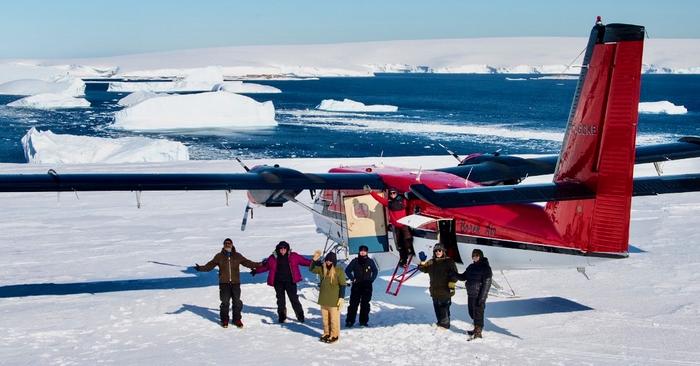
A McGill-led study suggests that Earth’s natural forces could substantially reduce Antarctica’s impact on rising sea levels, but only if carbon emissions are swiftly reduced in the coming decades. By the same token, if emissions continue on the current trajectory, Antarctic ice loss could lead to more future sea level rise than previously thought.

Credit: Nicolas Bayou
A McGill-led study suggests that Earth’s natural forces could substantially reduce Antarctica’s impact on rising sea levels, but only if carbon emissions are swiftly reduced in the coming decades. By the same token, if emissions continue on the current trajectory, Antarctic ice loss could lead to more future sea level rise than previously thought.
The finding is significant because the Antarctic Ice Sheet is the largest ice mass on Earth, and the biggest uncertainty in predicting future sea levels is how this ice will respond to climate change.
“With nearly 700 million people living in coastal areas and the potential cost of sea-level rise reaching trillions of dollars by the end of the century, understanding the domino effect of Antarctic ice melt is crucial,” said lead author Natalya Gomez, an Associate Professor in McGill’s Department of Earth and Planetary Sciences and Canada Research Chair in Ice sheet – Sea level interactions.
The study focuses on how the ice sheet interacts with the earth beneath, and how that dynamic is influenced by carbon-emission levels. This relationship has not been thoroughly explored in previous studies, the researchers said.
“Our findings show that while some sea level rise is inevitable, swift and substantive action to lower emissions could prevent some of the most destructive impacts of climate change, particularly for coastal communities,” Gomez said.
Rising seas and nature’s double-edged sword
As ice melts, its weight decreases, causing the land beneath it to rise like an expanding sponge. The researchers say this process, called post-glacial uplift, can be a double-edged sword.
If emissions drop quickly, limiting global warming, post-glacial uplift can act as a natural brake on ice-mass loss. It lifts the ice up, slowing the flow of ice from land to ocean. The study found this dynamic can reduce Antarctica’s contribution to sea- level rise by up to 40 per cent.
However, if carbon outputs keep pace and the planet heats up quickly, the rebounding land will not be enough to slow the rapidly melting ice, and instead pushes more ocean water away from Antarctica, accelerating sea-level rise along populated coastlines.
To reach their findings, Gomez and collaborating scholars from Canada and the United States developed a 3-D model of Earth’s interior. Their model used geophysical field measurements from the U.S. ANET-POLENET project, which had pioneered large-scale deployments of sensitive instruments to record the bedrock uplift and seismic signals across large expanses of Antarctica. These extensive field measurements were essential for characterizing the three-dimensional variations of the Antarctic mantle incorporated in the study.
“Our 3-D model peels back Earth’s layers like an onion, revealing dramatic variations in thickness and consistency of the mantle below. This knowledge helps us better predict how different areas will respond to melting,” said co-author Maryam Yousefi, a geodesist at Natural Resources Canada and previously a Postdoctoral Fellow at McGill and Penn State universities.
It’s the first model to capture the relationship between Antarctica’s ice and underlying earth in such detail, she added.
Notes Rob DeConto, a co-author and glaciologist at the University of Massachusetts, “This study marks a breakthrough in our ability to better predict the impacts of climate change on rising seas and to inform effective environmental policy.”
Global impacts
The findings, published in Science Advances, highlight the inequalities of climate change, the scholars noted. Island nations, which contribute the least to global emissions, are likely to bear the brunt of their consequences, they said.
The study is a collaboration between researchers at McGill, Pennsylvania State, Cambridge, Columbia, Colorado State, Ohio State, the University of Massachusetts Amherst, the University of Washington and the Union of Concerned Scientists. It was funded by the Canadian Natural Sciences and Engineering Research Council, the U.S. National Science Foundation and the Canada Research Chairs program.
About McGill University
Founded in 1821, McGill University is home to exceptional students, faculty, and staff from across Canada and around the world. It is consistently ranked as one of the top universities, both nationally and internationally. It is a world-renowned institution of higher learning with research activities spanning three campuses, 12 faculties, 14 professional schools, 300 programs of study and over 39,000 students, including more than 10,400 graduate students.
McGill’s commitment to sustainability reaches back several decades and spans scales from local to global. The sustainability declarations that we have signed affirm our role in helping to shape a future where people and the planet can flourish.
Journal
Science Advances
Method of Research
Computational simulation/modeling
Article Title
The influence of realistic 3-D mantle viscosity on Antarctica’s contribution to future 3 global sea levels
Article Publication Date
2-Aug-2024

