


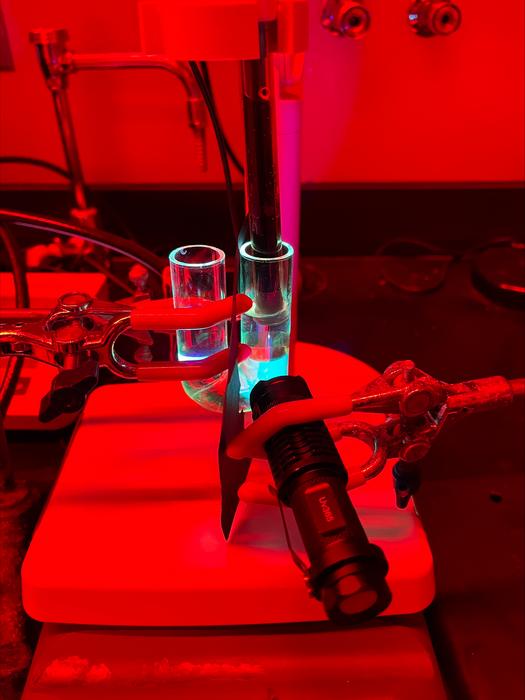
Dartmouth researchers have developed a self-powered pump that uses natural light and chemistry to target and remove specific water pollutants, according to a new report in the journal Science.

Credit: Ivan Aprahamian
Dartmouth researchers have developed a self-powered pump that uses natural light and chemistry to target and remove specific water pollutants, according to a new report in the journal Science.
As water enters the pump, a wavelength of light activates a synthetic molecular receptor designed to bond to negatively charged ions, or anions, a class of pollutants linked to metabolic disruptions in plants and animals. A second wavelength deactivates the receptors as water exits the pump and causes them to release the pollutants, trapping them in a non-reactive substrate until they can be safely discarded.
“This is a proof of concept that you can use a synthetic receptor to convert light energy into chemical potential for removing a contaminant from a waste source,” says the study’s senior author, Ivan Aprahamian, professor and chair of the Department of Chemistry at Dartmouth.
The pump is currently calibrated to the pollutants chloride and bromide, but the researchers are working to expand its use to target other anion-rich pollutants, Aprahamian says, such as radioactive waste and the phosphates and nitrates in agricultural runoff that cause massive dead zones.
“Ideally, you can have multiple receptors in the same solution, and you can activate them with different wavelengths of light,” Aprahamian says . “You can target and collect each of these anions separately.”
The synthetic receptor’s unusual ability to both trap and discharge negatively charged molecules allowed the researchers to control the flow of chloride ions from a low-concentration solution on one end of a U-shaped tube, to a high-concentration solution on the other end. Over a 12-hour period, the study reports, they moved 8% of chloride ions against the concentration gradient across a membrane embedded with the synthetic receptors.
The researchers focused on chloride for two reasons. During winter, stormwater laden with road salt raises chloride levels in waterways, causing harm to plants and animals. Second, the transport of chloride ions also plays a key role in healthy cell functioning. The disease cystic fibrosis is caused by cells being unable to pump out excess chloride. The trapped ions cause dehydration in cells, leading to a buildup of thick mucus in the lungs, among other organs.
In absolute terms, the chloride ions were driven almost 1.4 inches — the width of the membrane separating both ends of the tube. Relative to the receptor’s tiny size, they covered an impressive distance, fueled by light alone. “It’s the equivalent of kicking a soccer ball the length of 65,000 football fields,” Aprahamian says.
Aprahamian’s lab has long focused on a class of synthetic compounds known as hydrazones, which switch on and off when exposed to light. During the COVID pandemic, PhD student Baihao Shao came up with the idea to enhance the hydrazone receptor so that it could both collect and release target anions when switched on and off.
Aprahamian tried to dissuade him. “I told him that while it is a great idea, I do not think it will be competitive with the other impressive photoswitchable receptors in the literature,” he says. “Luckily, Baihao ignored me, and he went ahead and actually designed the receptor.”
Not only can the receptor be controlled by a renewable source of energy—light—it is relatively easy to make and modify, Aprahamian says. Researchers created the receptor by stitching them together using “click chemistry,” a Nobel Prize-winning technique that chemist Barry Sharpless ’63 helped invent years after graduating from Dartmouth.
In another Nobel connection, the study demonstrates the potential of molecular machines eight years after three chemists received the 2016 Nobel Prize in Chemistry for their work developing synthetic versions. Molecular machines are abundant in nature, powered by ATP in animal cells, and by the sun, in plant cells. In humans, tiny molecular machines carry out much of the work that occurs within cells, from replicating DNA to ferrying materials across the cell membrane.
For decades, scientists have tried to replicate these miniaturized workhorses outside of the body, with dreams of applying them to tasks like environmental cleanup, drug delivery, and the diagnosis and treatment of disease. But artificial molecular machines have proven easier to design on paper than to implement in real life.
“We want to mimic such biological processes, using sunlight as the energy source to create autonomous and self-sustaining filtration systems,” Aprahamian says.
Journal
Science
Method of Research
Experimental study
Subject of Research
Not applicable
Article Title
A molecular anion pump
Article Publication Date
1-Aug-2024
Cite Scienmag News
Bethany Barker. (August 6, 2024). Self-powered pump harnesses light and chemistry to target, capture pollutants. Scienmag. https://scienmag.com/self-powered-pump-harnesses-light-and-chemistry-to-target-capture-pollutants/
Bethany Barker. "Self-powered pump harnesses light and chemistry to target, capture pollutants." Scienmag, 6 August 2024, https://scienmag.com/self-powered-pump-harnesses-light-and-chemistry-to-target-capture-pollutants/. Accessed 4 September 2026.
Bethany Barker. "Self-powered pump harnesses light and chemistry to target, capture pollutants." Scienmag. August 6, 2024. https://scienmag.com/self-powered-pump-harnesses-light-and-chemistry-to-target-capture-pollutants/

