


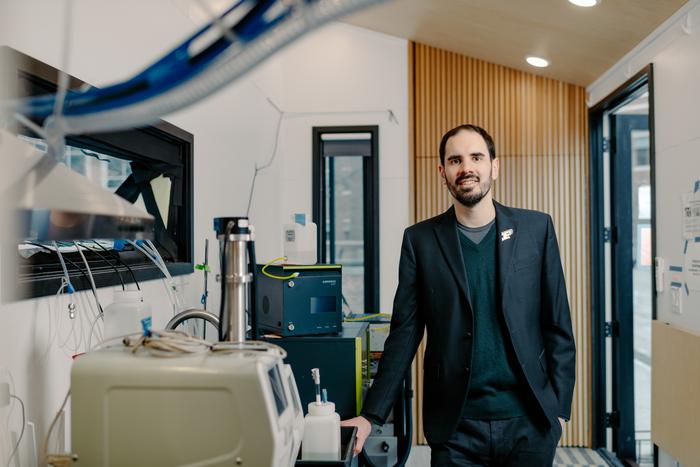
The air coming out of office buildings in urban areas may be more polluted than once believed, Purdue University researchers say.

Credit: Purdue University image/Kelsey Lefever
The air coming out of office buildings in urban areas may be more polluted than once believed, Purdue University researchers say.
A research team led by Brandon Boor, associate professor in the Lyles School of Civil Engineering, published a new study in the journal Cell Reports Sustainability that states modern buildings continually release volatile organic compounds (VOCs) to outdoor air and are likely to be an important contributor to the VOC burden of the urban atmosphere. The team conducted direct measurements of outdoor-indoor air pollutant exchange in a high-performance office building using state-of-the-art air quality instrumentation and an advanced building automation platform.
“We traditionally think of filtering the outdoor air entering our buildings. Based on the findings of our study, we now need to consider cleaning the air leaving our offices, homes and schools to reduce VOC emissions to the outdoor environment,” Boor said.
The aim of this research, Boor said, is to accurately measure VOCs in the air coming in and out of urban buildings and to use the data to understand how human occupancy and building operation impact VOC transport between indoor and outdoor air. Boor said that the influence of air exchange between indoor and outdoor atmospheres on urban air pollution is still not well understood — nor had it been fully explored before in a modern office building with a sophisticated ventilation system.
“A fundamental understanding of the fate and transport of urban air pollutants is important for developing mitigation strategies and policies that can improve urban air quality and reduce adverse impacts on human health and the climate,” Boor said. “Numerous studies have demonstrated the significant impact of traffic, industrial and biogenic emissions on urban air pollution. However, the influence of urban air pollutant interactions with buildings has often been overlooked.”
Modern public and commercial buildings are typically equipped with heating, ventilation and air conditioning (HVAC) systems to provide improved indoor air quality and thermal comfort. When urban air is mechanically circulated throughout buildings, its composition can significantly change due to interactions with HVAC components, indoor air, occupants and indoor surfaces.
“Buildings account for a significant fraction of the land area in cities and provide a significant amount of occupied indoor space,” said Tianren Wu, first author on the study and an assistant professor in the University of Cincinnati’s Department of Civil and Architectural Engineering and Construction Management. “To meet building ventilation and thermal comfort requirements, a substantial amount of air is actively exchanged between a building and its proximate urban atmosphere. This dynamic air exchange may have important implications for urban air quality due to both indoor-to-outdoor and outdoor-to-indoor transport and transformations of pollutants, especially in densely populated cities.”
Building materials, interior furnishings, and occupants and their activities — such as cooking, cleaning, and using consumer and personal care products — can release a variety of gaseous and particulate contaminants which can be directly exhausted into the urban atmosphere via a building’s HVAC system. Boor’s research found that indoor VOC concentrations are 2 to 15 times higher than outdoors and that per unit area, building emissions of VOCs are comparable to traffic, industrial and biogenic emissions.
Notably, the team found the office to be a significant emission source of reactive monoterpenes and siloxanes to the outdoor environment. Siloxanes are widely used in deodorants, perfumes, lotions and hair care products. A recent study led by Purdue’s Nusrat Jung, assistant professor of civil engineering, found everyday hair care routines to release large amounts of siloxanes to outdoor air via bathroom exhaust, further demonstrating how buildings can impact outdoor air pollution.
“The building source-sink behavior changed dynamically with occupancy and building ventilation conditions,” Boor said. “Our results demonstrate that buildings can directly influence urban air quality due to substantial outdoor-indoor air exchange.”
As for what can be done to mitigate VOC emissions from buildings, Boor said a greater focus on removing VOCs in HVAC systems using carbon filters and other air cleaning technologies is needed. Using consumer and personal care products with low VOC emissions will also help, Boor said.
Researchers from Indiana University and RJ Lee Group Inc. contributed to this study.
Acquiring the data
Boor’s team investigated the source and sink effects of a mechanically ventilated, realistic, open-plan office and its HVAC system on urban air pollutants through a comprehensive one-month field measurement campaign. The office used for their monthlong research is in the Ray W. Herrick Laboratories, a high-performance, LEED (Leadership in Energy and Environmental Design) Gold-certified building in central Indiana. The office is continuously mechanically ventilated by an independent air handling unit.
The field measurement campaign was performed during the winter season. Three types of common urban air pollutants were examined in the study, including VOCs, ozone and fine particulate matter. The mechanical ventilation conditions of the building were carefully monitored to quantify net mass emission rates from the office and its HVAC system to the urban atmosphere. VOCs were measured in real time at different locations throughout the HVAC system with a high-resolution proton transfer reaction time-of-flight mass spectrometer.
This research was funded and supported by the National Science Foundation and the Alfred P. Sloan Foundation.
Key takeaways
- Modern buildings continually release volatile chemicals into the outdoor atmosphere.
- Buildings can be significant emission sources of reactive monoterpenes and siloxanes.
- Building source-sink behavior changes with human occupancy and ventilation conditions.
- Direct VOC emissions from buildings must be considered in urban air pollution models.
Journal
Cell Reports Sustainability
Article Title
Modern buildings act as a dynamic source and sink for urban air pollutants
Article Publication Date
24-May-2024
Cite Scienmag News
Courtney Benton. (May 29, 2024). Study: Urban office buildings pump out volatile chemicals to the outdoors, comparable to traffic emissions. Scienmag. https://scienmag.com/study-urban-office-buildings-pump-out-volatile-chemicals-to-the-outdoors-comparable-to-traffic-emissions/
Courtney Benton. "Study: Urban office buildings pump out volatile chemicals to the outdoors, comparable to traffic emissions." Scienmag, 29 May 2024, https://scienmag.com/study-urban-office-buildings-pump-out-volatile-chemicals-to-the-outdoors-comparable-to-traffic-emissions/. Accessed 4 September 2026.
Courtney Benton. "Study: Urban office buildings pump out volatile chemicals to the outdoors, comparable to traffic emissions." Scienmag. May 29, 2024. https://scienmag.com/study-urban-office-buildings-pump-out-volatile-chemicals-to-the-outdoors-comparable-to-traffic-emissions/

