


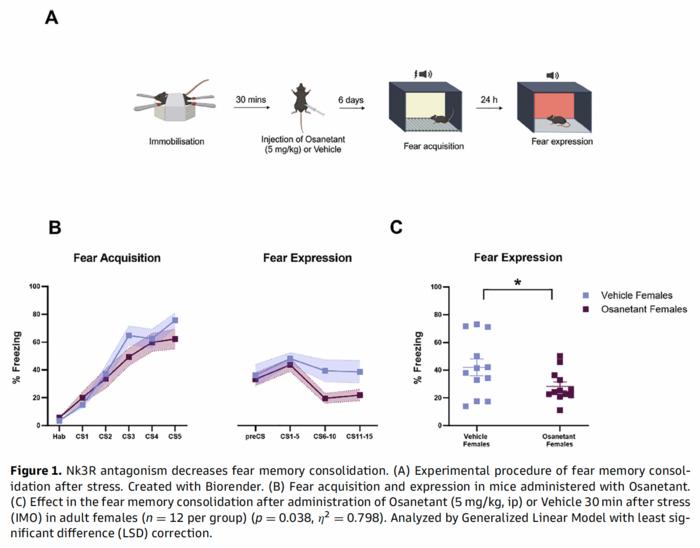
Recent research has gained significant traction in the understanding of post-traumatic stress disorder (PTSD) and its related treatments, particularly in how fear memories are formed and consolidated. A pivotal study illustrates that a single administration of Osanetant, a selective antagonist for the neurokinin 3 receptor (Nk3R), can significantly reduce fear expression when administered soon after a traumatic event. This research is particularly notable as it highlights a critical time-sensitive intervention specifically in female mice, which serves as a model for understanding the complexities of PTSD.
The backdrop of this study, published in Brain Medicine, touches upon the broader implications of PTSD, which is known to disproportionately affect women, creating an urgent need for gender-specific therapeutic approaches. The research team from the Institut de Neurociències, Universitat Autònoma de Barcelona, targeted the biologically distinct mechanisms of fear memory consolidation that arise from traumatic experiences. Their focus on female mice is a strategic and necessary step towards understanding how PTSD manifests differently in males and females.
Osanetant operates within the Tachykinin 2 (Tac2) pathway—an avenue previously unexplored in treatment contexts for fear-related disorders. By blocking Nk3R, Osanetant mitigates the neurochemical pathways that contribute to the formation and storage of fear memories. The study employs a controlled experimental design wherein female mice, subjected to immobilization stress—a commonly accepted model for PTSD—are treated with Osanetant shortly after exposure. This timing is critical, as interventions closer to the moment of trauma are theorized to have a more profound effect on the brain’s processing of stressful experiences.
The groundbreaking results of the study indicate that those treated with Osanetant demonstrated significantly less freezing behavior, a classical indicator of fear response in rodents. This confirms that the drug indeed affects the consolidation process of fear memories. The controlled statistical analysis revealed a significant p-value of 0.038, emphasizing the effectiveness of the treatment. Moreover, the estimated effect size with η2 = 0.798 suggests that the intervention accounted for a substantial proportion of variance in fear behavior, signifying a robust outcome that merits further investigation.
An intriguing aspect of this research is the observation that Osanetant behaved differently under varying conditions of stress exposure. Prior studies had shown that, in the absence of stress, Osanetant could enhance fear responses—an observation that perplexes researchers. The current findings suggest that stress may recalibrate neural pathways in such a way that they become more receptive to the therapeutic effects of Nk3R antagonism. This phenomenon beckons further inquiry into how trauma influences the brain’s biochemical and neurophysiological landscapes, potentially altering the efficacy of various interventions.
The importance of focusing exclusively on female subjects is essential in this line of research, as PTSD has been found to be significantly more prevalent in women compared to men. The prevailing reliance on male rodent models in neuroscience overlooks essential biological variances that can influence brain function and pharmacological response. As noted by Dr. Raül Andero, the senior author of the study, this research emphasizes the necessity for sex-inclusive studies in the field of neuroscience, particularly concerning trauma and its psychological ramifications.
Furthermore, the study invites questions about the potential translatability of these findings to human contexts. Could a similar mechanism operate within the human brain? If Osanetant has already been deemed safe in clinical environments, what does this mean for its potential application in emergent situations such as ER visits after traumatic events? These questions pivot towards the transformative potential of Nk3R antagonism in a clinical setting, particularly as emergency departments and mental health services look for innovative approaches to manage trauma responses.
Although the study presents robust findings, it is not without limitations. The exclusive focus on female mice means the findings may not inherently extend to male models or to human females without additional validation. Moreover, other biological variables, such as the estrous cycle, which can affect behavioral outcomes, were not accounted for in this trial. Nevertheless, the implications of Osanetant as a rapid-response therapeutic option are compelling, providing an actionable pharmacological intervention to prevent the intense consolidation of fear memories after traumatic exposure.
The findings highlight an urgent and actionable pathway towards developing a pharmacological framework aimed at mitigating the lasting effects of traumatic experiences. The data emerging from this research not only contributes to the growing body of evidence in the pharmaceutical treatment of PTSD but also enhances our understanding of the biological underpinnings of fear memory processing. Understanding these mechanisms could serve as a linchpin for future therapies targeting PTSD and related disorders, thereby aiding in the prevention of long-lasting psychological distress.
In addition to the immediate findings, there lies an exciting opportunity for interdisciplinary collaboration. Psychologists, neuroscientists, and clinicians can converge to explore and expand these findings into broader therapeutic realms, integrating behavioral therapies with pharmacological interventions. As the field of neuroscience progresses, studies like this pave the way for innovative solutions to complex mental health challenges, particularly as they relate to gender disparities in diagnosis and treatment.
As we move forward, it is critical to continue researching the role of Nk3R and its pathways, seeking to unravel further the intricate relationships between stress, memory, and drug response. The attention to biological variables, such as sex differences, will not only help in closing existing gaps in the research but also refine treatment approaches tailored to individual needs, ultimately based on a comprehensive understanding of pain and recovery from trauma.
Cite Scienmag News
Ophelia Keating. (April 8, 2025). Study Reveals Post-Trauma Drug Effectively Inhibits Fear Response in Female Mice. Scienmag. https://scienmag.com/study-reveals-post-trauma-drug-effectively-inhibits-fear-response-in-female-mice/
Ophelia Keating. "Study Reveals Post-Trauma Drug Effectively Inhibits Fear Response in Female Mice." Scienmag, 8 April 2025, https://scienmag.com/study-reveals-post-trauma-drug-effectively-inhibits-fear-response-in-female-mice/. Accessed 4 September 2026.
Ophelia Keating. "Study Reveals Post-Trauma Drug Effectively Inhibits Fear Response in Female Mice." Scienmag. April 8, 2025. https://scienmag.com/study-reveals-post-trauma-drug-effectively-inhibits-fear-response-in-female-mice/


