


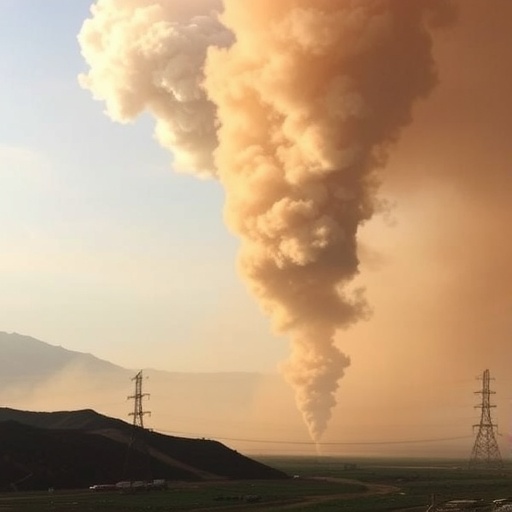
In the ever-evolving landscape of industrial mining, the management and control of dust emissions have emerged as critical challenges that necessitate innovative solutions. Among the various techniques being explored, researchers have devoted their attention to understanding the laws of dust transportation and enhancing dust control methodologies. A pioneering study by Zhao, Wang, and Wang, published in “Scientific Reports,” delves into these pressing issues specifically within the context of coal mining operations.
Dust generated at coalface sites poses significant health risks to workers and can adversely affect the surrounding environment. Dust particles are often small enough to infiltrate the respiratory systems of workers, leading to chronic health conditions. Furthermore, dust emissions can exacerbate air quality concerns in nearby communities, drawing regulatory scrutiny and potentially complicating mining operations. Therefore, understanding the dynamics of dust behavior is a top priority as mining continues to expand.
The researchers’ investigation centers around the transportation mechanisms of dust via airflow, particularly in the highly dynamic environment of coal seams. Coal mining operations typically generate intense airflow patterns due to the extraction processes, which can disperse dust over wide areas. By mapping out these airflow dynamics, the researchers aim to develop methodologies that could mitigate the spread of harmful dust particles, thus improving the health safety of workers.
The study introduces an innovative air curtain technology utilizing specially designed cyclones to capture and redirect dust particles released at the coalface. The essential principle behind this technique is the creation of a protective barrier of segmented airflow that envelops the coal extraction area. As dust is dislodged from the coal during mining, the cyclone-generated air curtain acts to contain the particles within an established perimeter, thereby reducing their dispersal into the environment.
Modeling the compound effects of airflow and dust behavior has also been a focal point of Zhao’s research. Advanced computational fluid dynamics (CFD) simulations provide invaluable insights into the interaction between the cyclone air curtains and particles of varying sizes and weights. These simulations enable the team to visualize how different configurations of airflow can either enhance or diminish dust control efficacy. By iterating on these models, they aim to optimize the design of the cyclone systems for maximum efficiency.
The importance of accurate modeling goes beyond theoretical applications. In practical scenarios, understanding the localized effects of airflow can guide real-time operational adjustments, which are essential in high-stakes environments like coal mining. For instance, adjusting the flow rates of air curtains based on real-time data could yield immediate benefits in dust suppression during peak operation hours, ultimately safeguarding worker health and maintaining productivity.
Moreover, the findings suggest integrating these air curtain solutions with existing dust control technologies already utilized in coal mining sites. This modular approach could minimize costs while maximizing overall dust control efficacy. By incorporating these innovations into broader dust management strategies, it becomes possible to address regulatory compliance while promoting sustainable mining practices.
The study indicates that further real-world testing will be essential to verify the theoretical models and computational simulations. Pilot programs at various mining sites will act as experimental grounds for the new technology, allowing for the observation of interactions between the cyclone air curtains and various environmental conditions. The goal is to gather comprehensive data on performance across different coal extraction scenarios.
Apart from technical advancements, the study carries significant implications for the future of mining practices. With increasing environmental regulations and heightened awareness of occupational health and safety, mining companies are under pressure to innovate and adopt more effective dust control methods. If successful, this air curtain technology could set a new standard in the industry, positioning companies at the forefront of sustainable mining practices.
Additionally, researchers emphasize the role of collaboration between technological developers and mining companies to facilitate the transition from theoretical research to practical implementation. By pooling resources and knowledge, stakeholders can enhance the speed and effectiveness of incorporating advanced technologies in mining operations. This partnership can foster a culture of continuous improvement and lead to further innovations in the field.
As dust control methods continue to revolutionize the mining sector, the implications extend beyond workplace safety. Improved dust management can contribute positively to local communities by minimizing air quality issues, promoting public health, and addressing community concerns surrounding mining operations. This alignment of interests between mining companies and the communities they operate within represents a turning point in fostering more harmonized relationships.
The impact of this research extends globally, as countries around the world balance the need for coal as an energy source with public health and environmental priorities. In settings where coal remains a crucial economic driver, deploying effective dust control technologies is vital to ensuring that the industry adapts to increasingly stringent regulations while retaining its operational viability.
In conclusion, the groundwork laid out by Zhao and colleagues presents a pivotal step toward revolutionizing dust management in coal mining. The integration of advanced cyclone air curtain technology alongside robust modeling approaches embodies an innovative spirit that promises to enhance workplace safety while addressing broader environmental concerns. As the mining industry faces ongoing challenges, studies such as this empower stakeholders to implement strategic solutions that can reshape the industry’s future.
By advancing our understanding of dust transportation and control technologies, we can embrace a future where coal mining practices are both responsible and sustainable. The evolution of these methodologies brings hope for a safer, cleaner, and more environmentally conscious mining industry, paving the way for advancements in technology and health safety.
Zhao, X., Wang, H. & Wang, J. Research on the dust transportation law and cyclone air curtain dust control technology of coalface. Sci Rep (2025). https://doi.org/10.1038/s41598-025-27756-6
Cite Scienmag News
Denise Maddox. (November 29, 2025). Study Reveals Cyclone Air Curtain Controls Coal Dust. Scienmag. https://scienmag.com/study-reveals-cyclone-air-curtain-controls-coal-dust/
Denise Maddox. "Study Reveals Cyclone Air Curtain Controls Coal Dust." Scienmag, 29 November 2025, https://scienmag.com/study-reveals-cyclone-air-curtain-controls-coal-dust/. Accessed 3 September 2026.
Denise Maddox. "Study Reveals Cyclone Air Curtain Controls Coal Dust." Scienmag. November 29, 2025. https://scienmag.com/study-reveals-cyclone-air-curtain-controls-coal-dust/


