


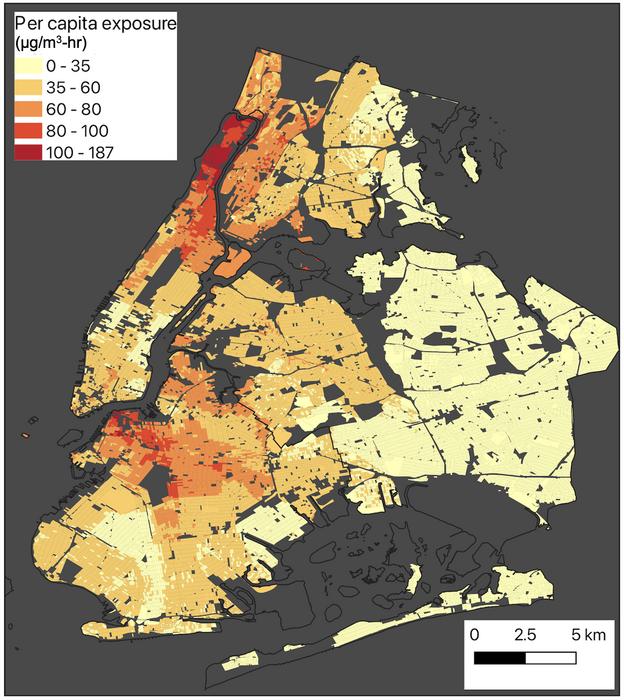
New York City subway commuters who are economically disadvantaged or belong to racial minority groups have the highest exposure to fine particulate matter during their commutes, according to a new study published August 7, 2024 in the open-access journal PLOS ONE by Shams Azad of New York University, USA.

Credit: Azad et al., 2024, PLOS ONE, CC-BY 4.0 (
New York City subway commuters who are economically disadvantaged or belong to racial minority groups have the highest exposure to fine particulate matter during their commutes, according to a new study published August 7, 2024 in the open-access journal PLOS ONE by Shams Azad of New York University, USA.
Fine particulate matter (PM2.5) is a type of air pollution that, due to its small size, when inhaled by a person can enter the bloodstream. PM2.5 is known to cause short- and long-term health complications. For the last few decades, cities have promoted public transportation to reduce traffic congestion and improve ambient outdoor air quality. Subway systems reduce pollution by decreasing vehicles on the road; however, the quality of air inside subways is typically poor.
In the new study, the researchers combined data on home-to-work commute patterns for 3.1 million working commuters across four boroughs of New York City (Manhattan, Brooklyn, Queens, and the Bronx) with measured PM2.5 concentration levels on platforms and on trains.
Overall, the mean underground PM2.5 platform concentration was 139 ± 25 μg/m3, and the on-train concentration was 99 ± 21 μg/m3. These concentrations are significantly higher than the 15 μg/m3 mean 24-hour exposure guideline set by the World Health Organization – though the authors note that as a subway ride is shorter than an entire day, these results provide only baseline understanding of exposure on a commute as a notable portion of a person’s exposure during a 24 hour period.
The researchers quantified the disparities in exposure across racial and income groups, using census data on where people in different demographics tended to live and calculating their commute time and therefore their exposure accordingly. They found that people from lower-income working communities tend to have higher exposures, and that Black and Hispanic workers experience on average 35% and 23% higher PM2.5 exposure, respectively, compared to Asian and white workers. The authors suggest this may be because these groups typically have longer subway commutes to work as there are comparatively fewer job opportunities in areas where Black and Hispanic workers tend to reside. However, they note that this analysis can only draw general conclusions about populations as an average at census block level, rather than calculating individuals’ exposures.
The authors note that their research focuses only on the exposure resulting from subway journeys and also does not examine journeys other than the home-to-work commute. The authors plans to examine exposure for all individuals using the subway, in addition to those on commute. Nonetheless, they conclude that, because socioeconomic factors play a role in shaping the transportation choices of individuals, they likely subsequently impact their exposure to PM2.5 from subway travel.
The authors add: “Measurement of fine particulate matter in the NYC subway system show concentrations which are significantly higher than the exposure guidelines set by the Environmental Protection Agency and the World Health Organization. The primary source of the fine particles is the abrasion of the train car’s metal wheels, breaks, and rails. This information was used to calculate the exposure of over 3 million New Yorkers, during home to work commute.”
#####
In your coverage please use this URL to provide access to the freely available article in PLOS ONE:
Citation: Azad S, Ferrer-Cid P, Ghandehari M (2024) Exposure to fine particulate matter in the New York City subway system during home-work commute. PLoS ONE 19(8): e0307096.
Author Countries: USA, Spain
Funding: M.G. and S.A. received funding from National Science Foundation (award number 1856032), and C2SMART Center, with a grant from the U.S. Department of Transportation’s University Transportation Centers Program under Grant Number 69A3551747124. The U.S. Government assumes no liability for the contents or use thereof. The funders had no role in study design, data collection and analysis, decisions to publish, or preparation of the manuscript.
Journal
PLoS ONE
Method of Research
Observational study
Subject of Research
People
Article Title
Exposure to fine particulate matter in the New York City subway system during home-work commute
Article Publication Date
7-Aug-2024
COI Statement
The authors have declared that no competing interests exist.
Cite Scienmag News
Russell Cooper. (August 7, 2024). Study quantifies air pollution for NYC subway commuters. Scienmag. https://scienmag.com/study-quantifies-air-pollution-for-nyc-subway-commuters/
Russell Cooper. "Study quantifies air pollution for NYC subway commuters." Scienmag, 7 August 2024, https://scienmag.com/study-quantifies-air-pollution-for-nyc-subway-commuters/. Accessed 4 September 2026.
Russell Cooper. "Study quantifies air pollution for NYC subway commuters." Scienmag. August 7, 2024. https://scienmag.com/study-quantifies-air-pollution-for-nyc-subway-commuters/

