


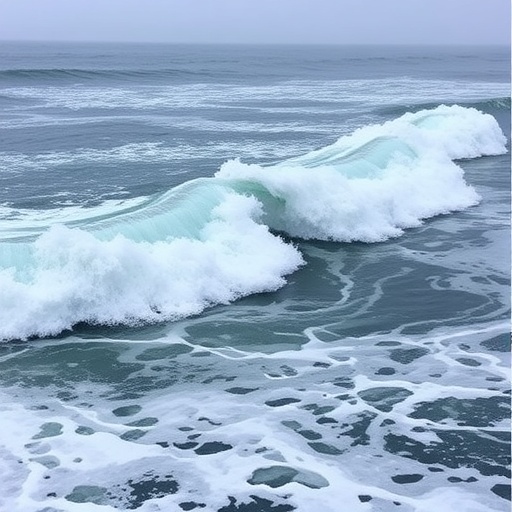
New research has unveiled a powerful and previously underestimated driver of climate change: the intensification of oceanic eddies. These dynamic swirling currents, which separate from major ocean currents, play a crucial role in the redistribution of heat and nutrients throughout the world’s oceans. This redistribution is not just a localized phenomenon; it is catalyzing the amplification of climate extremes within vital coastal ecosystems. As these eddies intensify, the ocean’s influence on climate becomes increasingly complex and profound, reshaping ocean dynamics and coastal environmental conditions in ways scientists are only beginning to understand.
A groundbreaking study spearheaded by Lisa Beal, a professor of ocean sciences at the University of Miami Rosenstiel School of Marine, Atmospheric, and Earth Science, has shed light on this phenomenon by focusing on the Agulhas Current. The Agulhas is a fast-moving, narrow western boundary current that flows poleward along the southeast coast of Africa. Over a span of two years, researchers implemented high-resolution mooring systems that captured hourly data on velocity, temperature, and salinity through the current’s full depth and breadth. This comprehensive dataset allowed an unprecedented look into the inner workings of the current and the eddies that peel off its main flow.
The significance of this dataset cannot be overstated, as it has laid the foundation for more than a decade of subsequent studies focused on oceanic boundary currents. Collaborating with Kathryn Gunn of the University of Southampton, Beal utilized these observations to demonstrate that the growing activity of eddies along the Agulhas Current is restructuring the current itself while simultaneously intensifying temperature extremes along adjacent coastal waters. Their research, published in the prestigious journal Nature Climate Change, identifies two key features governing this process: subtle frontal instabilities approximately 10 kilometers wide and larger-scale meanders. These oceanic structures redistribute heat, salt, and nutrients between the open ocean and coastal shelves, altering stratification and thermal gradients.
One of the most compelling revelations of this study is how increasing eddy activity accelerates warming at the ocean’s surface within the Agulhas Current, while paradoxically enhancing upwelling of cooler waters at greater depths. This dual effect induces a pronounced thermal stratification, deepening the ocean layers with cooler water underneath warmer surface layers. This stratification has significant consequences, as it intensifies extreme temperature fluctuations in shelf seas — areas of critical ecological importance. The onshore propagation of these eddies causes warmer surface waters to encroach closer to coastal zones, placing additional thermal stresses on marine ecosystems that are already vulnerable to climate perturbations.
The mechanics underlying this phenomenon hinge on the ability of eddies and current meanders to pump deep, cold, nutrient-rich water onto continental shelves. This nutrient injection has the potential to enhance coastal productivity, fueling biological activity in those regions. Conversely, farther offshore, these larger meanders act to trap heat and salinity near the sea surface, contributing to the rapid surface warming observed over recent decades. This layered thermal structure where warmer surface waters overlay cool subsurface waters provides a transformative understanding of how ocean currents modulate climate signals within subtropical western boundary current systems.
Satellite observations over the past several decades corroborate these findings, showing that the Agulhas Current surface waters are warming at a rate three to four times higher than the global ocean average. However, despite this rapid surface warming, the newly documented eddy-driven upwelling mechanism helps explain why deeper waters remain cooler than expected. This dichotomy in temperature profiles clarifies previously puzzling trends in regional climate, including increased rainfall in South Africa linked to warmer surface waters and a concurrent decrease in the total heat transported poleward by the current. The overall stability of the Agulhas Current’s volume transport amidst these dynamic changes challenges prior assumptions about the consequences of ocean warming.
The implications of these insights extend far beyond the African continent. Researchers propose that intensifying eddy dynamics could offer a unifying framework for understanding similar observed changes in other major ocean currents globally, such as the Gulf Stream along the eastern coast of the United States. Eddies, often overlooked in large-scale ocean models, appear to be a fundamental driver of how the ocean modulates climate change impacts by locally amplifying or modulating thermal and nutrient exchanges. Recognizing the pivotal role of these mesoscale processes marks a paradigm shift in oceanography and climate science.
Lisa Beal emphasized the transformative nature of these findings, highlighting that it is the increased “eddying” – the surge in frequency and intensity of swirling ocean currents – that fundamentally alters the stratification and heat distribution in the subtropic western boundary currents. Consequently, coastal ecosystems will experience increased thermal variability and nutrient dynamics, driving ecological consequences that span from primary productivity changes to the potential reshaping of fisheries and marine biodiversity hotspots. This research underscores the vital necessity to incorporate eddy dynamics into climate models to improve their accuracy and predictive capabilities.
The study, titled “More eddying of subtropical western boundary currents boosts stratification and cools shelf seas,” was officially published on April 15, 2026, in the journal Nature Climate Change. Supported by substantial funding from the U.S. National Science Foundation, the collaboration highlights the power of international scientific partnerships. The detailed observations and analyses provide novel understanding of how small-scale physical processes in the ocean influence large-scale climate feedbacks, advocating for a more nuanced approach to studying ocean-atmosphere interactions.
Ultimately, this research reinforces the ocean’s role as a climate regulator, capable of both buffering and exacerbating climate extremes through complex internal mechanisms. As eddy activity intensifies, the dual forces of surface warming and deep-water cooling create a stratified ocean environment that fundamentally changes coastal sea conditions. Understanding and predicting these changes enables better management of marine resources, coastal communities, and climate adaptation strategies as the planet continues to warm at unprecedented rates.
This exploration of eddy intensification challenges long-standing oceanographic paradigms by revealing the hidden yet profound power of mesoscale processes in modulating climate. By demonstrating the essential role of eddies in heat and nutrient transport, the study lights the way forward for climate science, highlighting the intricate dance between ocean physics and ecosystem responses. These revelations elevate the importance of high-resolution ocean monitoring programs and underscore the urgent need to incorporate fine-scale ocean dynamics into climate forecasting models for a sustainable future.
News Publication Date: 15-Apr-2026
Web References:
DOI link to the article
Cite Scienmag News
Violet Maxwell. (April 15, 2026). Study Finds Ocean Eddies Intensify Climate Extremes in Coastal Seas. Scienmag. https://scienmag.com/study-finds-ocean-eddies-intensify-climate-extremes-in-coastal-seas/
Violet Maxwell. "Study Finds Ocean Eddies Intensify Climate Extremes in Coastal Seas." Scienmag, 15 April 2026, https://scienmag.com/study-finds-ocean-eddies-intensify-climate-extremes-in-coastal-seas/. Accessed 3 September 2026.
Violet Maxwell. "Study Finds Ocean Eddies Intensify Climate Extremes in Coastal Seas." Scienmag. April 15, 2026. https://scienmag.com/study-finds-ocean-eddies-intensify-climate-extremes-in-coastal-seas/


