


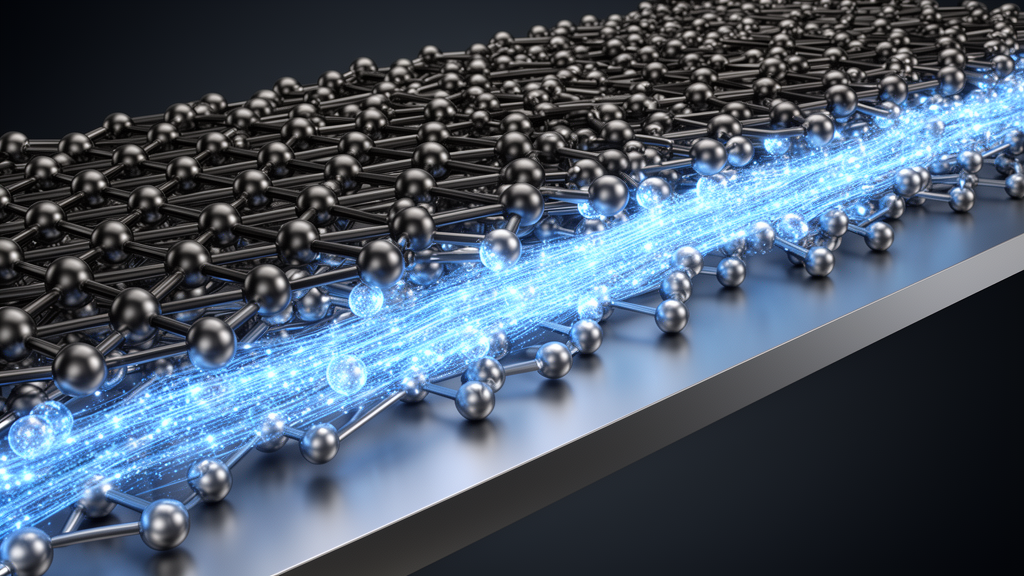
In an experimental study published in Nature, an international research team has achieved the first direct demonstration of an altermagnet acting as a source of pure spin current. The project, led by Helena Reichlová at the Institute of Physics of the Czech Academy of Sciences in collaboration with Fèlix Casanova at the Spanish research centre CIC nanoGUNE, demonstrated that altermagnets can generate spin currents as efficiently as conventional ferromagnets despite exhibiting zero net magnetization. This physical demonstration validates a long-theorized capability of altermagnetic materials and establishes an experimental foundation for developing smaller, more robust spintronic architectures.
By utilizing a spin current—a directional flow of electrons in which a single spin orientation predominates—spintronic systems offer the theoretical potential to operate with greater processing speed and significantly reduced energy dissipation compared to traditional charge-based circuitry.
Producing reliable spin currents in laboratory and industrial settings has historically required the use of ferromagnetic materials. While ferromagnets are efficient spin current generators, they possess an inherent net magnetization that produces an external magnetic field. In high-density electronic environments where nanoscale components are positioned close together, these stray magnetic fields create unwanted magnetic interference between neighbouring elements, impeding miniaturization. Antiferromagnets avoid this issue because their internal magnetic moments cancel each other out, yielding zero net external field, but their internal symmetry simultaneously prevents them from generating the necessary spin currents.
Altermagnets represent a distinct class of magnetic materials that combines the key functional advantages of both conventional groups. While showing zero net macroscopic magnetization, the specific structural symmetry of an altermagnet’s crystal lattice allows internal electrons to split by spin orientation almost as intensely as they do within ferromagnets. Despite extensive theoretical descriptions in recent years, experimental verification of practical spin transport had remained missing, as no laboratory experiment had previously demonstrated that a functional spin current could be successfully extracted from an altermagnetic lattice and injected into another medium.
To investigate whether this extraction was physically possible, Reichlová and her colleagues focused on a specific compound composed of manganese and silicon. At the Institute of Physics of the Czech Academy of Sciences, Reichlová heads the Max Planck Dioscuri Centre research group, which has studied this manganese-silicon compound since 2019. The material offers practical experimental advantages for laboratory investigation: it can be measured at readily accessible temperatures, is non-toxic, forms high-quality thin films, and had previously enabled the team to observe several other solid-state physical phenomena.
The central technical objective was to integrate this material into a spin valve, a foundational spintronic device where one magnetic element emits a spin current and a second element detects it. Standard spin valves utilized with ferromagnets typically consist of vertical multilayer stacks where current passes perpendicularly across the interfaces between layers. In the manganese-silicon altermagnet, however, spin transport cannot propagate perpendicular to the thin-film interface into an adjacent layer, ruling out the standard vertically layered spin-valve design.
To overcome this directional barrier, the researchers chose a lateral spin-valve architecture. In a lateral configuration, the spin current travels entirely within the plane of the thin film rather than across vertical interfaces. In addition to aligning with the specific transport properties of the manganese-silicon compound, lateral spin valves offer the experimental advantage of physically separating the pure spin current from the accompanying electric charge current, allowing researchers to study the spin properties independently of background electrical conduction.
Fabricating functional lateral devices from a new material system required specialized manufacturing techniques, prompting Reichlová’s group to establish a collaboration in 2022 with Casanova’s team at CIC nanoGUNE, an institution with long-standing expertise in lateral device production. The technical fabrication process required approximately a year of initial refinement. The primary laboratory work was conducted by doctoral student and first author Jone Mencos, who encountered early difficulties when the manganese-silicon compound repeatedly lost its critical magnetic characteristics during nanoscale patterning before an effective manufacturing routine was developed.
Beyond nanofabrication, detecting the spin signal posed substantial experimental hurdles. In standard ferromagnetic contacts, electron spin is injected uniformly across the entire contact surface. In the altermagnet, by contrast, spin injection takes place only over a small localized cross-section and strictly along designated crystallographic directions. Because such measurements had never been attempted on an altermagnet, the researchers faced significant uncertainty regarding whether the resulting electrical signal would be strong enough to detect above background noise.
Following successful device fabrication, the research team spent another full year recording measurements and determining the physical significance of the observed signals. Theoretical physicists joined the collaboration to evaluate the data and recommend specific additional measurement sequences required to interpret the experimental results.
The resulting measurements, described in the publication titled Time-reversal-symmetry-breaking spin injection from a compensated magnet, provided direct electrical proof that pure spin current can be injected from a compensated magnet into a non-magnetic material. Furthermore, the experiments delivered definitive evidence of the spin-splitter effect. In this characteristic altermagnetic mechanism, a pure spin current is produced in a direction perpendicular to the primary flow of electrical charge, confirming the transport properties predicted by crystallographic symmetry models.
Despite this experimental milestone, the researchers emphasized that the study constitutes fundamental science and that commercial applications cannot yet be precisely scheduled. Practical implementation will require further materials development, nanostructure engineering, and industrial investment in novel hardware architectures. At present, the test devices still rely on a conventional ferromagnetic element to detect the injected spin current, and ongoing research is examining whether the detector can also be replaced with non-ferromagnetic components. The team continues to study the manganese-silicon compound to determine how its signals depend on crystal direction and whether the lateral spin valves can be scaled to smaller dimensions.
Subject of Research: Electrical spin current generation and injection using lateral altermagnetic devices
Article Title: Altermagnet acts as a source of spin current for the first time
Article References: Altermagnet acts as a source of spin current for the first time. Original publication (Bibliographic details unavailable.)
Image Credits: AI Generated
DOI: Not provided
Keywords: altermagnets, spintronics, spin current, lateral spin valves, manganese-silicon compound, spin-splitter effect, compensated magnets, Helena Reichlová, Fèlix Casanova, Jone Mencos, Institute of Physics of the Czech Academy of Sciences, CIC nanoGUNE, thin films, ferromagnets, antiferromagnets, electron spin, nanostructures
Cite Scienmag News
Bethany Barker. (November 11, 2026). Study Demonstrates First Pure Spin Current Injection From an Altermagnetic Material. Scienmag. https://scienmag.com/study-demonstrates-first-pure-spin-current-injection-from-an-altermagnetic-material/
Bethany Barker. "Study Demonstrates First Pure Spin Current Injection From an Altermagnetic Material." Scienmag, 11 November 2026, https://scienmag.com/study-demonstrates-first-pure-spin-current-injection-from-an-altermagnetic-material/. Accessed 11 November 2026.
Bethany Barker. "Study Demonstrates First Pure Spin Current Injection From an Altermagnetic Material." Scienmag. November 11, 2026. https://scienmag.com/study-demonstrates-first-pure-spin-current-injection-from-an-altermagnetic-material/




