


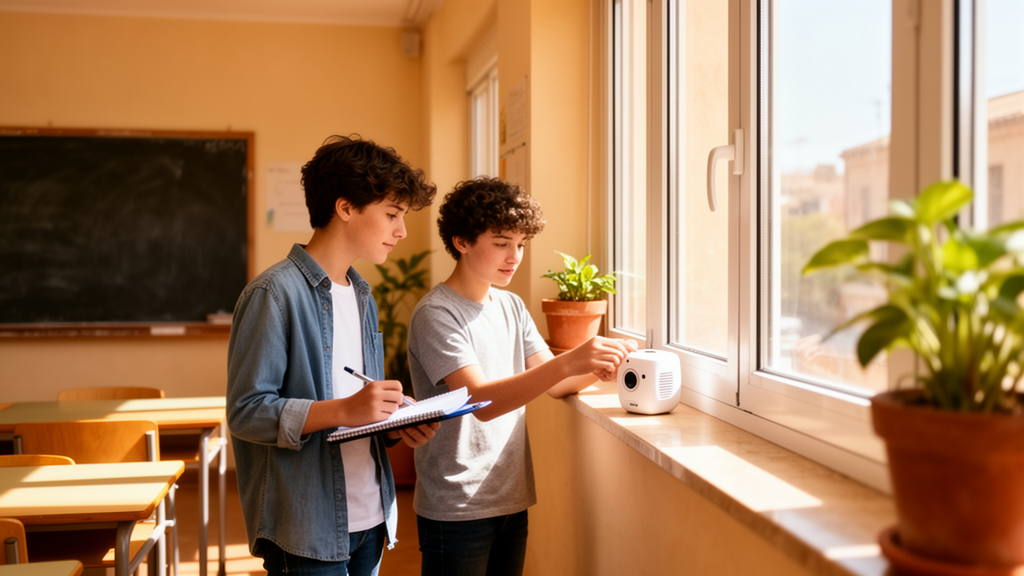
Indoor radon, an invisible radioactive gas that seeps into buildings from the soil beneath them, is a recognized cause of lung cancer, and schools are among the places where exposure matters most because children spend long hours there. A citizen-science project in Catalonia, Spain, known as RASCLET, has now combined classroom radon measurements with hands-on education, and the results show both an environmental picture and a striking shift in what students know about the hazard. Between the winter of 2024 and 2025, researchers placed integrated radon detectors in classrooms across 13 Catalan schools.
The schools were deliberately chosen to represent different radon risk zones defined by Spain's official radon potential maps, and detectors were installed on different floors so that vertical variation within buildings could be examined. Rather than treating the schools as passive measurement sites, the team invited roughly 40 students at each school to take part in educational activities about radon under their teachers' supervision, and the students and teachers themselves selected which classrooms would host the detectors. The environmental findings were reassuring for the schools involved.
Indoor radon concentrations varied between schools and between floor levels, with a median of 49 becquerels per cubic meter and an interquartile range of 24 to 77 Bq per cubic meter. The educational outcomes were equally notable. Before the activities began, 538 students completed a questionnaire; after the intervention, 339 did.
The participants were around 11 years old on average, with balanced female-to-male distributions in both rounds. When asked to identify radon as a radioactive gas, only 34.2 percent answered correctly before the program, but that figure rose to 72.9 percent afterward. Recognition of radon's long-term health effects improved even more dramatically, climbing from 42.0 percent to 85.5 percent.
Both changes were statistically significant, with p-values below 0.001, indicating that the improvements were very unlikely to be due to chance. Beyond the headline numbers, the study explored how environmental conditions shape indoor radon variability. The researchers combined their indoor measurements with meteorological data and modeled radon flux, the rate at which radon is released from the soil surface, in an exploratory modeling analysis.
Among the variables tested, wind speed emerged as the only statistically significant environmental factor associated with observed indoor radon concentrations, with a p-value of 0.025. The strength of the RASCLET approach lies in its dual purpose. On one side, it generates genuine exposure data in buildings occupied by children, using detectors placed with local knowledge of how classrooms are actually used.
On the other, it turns the measurement campaign itself into a learning experience, so that students are not merely subjects of a study but participants who choose detector locations, discuss the results, and connect abstract radiation concepts to their own environment. The pre- and post-questionnaire design provides quantitative evidence that this participation translated into measurable gains in knowledge and risk awareness. Radon itself deserves a brief technical explanation.
Long-term inhalation of elevated radon concentrations increases the risk of lung cancer, which is why national and international bodies set reference levels for indoor air. The Catalan schools all fell below the reference level in this campaign, but the authors emphasize that the study is a pilot. Thirteen schools, one region, and one winter season cannot capture the full range of building types, geological settings, and seasonal patterns across Spain.
The value of the work lies in demonstrating a workable protocol: schools can be recruited across different risk zones, students can be engaged meaningfully, questionnaires can quantify educational impact, and environmental variables can be collected alongside radon data for later modeling. The team explicitly presents these findings as the rationale for a larger-scale study across Spain to further evaluate the integrated approach.
Subject of Research: School-based citizen science for indoor radon monitoring and radon risk education in Catalonia
Article Title: Indoor radon monitoring through citizen science in Catalan schools: environmental assessment and educational outcomes
Article References: Javed, M., Martínez, I., Jimenez, A., Escarrabill, R. S., Vargas, A., Campillo i López, F., Pino, D., Sabbarese, C., & Grossi, C. (2026). Indoor radon monitoring through citizen science in Catalan schools: environmental assessment and educational outcomes. Frontiers in Public Health, 14, Article 1953882. https://doi.org/10.3389/fpubh.2026.1953882
Image Credits: AI Generated
DOI: 10.3389/fpubh.2026.1953882
Keywords: radon, citizen science, indoor air, schools, Catalonia, lung cancer risk, environmental health, radiation education, radon flux, risk awareness, exposure assessment, student questionnaires
Cite Scienmag News
Ophelia Keating. (October 27, 2026). Students Track Radon in Catalan Classrooms and Learn the Science Behind the Risk. Scienmag. https://scienmag.com/students-track-radon-in-catalan-classrooms-and-learn-the-science-behind-the-risk/
Ophelia Keating. "Students Track Radon in Catalan Classrooms and Learn the Science Behind the Risk." Scienmag, 27 October 2026, https://scienmag.com/students-track-radon-in-catalan-classrooms-and-learn-the-science-behind-the-risk/. Accessed 27 October 2026.
Ophelia Keating. "Students Track Radon in Catalan Classrooms and Learn the Science Behind the Risk." Scienmag. October 27, 2026. https://scienmag.com/students-track-radon-in-catalan-classrooms-and-learn-the-science-behind-the-risk/


