


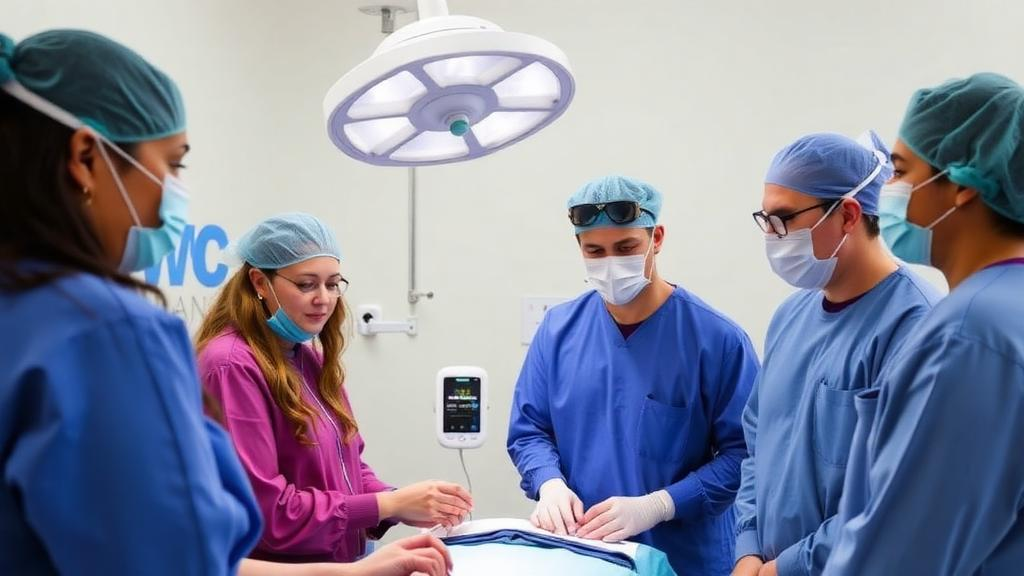
For most medical students, the first day in an operating room is a bewildering experience. The lights are blinding, the instruments are unfamiliar, the sterile rituals seem arcane, and everyone on the surgical team appears to move with a practiced fluency that the newcomer cannot hope to match. That anxiety is not merely a rite of passage; educators have long recognized that unprepared students learn less, participate less, and may quietly abandon surgical careers they might otherwise have pursued. A new study published in Global Surgical Education, the journal of the Association for Surgical Education, suggests that a remarkably inexpensive, student-driven simulation curriculum can transform that first operating room experience, and that the confidence it builds lasts for months.
The research, led by Jessica Yavner and colleagues at the State University of New York Downstate Health Sciences University in Brooklyn, set out to answer a question that has lingered in surgical education circles: how do you implement a cost-effective, medical-student-driven simulation program that actually works? Simulation is widely used to build clinical skills, but the literature is surprisingly thin on practical guidance for programs that must run on shoestring budgets, particularly in institutions and regions with limited resources. The Brooklyn team designed a surgical skills simulation clerkship course with an annual budget of less than $1,000, a figure that would barely cover the cost of a single high-fidelity mannequin session at many training centers.
The curriculum focused on four pillars of early surgical competence: opening and closing procedures, relevant anatomy, and post-operative care. Rather than relying on expensive technology, the organizers embraced a near-peer teaching model in which medical students themselves delivered the instruction. This approach, well documented in the education literature, benefits both sides of the equation. Senior students consolidate their own knowledge by teaching, while junior students often find it easier to ask basic questions of a peer than of an attending surgeon. It also happens to be one of the most economical ways to scale skills training, since it requires no additional faculty time for every session.
Over one year, 230 students participated in the program. The researchers administered questionnaires before each session, immediately afterward, and again at three- and six-month follow-ups, measuring confidence and perceived benefit on Likert scales. Of the participants, 117 students completed paired pre- and post-session surveys, a response rate of 51.3 percent. The statistical analysis was appropriately rigorous for the design: Wilcoxon signed rank tests compared pre- and post-session confidence scores, Dunnett’s test assessed whether the gains were retained over time, and Spearman’s correlation examined how surgical interest and operating room exposure related to perceived benefit.
The results were striking in their breadth. Students reported significant improvements in median confidence from before to after the sessions across essentially every domain the curriculum touched: preparation for the operating room learning environment, suturing, knot-tying, laparoscopic anatomy, sterile and scrub technique, post-operative care, knowledge of laparoscopy, identification and handling of surgical instruments, respectful and safe behavior in the operating room, and operating room protocols. All of these improvements reached statistical significance at the p < 0.05 level. In other words, a few hours of low-cost, peer-delivered practice measurably changed how prepared students felt for nearly every dimension of the surgical environment that intimidates newcomers.
Just as important was what the follow-up surveys showed. Confidence gains were not confined to the immediate afterglow of a positive teaching session; the study assessed retention at three and six months, and the curriculum was found to effectively sustain student confidence over that period. Durability is the perennial weakness of short educational interventions, and many simulation programs struggle to demonstrate that their effects outlast the novelty of the experience. The Brooklyn team’s finding that the benefits persisted suggests the curriculum taught durable mental models, not just momentary reassurance.
The perceived value of the program was equally emphatic. 92.3 percent of students found the curriculum beneficial, and the degree of perceived benefit was positively correlated with surgical interest, with a Spearman correlation coefficient of 0.31 that was statistically significant. That modest but real association hints at a virtuous cycle that surgical educators care deeply about: students who arrive with an interest in surgery get the most out of hands-on simulation, and positive early experiences may, in turn, reinforce that interest at a formative stage of training. With surgical specialties facing persistent recruitment and pipeline challenges, interventions that strengthen the earliest encounters between students and the operating room carry implications well beyond a single clerkship.
The study’s emphasis on cost is what elevates it from a competent local program to a potentially exportable model. In a systematic review cited by the authors, researchers noted that cost is the missing outcome in simulation-based medical education research; most studies report learning gains without ever accounting for what those gains required in dollars, equipment, or faculty hours. High-fidelity simulators, virtual reality platforms, and cadaver laboratories all deliver value, but their price tags put them out of reach for many institutions, particularly in low- and middle-income countries and in under-resourced teaching hospitals. A curriculum that achieves significant, sustained confidence gains on an annual budget under $1,000 removes the most common objection to adopting simulation in exactly the settings where students may have the least prior exposure to operating rooms.
The institutional context adds weight to the findings. SUNY Downstate serves a diverse population in Brooklyn, and its medical students span a wide range of prior exposure to surgical environments. The study received ethical approval as an exempt protocol from the institutional review board, with a waiver of written informed consent, and the curriculum was funded by the institution’s Surgery Clerkship rather than by external grants, underscoring its lean operating model. The authors dedicated the work to Erfan Faridmoayer, whose contributions to the project they describe as an inspiring legacy, a reminder that behind every curriculum study is a community of educators and trainees who built it session by session.
For educators weighing whether a student-led simulation program is worth the logistical effort, the study offers a clear signal. It demonstrates that near-peer instruction, deliberately scoped content, and repeated measurement can produce statistically significant and durable gains in the specific competencies that make students feel ready for the operating room, all while minimizing the implementation barriers that typically sink such efforts. The next step for the field will be testing whether confidence gains translate into objectively measured technical performance and, ultimately, into safer and more productive student participation in real operations. But as a proof of concept, this Brooklyn experiment makes a compelling case that the most valuable surgical training does not always require the most expensive equipment; sometimes it requires little more than students willing to teach each other how to hold a needle driver.
Subject of Research: Medical student-led surgical simulation training and its effect on operating room confidence in a limited-resource setting
Article Title: Impact of medical student-led surgical simulation curriculum on student confidence in the operating room in a limited resource setting
Article References: Yavner, J., Ferguson, C., Sharath, S. E., Glaser, K., Medvedovsky, S., Eisner, S., Kirwin, J., & Kougias, P. (2026). Impact of medical student-led surgical simulation curriculum on student confidence in the operating room in a limited resource setting. Global Surgical Education – Journal of the Association for Surgical Education, 5(1), Article 142. https://doi.org/10.1007/s44186-026-00539-x
Image Credits: AI Generated
DOI: 10.1007/s44186-026-00539-x
Keywords: surgical simulation, medical education, near-peer teaching, operating room confidence, low-resource setting, surgical skills, clerkship curriculum, simulation-based education, medical students, surgical education, Impact, medical
Cite Scienmag News
Courtney Benton. (October 2, 2026). Students Teaching Students: A $1,000 Simulation Curriculum Boosts Surgical Confidence. Scienmag. https://scienmag.com/students-teaching-students-a-1000-simulation-curriculum-boosts-surgical-confidence/
Courtney Benton. "Students Teaching Students: A $1,000 Simulation Curriculum Boosts Surgical Confidence." Scienmag, 2 October 2026, https://scienmag.com/students-teaching-students-a-1000-simulation-curriculum-boosts-surgical-confidence/. Accessed 17 October 2026.
Courtney Benton. "Students Teaching Students: A $1,000 Simulation Curriculum Boosts Surgical Confidence." Scienmag. October 2, 2026. https://scienmag.com/students-teaching-students-a-1000-simulation-curriculum-boosts-surgical-confidence/


