


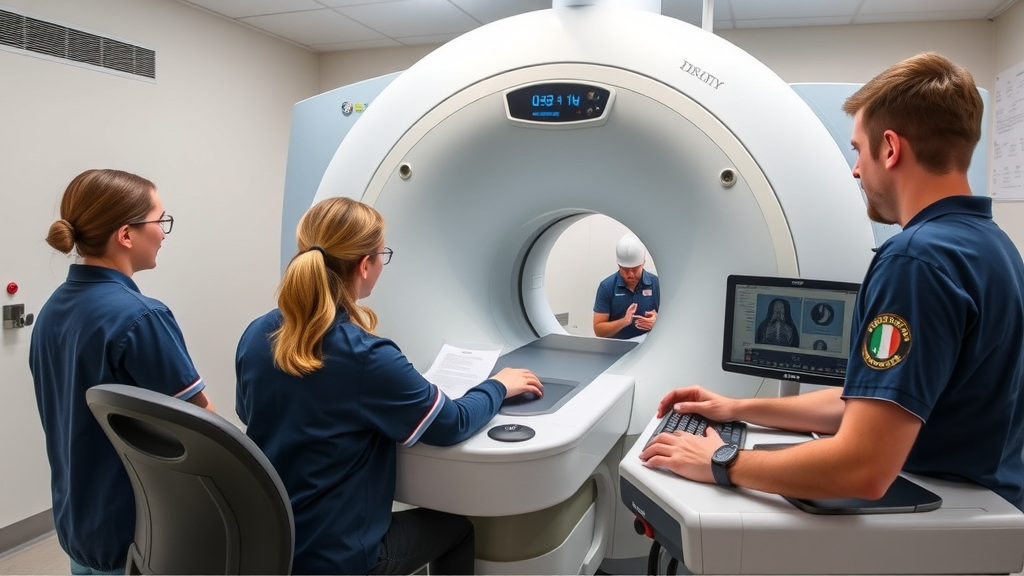
Magnetic resonance imaging has become one of the fastest-growing pillars of modern diagnostic medicine, yet for most undergraduate medical radiation science students the technology remains something they study through textbooks and simulations rather than touch. A team of Australian researchers and clinicians has now tested a way to close that gap. In a study published in BMC Medical Education, Rachel C. McNally of Curtin University and colleagues implemented and evaluated a hands-on MRI learning program built specifically for students in a four-year undergraduate medical radiation science course in Western Australia, with an eye toward rolling the program out across the entire course in the future.
The rationale behind the work is straightforward. Advances in MRI technology, an expanding range of clinical applications, and steadily reduced scan times have driven up demand for MRI services around the world. That demand translates directly into pressure on the workforce: graduates are increasingly expected to arrive with genuine MRI competence, not merely a theoretical appreciation of what the modality can do. Undergraduate MRI education, the authors argue, must therefore be effective enough to meet evolving workforce needs safely and competently. Yet access to real scanners is expensive and logistically difficult, which is why structured, evaluated programs like this one matter.
The program itself was a revision of an earlier pilot study, and its structure reveals a deliberate pedagogical design. It comprised two parts. Part 1 consisted of two weeks of pre-reading, allowing students to build a conceptual foundation in MRI physics, instrumentation, and safety before they ever entered the scanner room. Part 2 was a five-day hands-on learning component spread across two consecutive calendar weeks, during which every participant personally performed MRI scanning. The target audience was students who had already completed the second-year instrumentation subjects of the course, ensuring they arrived with the technical grounding needed to make the practical experience meaningful rather than overwhelming.
The setting was as authentic as it gets in Australian research imaging. The program ran at the research MRI scanning facility of the Western Australia node of the National Imaging Facility, a national collaborative research infrastructure capability hosted at the Centre for Microscopy, Characterisation and Analysis at The University of Western Australia. Supervision during scanning was provided by MRI radiographers from Perth Radiological Clinic, and the delivery was supported by Siemens Healthcare. The program also earned recognition through the Curtin Extra co-curricular program, signaling that the university formally acknowledged the additional skills students were developing outside their standard curriculum.
Evaluation relied on two complementary instruments. Participants completed pre- and post-program questionnaires capturing their self-perceived competence, alongside revised 38-item MRI knowledge tests administered before and after the program. The knowledge test preserved the same broad content domains and scoring approach as the pilot-study instrument, which had previously demonstrated acceptable internal consistency, with a Cronbach’s alpha of 0.79, and convergent validity, reflected in a Pearson correlation of 0.40. On the analysis side, the team used descriptive statistics for the questionnaire and test data, Wilcoxon signed-rank tests to assess changes in self-perceived competence, paired t-tests for knowledge test performance, and an independent samples t-test to compare mean test score changes against the pilot study.
The results, though drawn from a small cohort of eight enrolled students, were striking. Self-perceived MRI competence rose significantly from a mean of 2.63 to 3.13 on the program scale, a change reaching statistical significance at p = 0.046. More dramatically, overall MRI knowledge test performance climbed from 39.15 percent to 57.24 percent, a highly significant improvement with p = 0.002. The effect size for that knowledge gain was very large, Cohen’s d = 1.73, although the authors were careful to note that the wide 95 percent confidence interval, spanning 0.58 to 2.83, indicated substantial uncertainty about the true magnitude of the effect when the sample is this small.
Student perceptions of the program itself were overwhelmingly positive. Participants rated all aspects of the experience at 4.13 or higher on a five-point scale, with the sole exception of the supervision item. That item used a different response scale and returned a mean rating of 3.13, which the authors interpreted as supervision sitting close to the intended ideal of a perfect setting, in which students are watched and supported without being crowded or constrained. For a program that asks undergraduates to operate a research-grade MRI scanner, that balance between safety oversight and hands-on autonomy appears to have landed almost exactly where the designers hoped.
One of the more intriguing comparisons came from benchmarking the revised program against its pilot predecessor. The mean improvement in knowledge test scores in this study was 18.09 percent, which did not differ significantly from the 27.85 percent improvement observed in the pilot study, with the comparison yielding p = 0.139. The difference in means is notable on its face, but with eight participants the study was never powered to detect moderate differences between programs, and the authors appropriately declined to read too much into the gap. What the comparison does suggest is that the revised format, with its structured pre-reading phase and compressed hands-on week, sustained a meaningful learning trajectory rather than undermining the gains of the original design.
The authors are equally candid about the limits of what can be concluded. Because the study did not include a concurrent control group, the observed increases in competence and knowledge cannot be causally attributed to the program or to any individual program component. Students may have improved simply through repetition of testing, maturation, or the motivational effect of being selected for a voluntary enrichment activity. The findings, they write, provide further information for planning and evaluating future course-wide implementation but do not establish its feasibility. The suitability, scalability, resource requirements, safety, and effectiveness of compulsory course-wide delivery will require evaluation in larger studies using controlled designs.
Those caveats are a reminder of how science education research often has to proceed: small, voluntary, carefully instrumented pilots first, scaled implementation later, if and when the evidence justifies it. The study was retrospectively registered with the Australian New Zealand Clinical Trials Registry under ACTRN12626000824369, received ethics approval from the Curtin University Human Research Ethics Committee, and involved no external funding, with clinical supervision donated by working radiographers and technical support from an industry partner. Whether or not hands-on MRI training eventually becomes a compulsory element of every Australian medical radiation science degree, this study offers a concrete template: two weeks of disciplined pre-reading, five days at a real scanner console, validated knowledge testing before and after, and honest statistical reporting. For the eight students who got to drive one of medicine’s most powerful imaging machines themselves, the transformation in confidence and knowledge was measurable, significant, and, in the language of effect sizes, very large indeed.
Subject of Research: Hands-on MRI education for undergraduate medical radiation science students in Australia
Article Title: Hands‑on magnetic resonance imaging learning program for future course‑wide implementation in an undergraduate medical radiation science course in Australia
Article References: McNally, R. C., Parizel, P. M., Sun, Z., Vos, S. B., Moradi, H., Dickson, R., & Ng, C. K. C. (2026). Hands‑on magnetic resonance imaging learning program for future course‑wide implementation in an undergraduate medical radiation science course in Australia. BMC Medical Education. https://doi.org/10.1186/s12909-026-10490-6
Image Credits: AI Generated
DOI: 10.1186/s12909-026-10490-6
Keywords: magnetic resonance imaging, medical radiation science, medical education, hands-on learning, undergraduate training, MRI competence, Curtin University, National Imaging Facility, knowledge testing, radiography education, Australia, curriculum implementation
Cite Scienmag News
Courtney Benton. (September 26, 2026). Students Take the Controls of a Real MRI Scanner in Hands-On Australian Training Program. Scienmag. https://scienmag.com/students-take-the-controls-of-a-real-mri-scanner-in-hands-on-australian-training-program/
Courtney Benton. "Students Take the Controls of a Real MRI Scanner in Hands-On Australian Training Program." Scienmag, 26 September 2026, https://scienmag.com/students-take-the-controls-of-a-real-mri-scanner-in-hands-on-australian-training-program/. Accessed 4 October 2026.
Courtney Benton. "Students Take the Controls of a Real MRI Scanner in Hands-On Australian Training Program." Scienmag. September 26, 2026. https://scienmag.com/students-take-the-controls-of-a-real-mri-scanner-in-hands-on-australian-training-program/


