

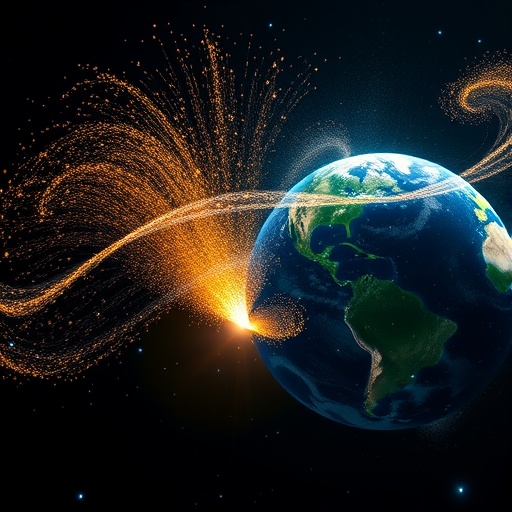
In a groundbreaking experiment in the realm of astrophysics, a PhD candidate named Linda Losurdo at the University of Sydney has successfully recreated a tiny piece of the universe within her laboratory confines, generating cosmic dust from fundamental gaseous components. This remarkable achievement, which leverages common gases to simulate the extreme conditions surrounding celestial bodies such as stars and supernova remnants, holds significant implications for our understanding of the molecular origins of life pre-dating Earth.
Losurdo’s work emerges from the School of Physics, where, through a meticulously controlled laboratory setup, she delves into the mysteries surrounding organic chemistry in space. By mixing nitrogen, carbon dioxide, and acetylene—three seemingly mundane gases—Losurdo is able to mimic the harsh and dynamic environments prevalent in the cosmos. This method allows her to explore the complex chemistry that underpins the formation of carbon-rich materials found throughout interstellar space and within cosmic structures like comets and asteroids.
The unique synthesis of cosmic dust is achieved by subjecting these carefully selected gases to an intense discharge of electrical energy, equivalent to around 10,000 volts. This formidable energy input propels the gases into a state of plasma—a key step in breaking molecular bonds and facilitating the recombination of atoms into more intricate structures. The output, a layer of carbonaceous dust, settles onto silicon chips within the glass tubes of the experimental apparatus, visually resembling sparkling cosmic material akin to that found in outer space.
One of the most significant aspects of Losurdo’s findings is the chemical complexity inherent in the produced dust, encompassing a rich blend of carbon, hydrogen, oxygen, and nitrogen. This constellation of elements, collectively referred to as CHON molecules, is fundamental to the formation of organic compounds and is thought to be pivotal for the genesis of life. Through her experimental setup, Losurdo posits that we no longer need to await the arrival of extraterrestrial materials such as meteorites and comets to gain insights into the histories of these celestial objects; instead, analogous environments can be built within the laboratory.
The intricacies of cosmic dust formation raise one of science’s most enigmatic questions: How did life originate on Earth? There exists an ongoing discourse among researchers regarding the origins of the earliest organic molecules, with hypotheses suggesting they formed either locally on the young Earth or arrived from off-planet sources during pivotal periods in solar system development. The bombardment of Earth by cometary and meteoritic material, particularly between 3.5 to 4.56 billion years ago, is theorized to have delivered an abundance of organic material to our planet’s surface. However, pinpointing the precise origins of these organic compounds remains elusive.
In her study, Losurdo emphasizes the importance of understanding the specific chemical pathways and conditions that lead to the incorporation of CHON elements into the complex structures of cosmic dust and meteorites. This line of inquiry not only sheds light on the fundamental processes that may have contributed to the emergence of life but also complements our comprehension of the environments within stars, where similar formative processes likely occur.
Losurdo’s technique of simulating cosmic environments further enables scientists to investigate conditions that otherwise would be inaccessible for direct study. By creating a controlled laboratory environment, the researchers can enthusiastically explore the impact of ion bombardment and high temperatures, both critical factors that govern the chemical reactions taking place within cosmic dust clouds. Such investigations equip scientists with the tools needed to decode the chemical signatures left behind by meteoritic and asteroidal fragments, effectively unraveling their extensive journeys through the cosmos.
Moreover, the establishment of a comprehensive library of infrared fingerprints derived from this laboratory-made cosmic dust will serve as an invaluable resource for astronomers. This database can inform observational studies in various stellar nurseries and the remnants of deceased stars, enhancing our understanding of the events and processes that shape the interstellar chemistry necessary for life’s potential emergence.
The profound implications of this research extend beyond the realms of academic inquiry into the origins of life; they touch upon fundamental questions regarding our existence and the characteristics of the universe. By recreating cosmic environments conducive to complex organic chemistry in a terrestrial setting, Losurdo and her team not only push the boundaries of experimental astrophysics but also open a new chapter in our understanding of life’s potential to arise throughout the cosmos.
Thus, as we venture further into the mysteries of the universe, Linda Losurdo’s innovative approach in the laboratory illustrates the capacity of human ingenuity to unlock the secrets of our origin. Her work stands as a testament to how science continues to push boundaries, providing insights that may ultimately redefine our place in the cosmos. With each experiment, Losurdo moves us one step closer to unraveling the intricate tapestry of cosmic evolution and the foundational processes that may have given rise to life itself.
Subject of Research: The synthesis of carbonaceous cosmic dust in laboratory conditions to study its chemical composition and implications for the origins of life.
Article Title: Carbonaceous cosmic dust analogues distinguish between ion bombardment and temperature.
News Publication Date: 30-Jan-2026.
Web References: The Astrophysical Journal.
References: Losurdo, L. and McKenzie, D.
Image Credits: Fiona Wolf/The University of Sydney.
Keywords
cosmic dust, organic chemistry, astrophysics, life origins, laboratory simulation, CHON molecules, plasma physics, stellar environments, meteoritic material, infrared fingerprints.


