

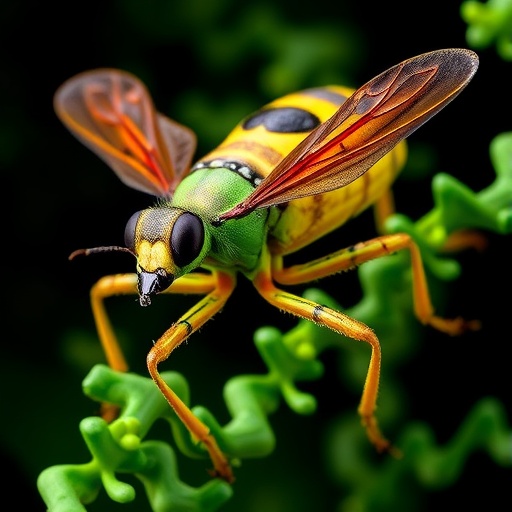
In an extraordinary leap forward in understanding the molecular underpinnings of life’s most diverse animal group, a new study has unveiled an unprecedented atlas encompassing over 13 million predicted protein structures across the insect kingdom. This groundbreaking research, recently published in Cell Research, reconstructs an extensive phylogenetic framework of nearly 5,000 insect species representing every order, allowing scientists to peer into the intricate relationships between protein sequences, structures, and functions at an unparalleled scale. The findings stand poised to revolutionize evolutionary biology and deepen our grasp of protein functionality across the vast and varied insect tree of life.
Proteins serve as the fundamental machinery behind virtually all biological processes, translating genetic code into functional molecules capable of executing complex tasks. Traditionally, understanding protein function has relied heavily on sequence similarity; however, sequence alone often fails to illuminate deeper functional relationships, especially among distantly related species where sequences have diverged substantially. Here, the research team exploited advancements in structural genomics to bridge this gap, unveiling a comprehensive structural landscape underpinning insect biodiversity.
Central to the study was the reconstruction of a highly resolved phylogenetic tree comprising 4,854 insect species. Spanning all extant orders, this phylogeny acts as a scaffold for subsequent structural analyses, enabling evolutionary insights that incorporate lineage-specific diversifications. The team meticulously curated representative species to generate a massive dataset of 13.29 million protein structure predictions, an achievement unprecedented in scale and scope. Remarkably, 11.63 million of these structures were newly predicted for this study, highlighting the magnitude of previously uncharted molecular territory.
Beyond sheer numbers, the research underscores the power of structure-based clustering approaches. By focusing on three-dimensional conformations rather than linear sequence similarities, the investigators illuminated functional relationships obscured by extensive sequence divergence. Proteins displaying divergent sequences yet maintaining homologous structural architectures were effectively grouped, enabling a fresh perspective on protein families and their evolutionary trajectories. This structural convergence approach facilitated the annotation of an astonishing 7.61 million insect proteins, significantly expanding the functional catalog, including identifying functions for nearly 14% of proteins that had remained previously uncharacterized.
The strategic use of known proteins with well-characterized functions served as queries for structural similarity searches throughout the insect protein universe. This tactic bridged a critical gap in functional genomics, especially given the frequent inadequacy of sequence-based annotation for diverse and rapidly evolving insect proteins. The elucidation of nearly three-quarters of a billion “remote homologs” — proteins related by structure but showing scant sequence similarity— speaks volumes to the extent of undiscovered functional diversity maintained by evolutionary pressures.
One of the study’s most compelling revelations revolves around the cGAS-like receptors (cGLRs), a family integral to innate immunity and antiviral defenses. Despite the vast sequence divergence over hundreds of millions of years of insect evolution, these receptors retained striking structural conservation across all 824 representative insects included in the atlas. This finding not only highlights the power of structural genomics to uncover functionally critical proteins missed by sequence analyses alone, but also hints at deeply conserved molecular mechanisms underlying immune defense across insects.
Functional assays provided concrete experimental validation by demonstrating that these structurally defined cGLRs actively participate in antiviral signaling pathways in the yellow fever mosquito, a notorious vector of viral pathogens affecting human populations. This discovery opens exciting possibilities for vector biology and vector control strategies, potentially unveiling new molecular targets to disrupt pathogen transmission by mosquitoes. Importantly, it underscores how structural studies can translate into mechanistic insights with real-world biomedical implications.
Taken together, the integration of large-scale phylogenetic reconstruction with structural predictions marks a transformative shift in molecular biology. Rather than relying solely on traditional sequence comparisons, this framework leverages three-dimensional protein landscapes to chart evolutionary and functional relationships crossing vast biological timescales. It brings to light the evolutionary persistence of crucial protein structures that transcend the limitations imposed by sequence evolution.
The research team’s contributions not only fill significant gaps in our understanding of insect biology but considerably advance the field of structural genomics. By providing an open, richly annotated protein structure atlas, future studies across diverse disciplines—from entomology to immunology and evolutionary biology—stand to gain unprecedented access to molecular blueprints bridging genotype and phenotype.
Moreover, the study’s methodological innovations illustrate the growing importance of integrating computational predictions with experimental validation. The vast majority of this structural atlas was inferred through cutting-edge computational algorithms, yet the concrete experimental verification of cGLRs establishes a model for translating structural annotations into biological functions. This synergy between in silico and in vivo investigations augurs well for accelerated discoveries.
It is also notable that this work highlights insects: not merely as subjects of ecological or agricultural concern, but as molecular troves harboring evolutionary secrets encoded in protein architectures. The staggering diversity of insect species, coupled with their varied ecological niches, suggests a treasure trove of unique proteins shaped by natural selection to fulfill specialized roles. Mining this diversity through the lens of structural genomics opens pathways to novel biomolecules with potential biotechnological applications.
In a broader biological context, such comprehensive structural explorations redefine the concept of homology. Where sequences falter in illuminating distant evolutionary relationships, structural conservation emerges as a robust criterion. This advance has profound implications for annotating unknown proteins across myriad species, potentially unraveling the molecular fabric of life’s tree far beyond insects.
As computational power and protein structure prediction methods continue improving, future iterations of such atlases may expand to other taxa, integrating functional genomics data, transcriptomics, and metabolomics to contextualize structural data within entire biological systems. The landscape painted by this pioneering research sets a new benchmark, showcasing how big data, phylogenetics, and structural biology can converge to shine light on the origins and workings of life’s most complex molecular machines.
This study stands as a testament to the transformative potential of structural genomics in unraveling nature’s molecular secrets. By unveiling an expansive protein structure atlas aligned with insect evolutionary history, it provides a cornerstone for exploring protein function, evolution, and diversity across the most species-rich animal lineage on the planet. With such profound implications for basic biology and applied sciences alike, this research heralds a new era in which three-dimensional structures unlock the mysteries hidden within the genomes of life’s myriad forms.
Subject of Research: Protein structure and function relationships across insect biodiversity.
Article Title: Structural genomics sheds light on protein functions and remote homologs across the insect tree of life.
Article References:
Wu, W., Cui, C., Zhu, Y. et al. Structural genomics sheds light on protein functions and remote homologs across the insect tree of life. Cell Res (2026). https://doi.org/10.1038/s41422-026-01220-0
Image Credits: AI Generated


