

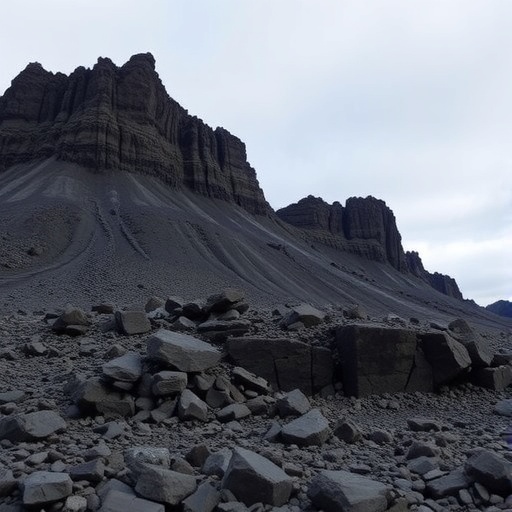
In recent years, there has been a growing recognition of the urgent need to address climate change, prompting researchers to explore innovative solutions for carbon sequestration. Among the most promising avenues for carbon dioxide capture and storage is the use of basalt formations, which are rich in minerals that can chemically react with CO2. A groundbreaking study conducted by Polteau et al. has uncovered the potential of well-connected basalt sequences to serve as effective reservoirs for large-scale carbon storage. This research, soon to be published in Communications Earth & Environment, utilizes strontium isotopes to evaluate the viability of these geological formations for carbon sequestration.
The research team’s analysis centers around basalt sequences that exhibit interconnectivity, which is critical for ensuring that the captured CO2 can be effectively injected and stored in the subsurface. By focusing on these well-connected basalt structures, the scientists have taken strides toward understanding the unique properties that make these formations suitable for long-term carbon storage. The implications are significant, considering the geological footprint of basalt covers a substantial portion of the Earth’s surface.
Utilizing strontium isotopes allowed the researchers to trace fluid movements within basalt sequences, providing insights into their permeability and porosity. This isotopic analysis empowers scientists to assess how well these basalt formations can retain CO2 over extended periods, which is vital for any carbon sequestration initiative aiming to mitigate climate change effectively. The precision of isotope analysis also offers a robust framework for evaluating the past and present migration paths of fluids through geological formations.
The findings indicate that certain basalt formations possess adequate characteristics to accommodate large volumes of injected CO2 without risking leakage. The high reactivity of basalt with CO2, combined with the geological integrity of these reservoirs, positions them as prime candidates for carbon sequestration projects. The study suggests that harnessing these formations may lead to a significant reduction of atmospheric carbon dioxide, ultimately aiding in global efforts to combat climate change.
One remarkable aspect of this research is the comprehensive approach that combines geochemical analysis, geological modeling, and advanced isotope techniques. The interdisciplinary nature of the study highlights the collaborative effort among geologists, chemists, and climate scientists, each contributing expertise to tackle the complexities of carbon capture and storage. This exceptional teamwork is crucial in generating well-rounded solutions that can be practically applied in real-world scenarios.
As policymakers and industry stakeholders seek solutions to reduce emissions, the study’s conclusions offer vital data that can guide strategic decisions. By illuminating the potential of utilizing basalt formations for carbon storage, this research could lead to the development of several large-scale projects aimed at mitigating greenhouse gas emissions from industrial sources. The utilization of strontium isotopes not only enhances our understanding of geological processes but also instills confidence that carbon sequestration can become a standardized practice.
While significant progress is being made in the field of carbon sequestration, challenges remain. Ensuring the safety and long-term integrity of CO2 storage sites is paramount. The novel findings from Polteau et al. provide a foundation for future research that can further validate the effectiveness of basalt formations. Investigating various types of basalt and their unique mineral compositions could unveil even more effective sequestration strategies, bolstering the argument for widespread adoption of these methods.
The timing of this research cannot be overlooked, as the world grapples with the pressing realities of climate change. As nations strive to meet stringent emissions targets set by international agreements, leveraging geological formations for carbon storage is becoming a focal point for many governments. The study reinforces the notion that utilizing existing geological features allows for a more immediate application of carbon capture strategies.
Moreover, the potential for basalt formations to serve as reservoirs for carbon storage dovetails with the broader goals of achieving sustainable development. The integration of carbon capture technologies into existing industrial processes not only promises to reduce emissions but also allows industries to continue operating while adhering to environmental regulations. The findings encourage a paradigm shift where economic growth and environmental sustainability can coexist.
In conclusion, the research conducted by Polteau et al. shines a light on the significant opportunities presented by well-connected basalt sequences as potential reservoirs for carbon sequestration. Through the advanced use of strontium isotopes, the study lays the groundwork for future developments in carbon capture technologies, making a substantial contribution to ongoing efforts to combat climate change. As the world looks for sustainable solutions to reduce atmospheric carbon, this innovative approach offers a glimmer of hope in the fight against global warming, reinforcing the urgency to implement these findings before it’s too late.
The pathway forward will require both public and private sectors to collaborate closely, as they work to establish frameworks that ensure the responsible development of carbon sequestration projects. Furthermore, continuous research and innovation in this domain will be essential to navigate potential hurdles and implement effective strategies for the geological storage of CO2 on a global scale.
In summary, this landmark research provides critical insights into the capabilities of basalt formations in carbon sequestration, aligning scientific inquiry with pressing environmental needs. Moving forward, the realms of geology, environmental science, and policy must closely intertwine to translate this evidence-based research into actionable strategies, solidifying the role of basalt reservoirs as pivotal components in addressing climate change.
Subject of Research: Carbon sequestration in basalt formations using strontium isotopes
Article Title: Well-connected basalt sequences as potential reservoirs for large-scale carbon sequestration revealed by strontium isotopes
Article References:
Polteau, S., Craig Smalley, P., Devegowda, V.N. et al. Well-connected basalt sequences as potential reservoirs for large-scale carbon sequestration revealed by strontium isotopes.
Commun Earth Environ 7, 33 (2026). https://doi.org/10.1038/s43247-025-03020-7
Image Credits: AI Generated
DOI: https://doi.org/10.1038/s43247-025-03020-7
Keywords: Carbon sequestration, basalt formations, strontium isotopes, climate change, geological storage, emissions reduction.


