


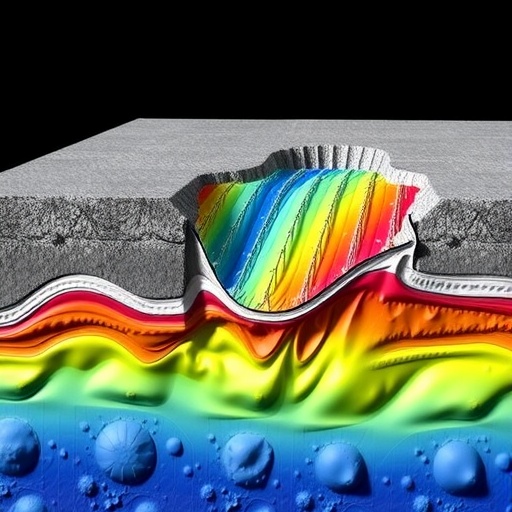
In a groundbreaking study that illuminates the mysteries lurking deep beneath Earth’s surface, researchers have uncovered intricate stress patterns within exhumed high-pressure rocks, revealing critical insights about the transient coupling mechanisms operating along deep subduction zone interfaces. These findings, reported in Nature Communications, are poised to significantly advance our understanding of how tectonic plates interact under extreme conditions, potentially reshaping our models of seismic risk and deep Earth dynamics.
Subduction zones, where one tectonic plate is forced beneath another and plunges into the mantle, are some of the planet’s most complex and volatile geological boundaries. The interface between the subducting and overriding plates can exhibit highly variable mechanical behavior, with periods of locking that store vast amounts of strain energy, interspersed with episodes of slow slip or rapid seismic rupture. Characterizing the transient coupling mechanisms that modulate this behavior has remained a formidable challenge, especially given the inaccessibility of these deep environments.
The innovative approach adopted by the research team involved detailed petrostructural analysis of high-pressure metamorphic rocks that have been exhumed from depths corresponding to conditions found along the plate interface during subduction. These rocks preserve a record of the stress states produced by tectonic forces during burial and uplift. By analyzing the heterogeneities in stress and deformation recorded in these natural archives, the investigators could infer the dynamics of stress accumulation and release in the deep subduction interface.
Their results reveal a complex mosaic of stress concentrations and heterogeneities within the rocks, indicative of spatially and temporally varying coupling between subducting and overriding plates. Contrary to previous assumptions of relatively uniform stress distribution, the study found that transient coupling occurs heterogeneously, with localized zones of high stress interspersed with regions exhibiting stress relaxations. This heterogeneous stress landscape suggests that the deep interface behaves more dynamically than previously recognized, with coupling strength fluctuating over short distances and timescales.
Such complexity in stress distribution at depth has profound implications for earthquake genesis and rupture propagation. Areas of heightened stress concentration are potential nucleation points for seismic events, while adjacent regions of lower stress may act as barriers that arrest rupture or facilitate slow slip episodes. Therefore, the identification of these stress heterogeneities could improve seismic hazard models by accounting for localized variations in coupling strength that influence earthquake behavior in subduction environments.
Moreover, the study’s findings lend strong support to transient coupling models wherein the interface is neither perfectly locked nor entirely slipping but cycles through states of partial coupling. This dynamic state provides a framework to explain the episodic nature of certain slow slip events and tremor phenomena observed in modern subduction zones, bridging a crucial gap between geological records and geophysical observations.
The multidisciplinary techniques employed, combining microstructural mapping, stress inversion, and metamorphic petrology, represent a significant methodological advancement. By integrating geological field data with high-resolution analytical techniques, the team could reconstruct the paleo-stress fields with unprecedented detail, enabling robust interpretations of the mechanical conditions prevailing during subduction and exhumation.
Additionally, the study opens avenues for exploring how fluid presence, mineralogical transformations, and temperature gradients influence the mechanical heterogeneities of the subduction interface. Fluids released from devolatilization reactions at depth can weaken mineral contacts and thus modulate coupling, potentially creating zones of enhanced slip. Understanding these interactions is vital for linking petrological processes with tectonic mechanics.
The nuanced picture of transient and heterogeneous coupling uncovered by this research also contributes to our comprehension of orogenic processes and mountain building. The deformation recorded in high-pressure rocks reflects not only seismic events but also the broader tectonic forces shaping continental margins. These insights enrich our knowledge of how large-scale tectonic motions translate into localized mechanical responses within the crust and mantle wedges.
Critically, the exhumation of these high-pressure rocks serves as a natural laboratory, offering a rare glimpse into in situ stress conditions that are otherwise inaccessible. This empirical evidence complements numerical models that strive to simulate subduction behavior, providing essential constraints that refine our theoretical frameworks.
Beyond academic interest, the implications of this work resonate with societal concerns regarding earthquake preparedness. Improved models of subduction zone coupling help refine forecasts of seismic activity and inform hazard mitigation strategies in regions prone to devastating earthquakes and tsunamis.
In summary, this landmark study elucidates the dynamic and spatially heterogeneous nature of stress distribution along deep subduction interfaces, highlighting the transient coupling mechanisms that govern seismic behavior. By unlocking the geological record locked within exhumed high-pressure rocks, the researchers pioneer a path toward more accurate and nuanced understanding of Earth’s deep tectonic processes, with far-reaching consequences for geoscience and public safety alike.
This research exemplifies the power of integrating field geology, laboratory techniques, and theoretical modeling to tackle some of the most challenging questions in Earth sciences. As subduction zones continue to be focal points of tectonic activity and natural hazards, studies of this caliber are invaluable for advancing both fundamental knowledge and practical applications.
As investigations progress, future work will likely delve deeper into the temporal evolution of stress heterogeneities during subduction, the interplay with fluid flow and metamorphic reactions, and the connections to observed seismic phenomena. Such comprehensive efforts will be essential to fully decode the intricate mechanical orchestra that plays out beneath our feet.
This study stands as a vivid reminder that the Earth’s interior, despite being obscured from direct observation, records its history in the rocks it returns to the surface. Careful deciphering of these records offers profound insights into the forces shaping our planet, demonstrating once again that the deep Earth holds many keys to understanding its dynamic and often unpredictable behavior.
Cite Scienmag News
Violet Maxwell. (October 14, 2025). Stress Variations Reveal Deep Subduction Interface Dynamics. Scienmag. https://scienmag.com/stress-variations-reveal-deep-subduction-interface-dynamics/
Violet Maxwell. "Stress Variations Reveal Deep Subduction Interface Dynamics." Scienmag, 14 October 2025, https://scienmag.com/stress-variations-reveal-deep-subduction-interface-dynamics/. Accessed 5 September 2026.
Violet Maxwell. "Stress Variations Reveal Deep Subduction Interface Dynamics." Scienmag. October 14, 2025. https://scienmag.com/stress-variations-reveal-deep-subduction-interface-dynamics/


