


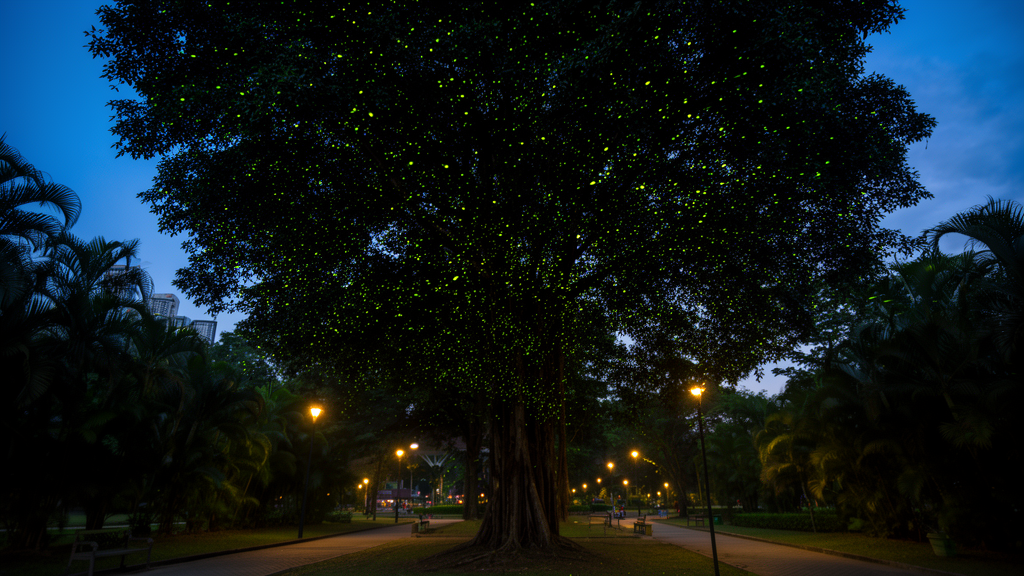
Fireflies are among nature’s most enchanting messengers, using bursts of bioluminescence to find mates in the dark. Yet across the world’s cities, that darkness is disappearing. A new field study conducted in Bukit Kiara, an urban park in Kuala Lumpur, Malaysia, offers some of the first empirical evidence that tree canopy cover can act as a functional dark refuge for fireflies living under light-polluted skies. The research, published in the journal One Ecosystem, quantifies for the first time in a Southeast Asian urban park how artificial lights at night and overhead vegetation jointly shape firefly abundance, and the numbers are striking: every additional streetlight along a 100 metre stretch of trail was associated with a 36.7 percent drop in expected firefly counts, while a modest increase in canopy cover boosted counts by 75.1 percent.
Artificial light at night, often abbreviated as ALAN, is a rapidly growing form of pollution. It takes two main forms: direct illumination from nearby fixtures with a short optical path, and skyglow, the diffuse haze created when upwelling artificial light scatters through the atmosphere. Skyglow is remarkably far-reaching, with measurable effects extending hundreds of kilometres from its source. For organisms that rely on light as a source of information about location, time and surroundings, this alteration of natural light regimes amounts to misinformation, and the consequences ripple through behaviour, reproduction and survival. Fireflies are particularly vulnerable because their entire mating system depends on bioluminescent signals that must be visible against a dark background.
Despite decades of evidence that artificial light disrupts firefly courtship, reduces mating success and drives population declines, fireflies continue to persist in brightly lit cities such as Kuala Lumpur, Morelia and Turin. This paradox presents a genuine puzzle for ecologists. If artificial light is so harmful, how do these small, limited-mobility insects survive in urban environments? One possibility is that certain environmental features, particularly dense vegetation, buffer the impact of light pollution by creating localised patches of darkness. Conservation guidelines have long recommended planting trees as light buffers, but until now this recommendation had received almost no direct testing in the field, and never before in an urban park setting in Southeast Asia, where rapid urbanisation is squeezing the region’s remaining firefly habitats.
The research team selected Bukit Kiara, a 466 hectare former rubber plantation that has been rehabilitated into secondary forest, wedged between two major residential and commercial townships and bordered by primary roads. A paved tarmac road runs through the park, lined with streetlights along its entire length, while forest trails branch off into relatively undeveloped vegetation. Nine firefly species have been documented at the site following the recent rediscovery of Pteroptyx gombakia, including two glow-worm species, three dark fireflies and four roving flashing fireflies. The streetlights along the tarmac road emitted an average intensity of 80.69 lux with an effective range of about 18 metres, and spectral measurements revealed peaks not only in the red part of the spectrum at 641 nanometres but also at shorter blue wavelengths of 424 and 472 nanometres.
Between November 2023 and April 2024, the researchers carried out extensive night surveys using a modified Pollard walk method, recording every firefly observed within a 15 by 15 metre boundary and marking its position with a handheld GPS device. The tarmac road was divided into 21 transects of 100 metres each and surveyed over 31 nights, with the number of functional streetlights per transect and the distance of each firefly sighting to the nearest streetlight carefully logged. Across the wider trail network, canopy cover was measured every 25 metres from upward-facing photographs processed in ImageJ, yielding 154 canopy cover points sampled over 39 nights. In total, the lighting analysis drew on 380 observations, while the canopy analysis encompassed 1,644 observations, a substantial dataset for a taxon that is notoriously difficult to survey.
The statistical approach was as rigorous as the fieldwork. The team fitted negative binomial generalised mixed models, a class of models well suited to count data in which the variance exceeds the mean, which was clearly the case here given that roughly 70 percent of observations recorded zero fireflies. For the streetlight analysis, transect identity and survey date were included as random intercepts to account for unmeasured site differences and nightly variation in weather, temperature and lunar phase. The canopy model added trail identity and canopy cover point nested within trail as further random effects. Model fit was verified with 1,000 simulated residuals, and diagnostics showed no evidence of overdispersion or zero-inflation in either model, lending confidence to the reported effect sizes.
The results painted a consistent picture. Ambient light intensity at firefly sighting locations ranged from 0.01 to 73.40 lux, but the mean was a mere 0.58 lux, indicating that the overwhelming majority of fireflies were active under very low light conditions. The model revealed a statistically significant negative association between streetlight density and firefly abundance, with each additional streetlight within a transect reducing the expected count by 36.7 percent. A Spearman rank correlation further showed that fireflies were observed more often at locations further from the nearest streetlight, though the correlation was weak, suggesting that distance from a lamp is not the only factor at play. On the canopy side, firefly counts rose by 75.1 percent for every 18.7 percent increase in canopy cover, the standard deviation of cover across sampled points, which ranged from 26.5 to 98.8 percent.
The weak distance correlation is itself scientifically interesting. Greater distance from a streetlight does not necessarily mean lower ambient light, because vegetation and built structures can shield certain areas from illumination. Indeed, most fireflies were recorded at very low light levels regardless of distance, hinting that microhabitat features mediate actual light exposure. There may also be a degree of light tolerance among some species and life stages. Intriguingly, prior work on Lamprigera fireflies, a genus present at Bukit Kiara, found that adult males are attracted to red and warm-white wavelengths, which would predict more fireflies near the lamps rather than fewer. The mixed spectral output of the Bukit Kiara streetlights, combining an attractive red peak with potentially deterrent blue peaks, may produce conflicting behavioural responses across species and life stages, dampening the overall pattern.
The researchers are careful to note that the reduced abundance near lights could stem from behavioural avoidance or from physiological consequences such as reduced activity, decreased mating and disrupted bioluminescent signalling. Some larvae and female glow-worms become immobilised when exposed to artificial light rather than fleeing it, an arguably maladaptive response, while adult fireflies can flash more brightly under illumination and appear to select brighter signals. Whatever the mechanism, the practical implication is the same: more streetlights mean less usable habitat. Reducing the number of lights in urban parks, or positioning them away from firefly habitat, would preserve a greater extent of dark, active space for these insects.
The canopy findings translate directly into management advice. Canopy cover is known to dampen the brightening effects of skyglow and bright moonlight, both of which have been shown to harm firefly populations, and the strong positive association found here suggests that overhead vegetation and artificial light may not act as fully independent drivers of abundance. Retaining trees and maintaining connectivity of canopy, especially in areas exposed to nearby lighting, may be a practical way to protect dark refuges within city parks. The authors caution that their study was conducted in a single park, did not resolve firefly observations to species level, and did not measure finer vegetation features such as understorey density or leaf litter depth, nor lunar phase. Even so, the broader principle that tree canopy can buffer light pollution offers a hopeful and testable blueprint for conserving fireflies, and likely other light-sensitive nocturnal insects, in the world’s increasingly illuminated green spaces.
Subject of Research: Effects of artificial light at night and canopy cover on urban firefly populations
Article Title: Dual forces at play: how artificial light and canopy cover affect firefly populations in an urban park
Article References: Muharraran, F., Tan, W. J., Foo, R., & Jusoh, W. F. A. (2026). Dual forces at play: how artificial light and canopy cover affect firefly populations in an urban park. One Ecosystem, 11, Article e193276. https://doi.org/10.3897/oneeco.11.e193276
Image Credits: AI Generated
DOI: 10.3897/oneeco.11.e193276
Keywords: fireflies, light pollution, ALAN, canopy cover, urban ecology, bioluminescence, Kuala Lumpur, streetlights, conservation, negative binomial GLMM, dark refuges, urban parks
Cite Scienmag News
Gavin Prescott. (October 15, 2026). Streetlights dim the glow, but tree canopy gives fireflies a refuge in a Kuala Lumpur park. Scienmag. https://scienmag.com/streetlights-dim-the-glow-but-tree-canopy-gives-fireflies-a-refuge-in-a-kuala-lumpur-park/
Gavin Prescott. "Streetlights dim the glow, but tree canopy gives fireflies a refuge in a Kuala Lumpur park." Scienmag, 15 October 2026, https://scienmag.com/streetlights-dim-the-glow-but-tree-canopy-gives-fireflies-a-refuge-in-a-kuala-lumpur-park/. Accessed 15 October 2026.
Gavin Prescott. "Streetlights dim the glow, but tree canopy gives fireflies a refuge in a Kuala Lumpur park." Scienmag. October 15, 2026. https://scienmag.com/streetlights-dim-the-glow-but-tree-canopy-gives-fireflies-a-refuge-in-a-kuala-lumpur-park/


