

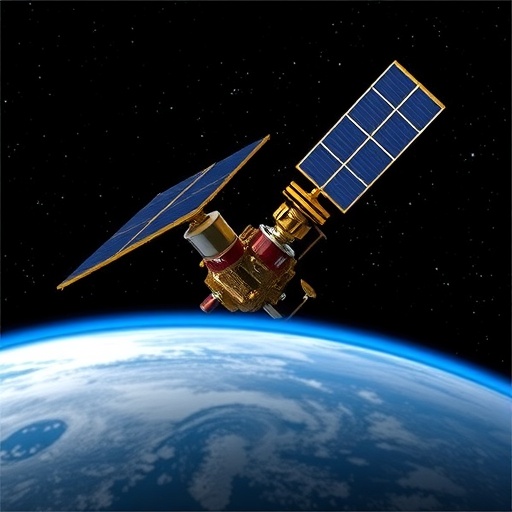
In the rapidly evolving domain of satellite technology, the demand for efficient and reliable satellite communication systems has never been more pressing. As we venture into an era characterized by increasing connectivity needs, understanding how systems respond to requests has become crucial. Recent research led by Scherberger and Schäfer presents a simplified method for predicting the system response time of satellite constellations, a breakthrough that holds significant implications for satellite operations and the telecommunications industry at large. Their study, published in the journal AS, meticulously delves into the intricate complexities of satellite constellations and their operational efficiency.
Satellite constellations, which are networks of satellites working in harmony, play a vital role in modern communications, weather monitoring, and navigation. Understanding the response time, which reflects how quickly a satellite can process and respond to incoming requests, is essential for optimizing their performance. Currently, the performance evaluation of these systems often involves complex calculations and simulations that can be time-consuming and resource-intensive. Scherberger and Schäfer’s approach, however, simplifies this process, allowing for quicker predictions with less computational overhead.
The significance of predicting response time efficiently cannot be overstated. With the proliferation of satellite networks, particularly low Earth orbit (LEO) constellations, operators must manage a vast number of satellites interacting simultaneously. An efficient response prediction can lead to improved scheduling, reduced latency, and enhanced service availability across various applications, including internet services, emergency communications, and global positioning. The researchers’ novel approach aims to make these predictions more accessible, facilitating better overall management of satellite systems.
One of the pivotal elements of their study is the formulation of a simplified mathematical model that accurately reflects the behavior of satellite constellations. Traditional models often require extensive inputs and verifications, which can lead to prolonged analysis times. In contrast, Scherberger and Schäfer’s method condenses several components into a more manageable framework that retains accuracy while allowing for rapid assessments of system performance. This breakthrough is likely to resonate with engineers and operators alike, who have been grappling with the complexities inherent in existing methodologies.
The research highlights the importance of real-time data integration, which serves as the foundation for the proposed predictive model. By harnessing data from various sources such as satellite telemetry and user interactions, the model can provide a nuanced understanding of current system performance. This data-driven approach empowers operators to make informed decisions, adapting their strategies based on real-time insights. The model not only estimates response times but also accounts for varying environmental conditions and orbital dynamics, making it a robust tool in satellite operations.
Furthermore, Scherberger and Schäfer emphasize the need for feedback loops within satellite systems. This involves continuously updating the model based on operational outcomes and changing conditions. Such iterations can improve the predictability of response times over time, ultimately leading to systems that learn and adapt more effectively. This concept of adaptive systems is gaining traction in various technological fields, and its adoption in satellite communications signifies a forward-thinking approach to engineering.
As satellite companies race to deploy their constellations, the implications of this research extend beyond mere operational efficiency. The simplified predictive method can also enhance user experience significantly. In an age where consumers expect instantaneous connectivity, any reduction in response time can lead to improved services, fostering greater satisfaction among users. Moreover, this can be particularly critical in emergency situations where timely communication is paramount. By streamlining response predictions, operators can ensure that their systems remain responsive even under heavy loads.
The commercial potential of this research is vast. Telecommunications companies and satellite service providers are likely to benefit from the implementation of Scherberger and Schäfer’s predictive model. By utilizing these insights, they can refine their service offerings, reduce operational costs, and ultimately secure a competitive edge in a saturated market. Additionally, the space industry, which is witnessing an unprecedented surge in investment and innovation, stands to gain from the broader applications of improved operational predictability.
In light of the findings, it will be essential for future research to investigate not only the theoretical aspects but also the practical applications of this simplified prediction model. Integrating the model into existing systems and evaluating its performance under real-world conditions will be critical for validation. Collaboration between academia and industry will likely play a crucial role in kicking off this next phase of development, fostering an environment conducive to innovation and growth.
As we look toward the future, the potential for improved satellite connectivity is promising. Enhanced response prediction capabilities could facilitate the expansion of various applications, including smart cities and autonomous vehicles, guiding the trend toward seamless connectivity on a global scale. This transformative potential underscores the need for ongoing collaboration and innovation in satellite communications.
Ultimately, Scherberger and Schäfer’s research delivers a compelling narrative of progress in the satellite communications arena. By offering a simplified method for predicting response times, they pave the way for a new era of efficiency and performance in satellite operations. As the hunger for connectivity grows, so does the urgency to equip satellite systems with the tools needed to thrive in a competitive landscape. This study heralds a significant step towards achieving operational excellence, ensuring that satellite constellations can meet the demands of tomorrow head-on.
In conclusion, the trajectory of satellite technology is forever altered by the insights gained through this research. As satellite constellations continue to multiply and evolve, understanding their operational metrics with accuracy and efficiency will be paramount. Scherberger and Schäfer’s work not only contributes to the academic discourse surrounding satellite technology but also serves as a catalyst for tangible improvements in the field. The implications of their findings will resonate for years to come, ushering in a new era of satellite communication defined by responsiveness, reliability, and resilience.
Subject of Research: Predicting the System Response Time of Satellite Constellations
Article Title: Simplified method for predicting the system response time of satellite constellations
Article References:
Scherberger, L., Schäfer, F. Simplified method for predicting the system response time of satellite constellations.
AS (2025). https://doi.org/10.1007/s42401-025-00420-7
Image Credits: AI Generated
DOI: 10.1007/s42401-025-00420-7
Keywords: Satellite constellations, response time, predictive modeling, telecommunications, low Earth orbit.


