

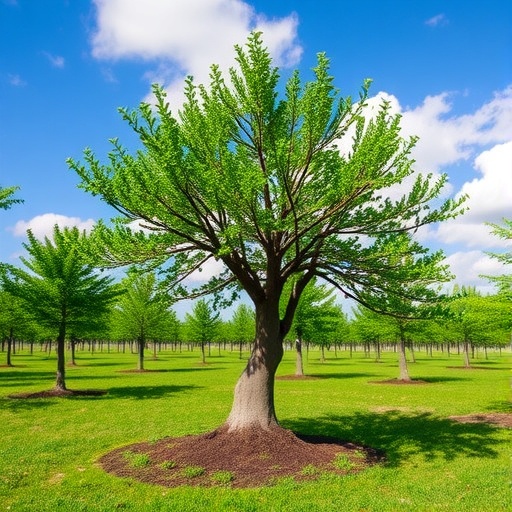
A groundbreaking new study from the University of Waterloo reveals that Canada’s boreal forest, particularly along its northern edge, holds immense untapped potential for carbon sequestration. By deploying strategic reforestation and afforestation efforts across more than six million hectares of land in this vast Taiga region, researchers estimate the possibility of removing carbon dioxide at a scale that far exceeds Canada’s annual emissions. This revelation could mark a pivotal advance in the fight against climate change, unlocking nature-based solutions that synergize with national and global carbon reduction commitments.
The research team employed sophisticated computational modeling that incorporated satellite-derived data alongside fire regime assessments, vegetation loss dynamics, and climate variables intrinsic to the boreal ecosystem. These multi-dimensional models provide more realistic and spatially explicit forecasts of carbon capture potential, distinguishing this work from prior analyses that often overlooked environmental complexities. Factoring in the realities of frequent wildfires and altered seedling survival rates, the study determined that planting roughly 6.4 million hectares could feasibly sequester approximately 3.9 gigatonnes of CO₂ by the year 2100.
Even more striking is the finding that if planting efforts are scaled up to encompass the most ecologically suitable areas, carbon removal estimates surge to nearly 19 gigatonnes. This would represent more than five times Canada’s yearly carbon emissions, underscoring the massive mitigation impact that well-targeted forest restoration could achieve. The research further highlights the importance of selecting historically forested lands for replanting, as these areas proved significantly more effective compared to afforestation on long-term non-forested terrains. This insight informs future strategic decisions, illuminating pathways to maximize carbon uptake while preserving ecological integrity.
The implications of these results go well beyond carbon accounting. Boreal forests are globally significant carbon reservoirs and active participants in Earth’s climate system. They influence albedo effects via snow cover, play a pivotal role in permafrost stability, and serve as critical habitats supporting biodiversity and Indigenous livelihoods. Hence, the study emphasizes that reforestation efforts must carefully balance ecological, cultural, and climate objectives to foster truly sustainable outcomes, avoiding unintended consequences that could arise from expedient but poorly planned interventions.
Dr. Kevin Dsouza, the lead author and postdoctoral researcher in the Department of Earth and Environmental Sciences, remarked on the surprising resilience of carbon removal potential despite conservative assumptions. He stressed that the frequency of fires and early seedling mortality emerged as dominant factors determining the ultimate efficacy of planting initiatives. This nuanced understanding underscores the need for adaptive forest management strategies that incorporate fire dynamics and promote seedling survival to ensure long-term success.
Canada’s government has invested heavily in the “2 Billion Trees” program aiming to combat climate change via large-scale tree planting. However, the study’s authors caution that planting vast quantities of trees alone is insufficient for meaningful climate impact. The selection of planting locations, appropriate species mixes adapted to northern latitudes, and robust post-planting stewardship are crucial to sustain carbon storage and ecological benefits. This integrated approach extends beyond mere numbers, demanding scientific rigor, local engagement, and policy coherence.
Technically, the research advances knowledge of boreal forest carbon dynamics under the influences of climate change, disturbance patterns, and land suitability constraints. It represents one of the first spatially explicit, high-resolution simulations modeling carbon sequestration potentials while integrating feedbacks from fire regimes and climate scenarios. This methodological innovation offers a valuable framework for other regions exploring nature-based climate solutions, providing a replicable blueprint for balancing ecological complexity with carbon accounting.
The boreal edge of Canada’s Taiga biome is characterized by its extreme climatic conditions, including cold temperatures, permafrost presence, and fire-prone landscapes. These factors sharply influence tree growth rates, mortality, and regeneration success. The study’s models accounted for these variables with remarkable precision, using a combination of remote sensing datasets and ecological process simulations to capture fire risks, seedling establishment probabilities, and vegetation succession trends. This holistic approach enhances confidence in the findings and informs the design of resilient afforestation programs.
Importantly, the research team acknowledges the broader socioecological context within which reforestation must be embedded. Indigenous peoples hold deep connections to boreal landscapes, and their knowledge and priorities are essential in shaping sustainable land management practices. Furthermore, local land uses such as forestry and resource extraction must be reconciled with climate mitigation aims to avoid conflicts and foster collaborative stewardship. Thus, future interventions will require inclusive governance frameworks that integrate diverse perspectives alongside scientific insights.
The study promises to catalyze further investigations into how afforestation activities influence other critical physical processes such as permafrost stability and surface albedo effects related to snow cover. Since boreal forests affect Earth’s energy balance by altering the reflectivity of snow, changes in forest extent can modulate regional and even global climate patterns. Understanding these feedback loops will be vital for assessing the true net climate benefits of large-scale planting projects and refining management approaches accordingly.
In summary, this research positions the northern boreal forest of Canada as a powerful natural ally in carbon mitigation efforts, provided that planting is thoughtfully coordinated and ecologically grounded. The prospect of removing multiple gigatonnes of CO₂ by the close of the century through smart reforestation offers a beacon of hope in global climate strategies. As the urgency to meet Paris Agreement targets intensifies, leveraging such nature-based solutions—complemented by technology and policy innovations—could prove indispensable for a sustainable future.
This study is published in Communications Earth & Environment under the title “Substantial carbon removal capacity of Taiga reforestation and afforestation at Canada’s boreal edge” and reflects a rigorous convergence of Earth system science, computational modeling, and climate mitigation research. It invites policymakers, scientists, and stakeholders to rethink the potential roles of boreal forests, embracing complex ecological dynamics to unlock profound environmental benefits.
Subject of Research: Not applicable
Article Title: Substantial carbon removal capacity of Taiga reforestation and afforestation at Canada’s boreal edge
News Publication Date: 13-Nov-2025
Web References: https://www.nature.com/articles/s43247-025-02822-z
Keywords: Climate change, Earth sciences, Earth climate, Carbon, Greenhouse gases, Environmental methods, Modeling, Trees, Forestry


