


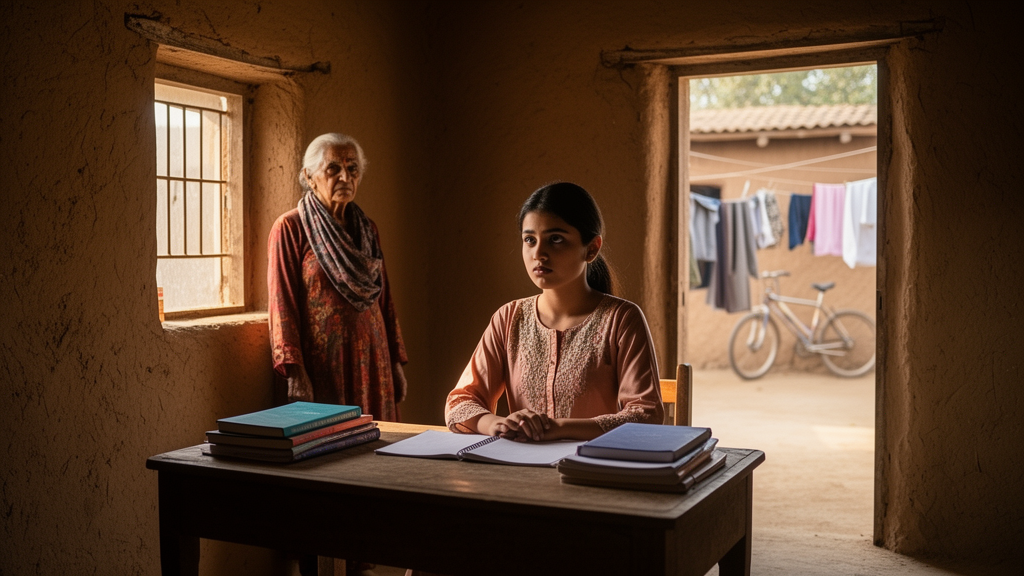
A qualitative study published in Frontiers in Psychology on 27 October 2026 examined how stigma shapes educational opportunity in District Bhakkar, a predominantly rural district in Punjab Province, and found that female education was broadly valued by families and communities, yet almost always on conditional terms tied to mobility, supervision, and conformity with traditional roles as daughters, wives, and mothers. The research team, drawn from institutions in China and Pakistan, interviewed 30 participants using a descriptive phenomenological design: eight rural female intermediate students, nine female family members including mothers and sisters, and 13 male family and community members such as fathers, brothers, teachers, politicians, and journalists. Interviews were conducted in Urdu by researchers native to the study area, with semi-structured guides covering daily mobility, household responsibilities, educational history, career aspirations, decision-making, and views on coeducation.
Data collection continued until saturation was reached, meaning final interviews produced no substantively new themes. Thematic analysis identified four interrelated themes: restricted mobility and chaperonage as a condition of access, conditional educational and career aspirations, internalized domestic identity built around the wife-mother-daughter script, and protectionist narratives surrounding coeducation. Students described traveling to college with brothers, male relatives, or female cousins as a routine requirement rather than a preference.
One respondent said her family did not allow females to go out shopping at all; another recalled being terrified of traveling alone to college and feeling secure only when her brother dropped her off. Where accompaniment was unavailable, attendance itself became precarious. The students were not without ambition.
Nearly all named a career they wanted, but each attached at least one recurring condition: family approval, the physical proximity of a suitable institution, and the social acceptability of the occupation for a rural woman. One aspiring computer science student said that if she could not enroll at the nearest university campus, she would either need family members to accompany her to a big city or drop out of her education. Another wanted to become a news anchor but already anticipated that her family, and particularly her brother, would resist, expecting them to permit only the teaching profession.
Distance functioned almost as a second gatekeeper alongside family approval. Beneath these practical constraints lay a deeper pattern: a self-understanding of womanhood organized around household service. One student reported performing roughly 80 percent of household activities alongside her studies, with her mother advising her to prioritize chores regardless of circumstances, and with her elder brother involved in decisions about her education.
Female relatives described womanhood in nearly identical terms and treated religious education as preparation for those roles. Most wanted their daughters to attend university eventually, but hedged that wish with conditions rooted in propriety and reputation rather than academic readiness. Asked to prioritize between a son's and a daughter's higher education if forced to choose, five favored sons and four favored daughters, and even those favoring daughters framed the benefit as producing a more capable future mother rather than a more independent professional.
Male community members converged on the same definition of a successful female life: a stable marriage, well-raised children, and conduct aligned with cultural and religious expectations. A male teacher and social worker explained his support for female education on the grounds that an educated mother could raise her children more effectively, extending the reasoning to widowhood as a situation in which education would let a woman work and raise children alone. Occupational or personal achievement outside this family-centered frame was rarely raised as a marker of success by either male or female participants.
The fourth theme revealed how restrictions were justified rather than imposed arbitrarily. Family and community members described an unsupervised female student as exposed to romantic entanglement, harassment, or distraction from her studies, and treated supervision as the responsible response to that risk. One female family member, herself a university graduate with hostel experience, objected not to female university education as such but to unsupervised proximity between unrelated men and women, invoking the religious-historical figures Junaid Baghdadi and Rabia Basri to argue that even revered figures did not study together.
Her account also carried a broader anxiety about shifting gender expectations, framing greater equality at university as a danger to women's futures rather than an opportunity. The study's theoretical contribution lies in applying stigma theory, developed from Erving Goffman's account of stigma and Peter Corrigan's distinction between public and self-stigma, to educational inequality. Public stigma was reflected in shared judgments about appropriate female conduct and in practices restricting movement, educational location, and occupational choice.
Self-stigma emerged where those socially produced expectations entered participants' own assessments: some students anticipated family or community disapproval and adjusted their educational preferences before any formal restriction was imposed. The authors emphasize that not every participant accepted these expectations; several expressed ambitions that challenged conventional roles, and the interviews showed a tension between aspiration and anticipated sanction rather than complete conformity or complete resistance. This framing adds nuance to earlier explanations of gender inequality in education, which have typically emphasized economic constraints such as household poverty and schooling costs, supply-side barriers such as distance to schools and shortages of female teachers, or cultural norms such as early marriage and son preference.
Those accounts treat inequality as the outcome of external barriers. The present study argues that an internal, psychological dimension also matters: women may withdraw from opportunities through self-censorship before encountering an external obstacle. It also complicates the assumption that support for female education signals a rejection of traditional gender roles, since participants could favor education while defining its purpose in terms of motherhood, marriage, and caregiving.
The authors caution that the findings come from a single rural district with a purposively selected sample and should be understood as context-specific rather than representative of all rural women in Pakistan. Pakistan ranked 139th in Educational Attainment in the 2024 Global Gender Gap Index, and census data show substantially lower literacy among rural women than urban counterparts, underscoring the stakes. The researchers suggest that expanding provision alone may be insufficient: reliable transport, safe travel arrangements, accommodation, harassment-prevention procedures, family-inclusive outreach, and career guidance that widens perceived occupational options could all matter.
They also note that interventions should avoid portraying rural families simply as opponents of women's education, since concerns about safety, distance, and reputation were genuine. Progress toward Sustainable Development Goals 4 and 5, they argue, requires attention not only to educational infrastructure but to the social conditions under which rural women are permitted, and feel able, to use it.
Subject of Research: Social stigmatization, self-censorship, and gender inequality in rural Pakistani women's higher education
Article Title: Social stigmatization and gender inequality in education: evidence from rural Pakistan
Article References: Hussain, Z., Chenmei, C., Zhijun, N., Hassan, N., & Iqbal, M. (2026). Social stigmatization and gender inequality in education: evidence from rural Pakistan. Frontiers in Psychology, 17, 1840642. https://doi.org/10.3389/fpsyg.2026.1840642
Image Credits: AI Generated
DOI: 10.3389/fpsyg.2026.1840642
Keywords: gender inequality, higher education, rural Pakistan, social stigma, self-censorship, qualitative research, phenomenology, mobility restrictions, coeducation, gender roles, educational access, Punjab
Cite Scienmag News
Courtney Benton. (October 27, 2026). Stigma and Self-Censorship Narrow Higher Education for Rural Pakistani Women, Study Finds. Scienmag. https://scienmag.com/stigma-and-self-censorship-narrow-higher-education-for-rural-pakistani-women-study-finds/
Courtney Benton. "Stigma and Self-Censorship Narrow Higher Education for Rural Pakistani Women, Study Finds." Scienmag, 27 October 2026, https://scienmag.com/stigma-and-self-censorship-narrow-higher-education-for-rural-pakistani-women-study-finds/. Accessed 27 October 2026.
Courtney Benton. "Stigma and Self-Censorship Narrow Higher Education for Rural Pakistani Women, Study Finds." Scienmag. October 27, 2026. https://scienmag.com/stigma-and-self-censorship-narrow-higher-education-for-rural-pakistani-women-study-finds/


