


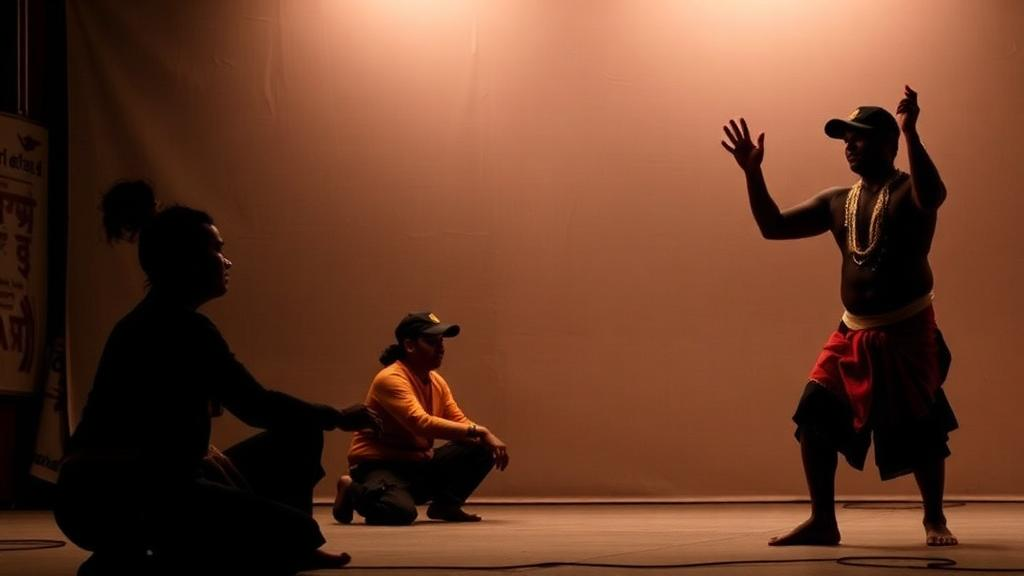
Behind every curtain call in Kathmandu lies a quieter, less visible performance: the struggle to stay psychologically well in one of the world’s most precarious professions. A new cross-sectional study published in BMC Psychology has taken one of the first systematic looks at the mental well-being of performing artists in Nepal’s capital, surveying 240 actors, theatre artists, dancers, and singers across Kathmandu Metropolitan City. The findings paint a nuanced picture. Most artists in the sample reported reasonably good mental well-being, but a substantial minority—one in six—fell below the threshold the researchers used to flag poor psychological health. And the factor that most strongly separated the two groups was not talent, training, or even income, but something deceptively simple: whether artists felt satisfied with the availability of work.
The research team, led by Soniya Thapa of Om Health Campus in Kathmandu, with colleagues from the Kathmandu Institute of Child Health and Manmohan Memorial Institute of Health Sciences, framed their investigation around a definition of mental well-being drawn from the World Health Organization: a state in which an individual realizes his or her own abilities, can cope with the normal stresses of life, can work productively, and is able to contribute to his or her community. That framing matters, because performing artists occupy an occupational niche that systematically tests each of those capacities. Irregular employment, financial insecurity, intensely competitive work environments, and unstable professional opportunities are chronic features of artistic careers everywhere, but they are amplified in low-resource settings where arts funding is thin, formal contracts are rare, and social safety nets are limited. Despite growing recognition of mental health as a public health priority, the authors noted that evidence on the mental well-being of performers in countries like Nepal has remained strikingly sparse.
To fill that gap, the researchers conducted a cross-sectional survey between February and March 2025, recruiting 240 performing artists through snowball sampling, a technique in which initial participants refer others from their professional networks. This approach is common when studying dispersed or hard-to-reach occupational communities, though it means the sample is not a random draw from the full population of Kathmandu’s artists. Participants completed structured, self-administered questionnaires covering socio-demographic details, occupational characteristics, and behavioral factors. The centerpiece of the assessment was the 14-item Warwick–Edinburgh Mental Well-being Scale, or WEMWBS, a validated instrument that asks respondents to rate statements about their feelings, relationships, and functioning. The scale can yield scores from 14 to 70, with higher scores indicating better mental well-being. The researchers analyzed the data using descriptive statistics, chi-square tests, and multivariable logistic regression, setting the threshold for statistical significance at p less than 0.05.
The demographic profile of the sample skews young and male. Participants had a mean age of 27.75 years, with a standard deviation of 6.00 years, and 70.8 percent were male. The mean WEMWBS score came in at 47.22, with a standard deviation of 7.65. Notably, the observed range in the sample spanned the entire possible range of the scale, from 14 to 70, meaning the cohort included individuals at both the theoretical floor and ceiling of the instrument. That full spread is itself informative: it signals that while the group average sits comfortably above the midpoint, the lived experience of Kathmandu’s performing artists is far from uniform, encompassing both people flourishing across every dimension the scale measures and people reporting the lowest possible well-being the instrument can capture.
Using a predefined cut-off score of 40, the researchers classified 83.3 percent of participants as having higher mental well-being and 16.7 percent as having poor mental well-being. That figure—roughly one in six artists experiencing poor psychological well-being—is the study’s central alarm bell. In a profession already marked by gig-to-gig uncertainty, a substantial minority operating below the well-being threshold represents a public health concern that the authors argue deserves targeted attention. The proportion also provides a baseline for a population that has, until now, been largely invisible in the mental health literature of low- and middle-income countries, where most occupational mental health research has focused on more conventional employment sectors such as healthcare, education, and manufacturing.
The bivariate analysis, which examines each potential factor in isolation, identified four variables significantly associated with mental well-being. Weekly working hours showed an association with a p-value of 0.030, suggesting that the sheer quantity of work an artist performs each week tracks with their psychological state. Physical exercise was associated at p equals 0.020, consistent with a broad body of literature linking physical activity to mental health. Satisfaction with work availability was associated at p equals 0.002, the strongest signal in the analysis, and access to resources or support was associated at p equals 0.036. Each of these findings aligns with the Job Demands–Resources model, a widely used occupational psychology framework that the study’s authors reference, which holds that well-being depends on the balance between the demands placed on workers and the resources available to help them meet those demands.
But bivariate associations can be misleading, because factors in real lives travel together. An artist who exercises regularly may also be the kind of person with steadier work; someone with access to support may also be more satisfied with their opportunities. To disentangle these threads, the researchers turned to multivariable logistic regression, a statistical technique that estimates the independent effect of each variable while holding the others constant. The team also checked for multicollinearity using the variance inflation factor, a diagnostic that flags when predictor variables are too tightly correlated to be separated reliably. When the statistical dust settled, only one factor remained independently associated with mental well-being: satisfaction with work availability.
The magnitude of that association was substantial. Compared with participants who were dissatisfied with the availability of work, those who reported neutral satisfaction had roughly two and a half times higher odds of higher mental well-being, with an adjusted odds ratio of 2.49 and a 95 percent confidence interval of 1.10 to 5.66. Participants who were satisfied with work availability fared better still, with an adjusted odds ratio of 3.85 and a 95 percent confidence interval of 1.19 to 12.48. In plain terms, after accounting for age, gender, working hours, exercise, and access to support, an artist who felt good about the amount of work coming their way was nearly four times as likely to score above the well-being threshold as one who did not. The confidence intervals are wide, a reflection of the modest sample size, but the dose-response pattern—from dissatisfied to neutral to satisfied—is consistent and points in a clear direction.
Why would work availability eclipse every other factor? The answer likely lies in the structure of artistic labor in a city like Kathmandu. For a performer, work availability is not merely a paycheck; it is the signal that their skills remain in demand, their professional identity remains viable, and their place in a competitive ecosystem is secure. Weeks without engagements can erode all three at once. The finding also carries practical weight, because work availability is arguably more amenable to intervention than fixed traits. The authors suggest that interventions addressing occupational stability and professional opportunities, combined with mental health promotion, could meaningfully support the well-being of performing artists in low-resource settings. Policies that smooth the feast-and-famine cycle of artistic employment—whether through steady engagement schemes, cooperative booking structures, or targeted support services—might therefore function as mental health interventions in their own right.
The study’s authors are careful about what their design can and cannot show. As a cross-sectional survey, it captures a single moment in time and cannot establish whether dissatisfaction with work availability causes poor well-being, or whether artists experiencing low well-being perceive their work prospects more negatively. Snowball sampling, while pragmatic, further limits how far the findings can be generalized to all performing artists in Kathmandu or beyond. The researchers explicitly call for longitudinal research to clarify the direction of these associations, tracking artists over time to see whether changes in work availability precede changes in mental well-being. Still, the study marks a genuine contribution: one of the first quantitative portraits of an occupational group whose psychological health has been shaped by irregular employment, financial insecurity, and unstable opportunities, and whose well-being, this research suggests, may hinge most of all on the simple question of whether there will be work tomorrow.
Subject of Research: Mental well-being and its occupational determinants among performing artists in Kathmandu, Nepal
Article Title: Mental well-being and associated factors among performing artists in Kathmandu Metropolitan City, Nepal: a cross-sectional study
Article References: Thapa, S., Shetty, G., Khadka, P., Basnet, P., & Nepal, S. (2026). Mental well-being and associated factors among performing artists in Kathmandu Metropolitan City, Nepal: a cross-sectional study. BMC Psychology. https://doi.org/10.1186/s40359-026-05763-0
Image Credits: AI Generated
DOI: 10.1186/s40359-026-05763-0
Keywords: mental well-being, performing artists, occupational health, Nepal, WEMWBS, cross-sectional study, job demands-resources model, work availability, Kathmandu, BMC Psychology, public health, logistic regression
Cite Scienmag News
Glenn Wilkins. (October 11, 2026). Steady Work, Steady Mind: What Keeps Kathmandu’s Performing Artists Psychologically Afloat. Scienmag. https://scienmag.com/steady-work-steady-mind-what-keeps-kathmandus-performing-artists-psychologically-afloat/
Glenn Wilkins. "Steady Work, Steady Mind: What Keeps Kathmandu’s Performing Artists Psychologically Afloat." Scienmag, 11 October 2026, https://scienmag.com/steady-work-steady-mind-what-keeps-kathmandus-performing-artists-psychologically-afloat/. Accessed 11 October 2026.
Glenn Wilkins. "Steady Work, Steady Mind: What Keeps Kathmandu’s Performing Artists Psychologically Afloat." Scienmag. October 11, 2026. https://scienmag.com/steady-work-steady-mind-what-keeps-kathmandus-performing-artists-psychologically-afloat/


