

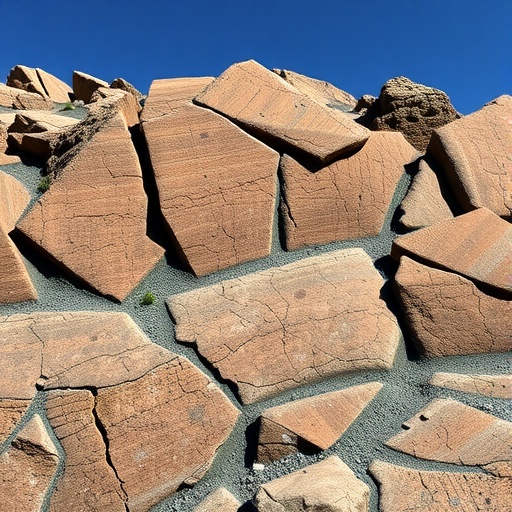
In a groundbreaking study set to reshape our understanding of the Earth’s mineral wealth, Xiao et al. unveil the untapped potential of staurolite-rich metamorphic belts as fertile grounds for lithium—a critical element in the global clean energy transition. Lithium, often hailed as the “white gold” of the 21st century, powers everything from electric vehicle batteries to grid-scale energy storage systems. However, global supply has struggled to keep pace with soaring demand, prompting urgent calls for novel sources. This new research, published in Communications Earth & Environment, illuminates a previously underexplored geological context that could significantly expand the world’s lithium resource base.
At the heart of this discovery lies staurolite, a silicate mineral typically associated with metamorphic rocks formed under moderate to high pressure and temperature conditions. These staurolite-rich belts, scattered across ancient orogenic terrains, have historically been sidelined in lithium exploration despite their widespread presence. The study delivers compelling geochemical and petrological evidence that these belts, particularly when subjected to reworking processes such as tectonic deformation and fluid mobilization, can concentrate lithium to economically viable levels.
The research team conducted integrated field studies across several reworked staurolite-bearing belts, employing advanced mineralogical analysis techniques including X-ray diffraction and electron microprobe spectroscopy to map lithium distribution. These methods revealed lithium enrichment linked to metamorphic fluid activity that mobilized and concentrated lithium within staurolite and associated mica minerals. Intriguingly, the study highlights how structural deformation zones, such as shear zones, acted as channels for lithium-bearing fluids, enhancing mineralization.
From a geodynamic perspective, the findings challenge the conventional wisdom that lithium enrichment is predominantly confined to pegmatite or sediment-hosted brine deposits. Instead, this research posits that metamorphic terranes—once considered lithium-poor—can, under specific conditions, become prolific lithium sources. This paradigm shift could drastically alter exploration strategies, urging geologists and mining companies to reassess previously overlooked terrains.
The implications extend beyond geological curiosity. As the world races to decarbonize energy systems, the demand for lithium is projected to exceed current supply capacities drastically. Traditional sources, including spodumene-rich pegmatites and salar brines, face environmental, geopolitical, and technical challenges. The possibility that abundant, stable metamorphic belts could supplement or even surpass these sources offers a tantalizing solution to some of the most pressing resource constraints in clean energy technology development.
Moreover, the environmental footprint of exploiting staurolite-rich belts may differ considerably from that of typical lithium deposits. While conventional lithium mining often involves massive water consumption or produces significant surface disturbance, metamorphic belt extraction might leverage more targeted approaches with potentially reduced ecological impact. Exploring this avenue further could align lithium supply chains more closely with sustainability goals, an increasingly critical consideration for policy makers and investors alike.
The paper also delves deep into the mineral transformation mechanisms that drive lithium enrichment. The authors reveal that during the regional metamorphism and subsequent deformation, lithium initially hosted in less stable minerals is liberated by fluid-assisted recrystallization processes. These fluids, rich in potassium, sodium, and lithium, then refertilize staurolite and other robust metamorphic minerals. Such cyclic reworking concentrates lithium progressively, creating discreet zones of anomalously high lithium concentration that can be mined profitably.
One of the report’s most captivating sections describes case studies from key regions where these processes have been documented. Detailed petrographic descriptions show the textural relationships between staurolite and associated lithium-bearing phases. By correlating these textures with fluid inclusion data and isotopic signatures, the research constructs a narrative of lithium mobilization spanning hundreds of millions of years, linked to multiple tectonometamorphic events.
Perhaps most innovative is the incorporation of state-of-the-art geochemical modeling that simulates fluid-rock interactions under varying pressure-temperature regimes. This approach not only corroborates field observations but also allows the prediction of new lithium-rich zones within metamorphic belts still awaiting exploration. Such predictive modeling could revolutionize the early stages of mineral prospecting, enhancing efficiency and reducing economic risks.
In addition to refining exploration methods, the study addresses metallurgical challenges associated with extracting lithium from these complex metamorphic assemblages. Preliminary experiments suggest that conventional beneficiation techniques can be adapted to liberate lithium compounds effectively, although further research is needed to optimize recovery rates and manage impurities. These findings open doors for the development of specialized processing technologies tailored to staurolite belt deposits.
Interdisciplinary collaboration underpins the success of this research. Mineralogists, geochemists, structural geologists, and economic geologists combined their expertise, highlighting the value of integrating diverse scientific perspectives in tackling resource challenges. The study also emphasizes the role of geological history—especially the timing and nature of orogenic events—in governing lithium fertility, reinforcing the importance of understanding deep-time processes in resource characterization.
Beyond academic circles and resource extraction companies, the paper’s insights resonate strongly with governments and policymakers. Securing lithium supplies from diversified sources mitigates geopolitical risks and fosters stable markets crucial for sustained clean energy transitions. The identification of new lithium provinces within staurolite-rich belts could help countries ensure domestic resource availability, thus enhancing strategic autonomy and reducing reliance on imports.
This discovery also comes at a pivotal moment when rapid urbanization and technological innovation intensify demand for battery-grade lithium. Global industry faces increasing pressure to innovate sustainably, necessitating not only alternative deposit types but also improved extraction and recycling technologies. Insights gleaned from these metamorphic systems might inform broader materials science challenges, potentially inspiring novel lithium recovery techniques compatible with circular economy models.
The environmental dimension is equally intriguing. Quantifying the ecological impact of exploiting metamorphic lithium sources requires comprehensive lifecycle assessments, but the initial indication that some staurolite-rich belts occur in less environmentally sensitive regions is promising. Prioritizing deposits in such areas while leveraging emerging clean mining technologies could set new standards in responsible resource development.
While the study underscores significant potential, it also cautions against simplistic enthusiasm. Not all staurolite belts are lithium-rich, and economic viability depends on a constellation of factors including deposit size, grade, and accessibility. The interaction between tectonics, fluids, and mineral transformations is complex, necessitating continued research to unravel the conditions conducive to enrichment and to delineate exploration criteria rigorously.
In summary, the work by Xiao and colleagues heralds a transformative era in lithium exploration and extraction. By spotlighting staurolite-rich metamorphic belts as promising new lithium terranes, they challenge established paradigms and invite a reimagining of global lithium supply chains. The synthesis of meticulous fieldwork, advanced analytical technology, and theoretical modeling exemplifies the power of contemporary geoscience to address pressing global challenges. As the push towards sustainable energy intensifies, discoveries like this will be crucial in ensuring that the materials driving innovation remain abundant, accessible, and responsibly sourced.
Subject of Research:
The investigation into staurolite-rich metamorphic belts as potential lithium-fertile terranes, focusing on their mineralogical, geochemical, and tectonic controls on lithium enrichment.
Article Title:
Reworked staurolite-rich metamorphic belts as lithium-fertile terranes.
Article References:
Xiao, M., Zhao, G., Jiang, Y. et al. Reworked staurolite-rich metamorphic belts as lithium-fertile terranes. Commun Earth Environ 7, 280 (2026). https://doi.org/10.1038/s43247-026-03293-6
Image Credits: AI Generated
DOI: https://doi.org/10.1038/s43247-026-03293-6


