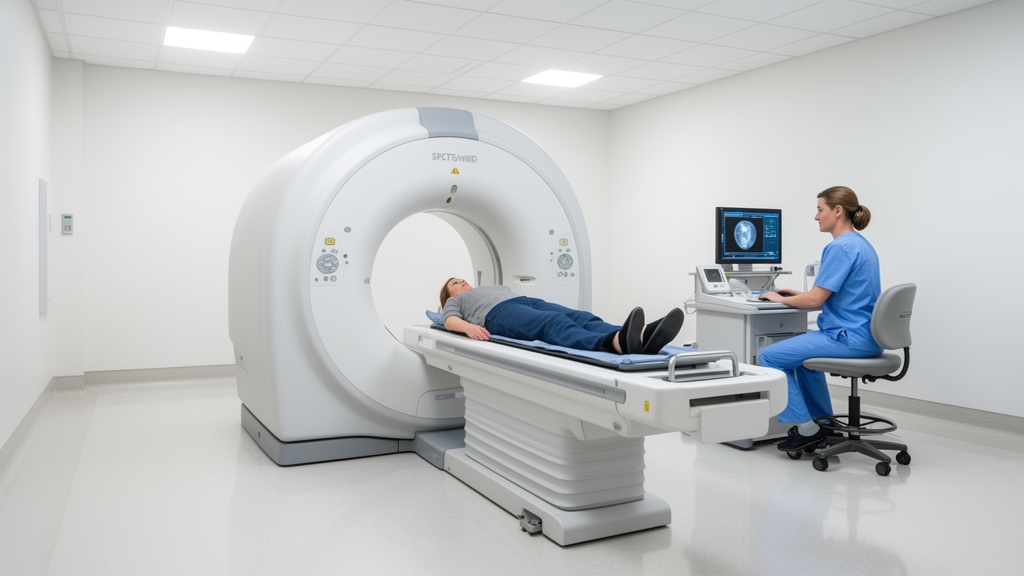
A new stationary full-ring SPECT/CT system detected significantly more cancer lesions and produced sharper, more quantitatively accurate images than a conventional dual-head gamma camera in one of the first head-to-head comparisons of the two technologies within the same patients, according to a study published in EJNMMI Physics.
Despite the growing clinical adoption of novel full-ring SPECT platforms, researchers note a critical gap in the evidence base: intra-individual, direct comparative studies between these advanced systems and conventional dual-head SPECT cameras have been lacking. As a result, the definitive impact of the new architecture on diagnostic and therapeutic decision-making has remained unclear. The new study was designed specifically to address that gap.
The investigators conducted a prospective, randomized, intra-patient crossover study involving 30 patients referred for SPECT/CT imaging. Each participant was scanned sequentially on both a novel stationary full-ring SPECT/CT system, the AIMS Epoch 310, and a conventional dual-head camera, the GE-D870. Because every patient served as their own control, the design minimized variability from differences in anatomy, disease burden and radiopharmaceutical uptake between individuals.
The clinical cohort spanned a broad range of routine nuclear medicine applications: bone scintigraphy, thyroid imaging, myocardial perfusion imaging, dynamic renal scintigraphy, and post-radioligand therapy imaging with iodine-131 and lutetium-177-labeled PSMA agents. The researchers compared diagnostic yield, signal-to-noise ratio (SNR) and lesion detection rates between the two platforms.
Across the board, the stationary full-ring system showed higher image quality and better diagnostic metrics than the conventional system. In bone scintigraphy, the full-ring platform detected 20.0% additional metastatic lesions that were occult on the dual-head system, and it achieved a 1.7-fold increase in SNR, a difference that reached statistical significance with P = 0.010.
The advantages were even more pronounced in theranostic applications, where quantitative accuracy directly informs treatment decisions. For post-therapy imaging with iodine-131, the full-ring system demonstrated a 3.2-fold higher SNR than the dual-head camera, and for lutetium-177-PSMA imaging the SNR advantage rose to 4.8-fold. Both differences were statistically significant, with P values below 0.05. The platform also significantly enhanced the delineation of metastatic foci, a capability the authors link to potential value in oncologic staging and theranostic dosimetry.
Beyond static imaging, the stationary full-ring architecture enabled synchronous four-dimensional volumetric dynamic acquisition. When the researchers used this dynamic capability to estimate glomerular filtration rate (GFR), a key measure of kidney function, the estimates were 26.2% higher than those obtained with the traditional two-dimensional planar Gates method, with P < 0.05. This suggests that conventional planar GFR techniques may systematically underestimate the parameter relative to the new volumetric approach, although the clinical implications of that difference would require further study.
The authors conclude that the stationary full-ring SPECT/CT architecture may reduce some of the limitations associated with conventional dual-head systems. By combining broad-spectrum quantitative accuracy with synchronous 4D volumetric imaging, the platform may offer additional technical options for quantitative SPECT/CT and functional imaging in clinical practice.
The researchers are careful to frame these findings as preliminary. The study involved a relatively small cohort of 30 patients, and the authors explicitly state that further validation in larger cohorts is required before the full clinical impact of the technology can be established. The published version is also an early-release, peer-reviewed accepted manuscript that remains subject to further edits before the final Version of Record appears.
Nevertheless, the intra-patient crossover design gives the comparison unusual strength for an early evaluation of a new imaging platform, because each patient’s images on the two systems could be compared directly. If the findings hold up in larger studies, stationary full-ring SPECT/CT could sharpen lesion detection in bone metastases, improve quantification in radioligand therapy monitoring, and provide more accurate dynamic renal function measurements across everyday nuclear medicine practice.
Subject of Research: Head-to-head comparison of a stationary full-ring SPECT/CT system with conventional dual-head SPECT across clinical imaging applications
Article Title: Next-generation stationary full-ring SPECT/CT: enhancing theranostic quantification and 4D dynamic volumetric imaging
Article References: Chen, R., Hu, N., Yin, P., Liu, H., Zhao, H., Xue, T., Deng, X., Huo, L., Wang, Y., & Huang, G. (2026). Next-generation stationary full-ring SPECT/CT: enhancing theranostic quantification and 4D dynamic volumetric imaging. EJNMMI Physics. https://doi.org/10.1186/s40658-026-00940-x
Image Credits: AI Generated
DOI: 10.1186/s40658-026-00940-x
Keywords: SPECT/CT, full-ring detector, bone scintigraphy, theranostics, radioligand therapy, 131I, 177Lu-PSMA, glomerular filtration rate, 4D dynamic imaging, myocardial perfusion imaging, lesion detection, quantitative imaging
Cite Scienmag News
Ophelia Keating. (October 29, 2026). Stationary full-ring SPECT/CT outperforms dual-head cameras in head-to-head patient study. Scienmag. https://scienmag.com/stationary-full-ring-spect-ct-outperforms-dual-head-cameras-in-head-to-head-patient-study/
Ophelia Keating. "Stationary full-ring SPECT/CT outperforms dual-head cameras in head-to-head patient study." Scienmag, 29 October 2026, https://scienmag.com/stationary-full-ring-spect-ct-outperforms-dual-head-cameras-in-head-to-head-patient-study/. Accessed 29 October 2026.
Ophelia Keating. "Stationary full-ring SPECT/CT outperforms dual-head cameras in head-to-head patient study." Scienmag. October 29, 2026. https://scienmag.com/stationary-full-ring-spect-ct-outperforms-dual-head-cameras-in-head-to-head-patient-study/