
Saturday, February 7, 2026
Science
No Result
View All Result
  • Login
  • HOME
  • SCIENCE NEWS
  • CONTACT US
  • HOME
  • SCIENCE NEWS
  • CONTACT US
No Result
View All Result
Scienmag
No Result
View All Result
Home Science News Biology

Starfish skeleton inspires new 4D morphing structure

July 2, 2024
in Biology
Reading Time: 2 mins read
0
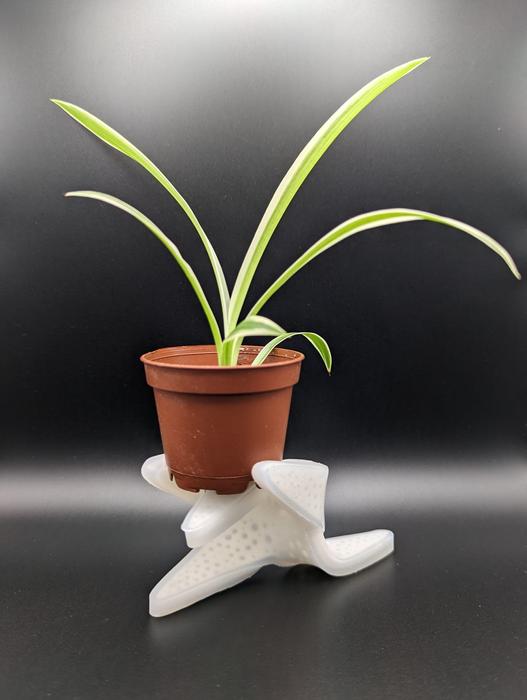
Morphing structure holding pot plant
67
SHARES
611
VIEWS
Share on FacebookShare on Twitter
ADVERTISEMENT

Researchers have recently developed a flexible-yet-sturdy morphing structure inspired by the starfish skeleton that exhibits 4D morphing features with promising applications for robotics, aviation, and medical devices.

Morphing structure holding pot plant

Credit: Raman Raman

Researchers have recently developed a flexible-yet-sturdy morphing structure inspired by the starfish skeleton that exhibits 4D morphing features with promising applications for robotics, aviation, and medical devices.

“Starfish possess the remarkable ability to effortlessly hold themselves in any body posture by changing the stiffness of their endoskeleton,” says Raman, a PhD student in the Biological Structures and Biomimetics workgroup at Hochschule Bremen – City University of Applied Sciences Bremen, Germany. 

Ossicles are calcite microstructures inside starfish bodies that are connected in a network by collagen fibres to form the endoskeleton. This strong but simple structure allows them to hold a wide variety of body postures with minimal energy use.

“We became fascinated with this biological solution to a complex engineering problem,” says Mr Raman. “Our goal was to unlock the secrets of their intricate skeleton and translate those principles into a novel material with similar remarkable properties.”

Mr Raman and his team used a multidisciplinary approach for this project. By using high resolution X-ray CT scans, they visualised the starfish skeletal structures and used mathematical models (Finite Element Analysis and Multibody Simulations) to understand the complex interlinked mechanics of the skeletal components.

“For the first time, we are able to show the complex 3D structure of the starfish skeleton and the fine ultrastructure of the small ossicles,” says Mr Raman. “We have now used these insights for the biomimetic design process of our own morphing structure, incorporating rapid prototyping techniques for fabrication.”

Mr Raman and his team have used 3D printing to produce different working prototypes that can accomplish an impressive range of physical challenges. “Our patented starfish-inspired morphing structure shows self-locking, continuous bending, self-healing, and shape memory features,” says Mr Raman.

The scalability, low cost and relative ease of manufacture of this morphing structure provides many opportunities for industry applications, including robotics, aviation, and biomedical devices such as prosthetics and implants.

This study was funded by the German Federal Ministry of Education and Research (BMBF) FHprofUnt 2018 program, project number 13FH150PX8 (JHD, SL) and the Hochschule Bremen PhD scholarship (R).

This research is being presented at the Society for Experimental Biology Annual Conference in Prague on the 2-5th July 2024.



Share27Tweet17
Previous Post

American Indian/Alaska Native patients less likely to undergo breast reconstruction

Next Post

Eating more soy foods could improve thinking and attention in kids

Related Posts

blank
Biology

Florida Cane Toad: Complex Spread and Selective Evolution

February 7, 2026
blank
Biology

New Study Uncovers Mechanism Behind Burn Pit Particulate Matter–Induced Lung Inflammation

February 6, 2026
blank
Biology

DeepBlastoid: Advancing Automated and Efficient Evaluation of Human Blastoids with Deep Learning

February 6, 2026
blank
Biology

Navigating the Gut: The Role of Formic Acid in the Microbiome

February 6, 2026
blank
Biology

AI-Enhanced Optical Coherence Photoacoustic Microscopy Revolutionizes 3D Cancer Model Imaging

February 6, 2026
blank
Biology

PolyU Unveils Innovative AI Graph Neural Network Models to Decode Complexities in Image Recognition and Neuroscience

February 6, 2026
Next Post
Eating more soy foods could improve thinking and attention in kids

Eating more soy foods could improve thinking and attention in kids

  • Mothers who receive childcare support from maternal grandparents show more parental warmth, finds NTU Singapore study

    Mothers who receive childcare support from maternal grandparents show more parental warmth, finds NTU Singapore study

    27610 shares
    Share 11040 Tweet 6900
  • University of Seville Breaks 120-Year-Old Mystery, Revises a Key Einstein Concept

    1017 shares
    Share 407 Tweet 254
  • Bee body mass, pathogens and local climate influence heat tolerance

    662 shares
    Share 265 Tweet 166
  • Researchers record first-ever images and data of a shark experiencing a boat strike

    529 shares
    Share 212 Tweet 132
  • Groundbreaking Clinical Trial Reveals Lubiprostone Enhances Kidney Function

    515 shares
    Share 206 Tweet 129
Science

Embark on a thrilling journey of discovery with Scienmag.com—your ultimate source for cutting-edge breakthroughs. Immerse yourself in a world where curiosity knows no limits and tomorrow’s possibilities become today’s reality!

RECENT NEWS

  • Decoding Prostate Cancer Origins via snFLARE-seq, mxFRIZNGRND
  • Abyssal Hydrothermal Alteration Sparks Prebiotic Molecules
  • Florida Cane Toad: Complex Spread and Selective Evolution
  • Single-Atom Enzymes Transform Water Pollutants Efficiently

Categories

  • Agriculture
  • Anthropology
  • Archaeology
  • Athmospheric
  • Biology
  • Biotechnology
  • Blog
  • Bussines
  • Cancer
  • Chemistry
  • Climate
  • Earth Science
  • Editorial Policy
  • Marine
  • Mathematics
  • Medicine
  • Pediatry
  • Policy
  • Psychology & Psychiatry
  • Science Education
  • Social Science
  • Space
  • Technology and Engineering

Subscribe to Blog via Email

Enter your email address to subscribe to this blog and receive notifications of new posts by email.

Join 5,190 other subscribers

© 2025 Scienmag - Science Magazine

Welcome Back!

Login to your account below

Forgotten Password?

Retrieve your password

Please enter your username or email address to reset your password.

Log In
No Result
View All Result
  • HOME
  • SCIENCE NEWS
  • CONTACT US

© 2025 Scienmag - Science Magazine

Discover more from Science

Subscribe now to keep reading and get access to the full archive.

Continue reading