


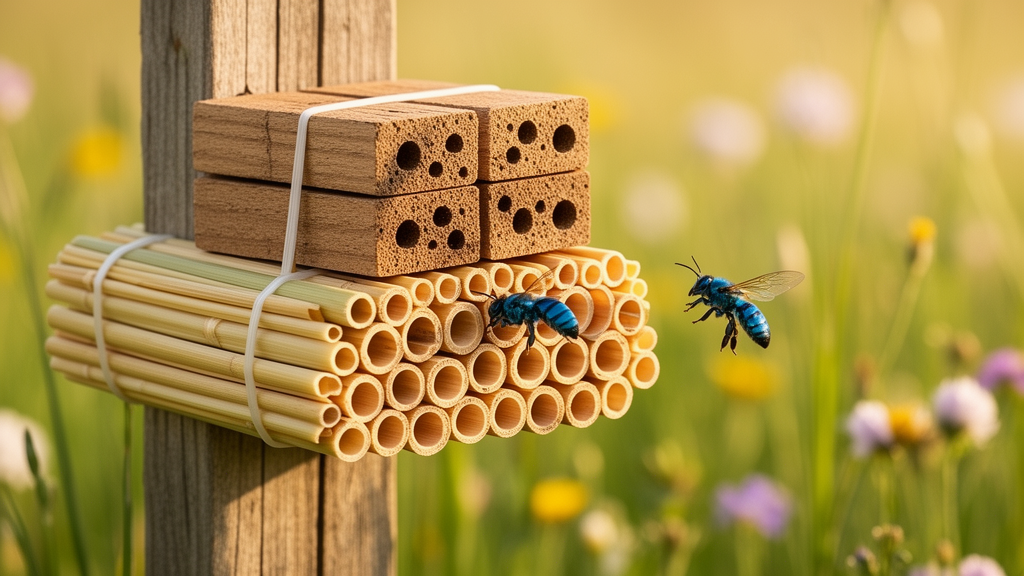
Solitary bees and wasps that nest inside hollow stems and pre-drilled cavities are among the most quietly important members of temperate ecosystems. They pollinate crops and wildflowers, hunt agricultural pests, and anchor food webs across farmland, wetlands, and forests. Yet many of these cavity-nesting Hymenoptera are declining, and researchers still lack basic information about their life histories, seasonal timing, and population trajectories. A new study published in the Journal of Hymenoptera Research takes a direct step toward closing that gap by presenting the first publicly available, step-by-step protocol for building and deploying trap nests, the artificial hollow tubes that mimic natural nesting sites and allow scientists to collect entire nests for inspection.
Trap nests are not a new idea. Researchers have used them since at least the 1960s, binding together reed stems or drilling holes into wooden blocks to entice female bees and wasps to establish nests that can later be retrieved and dissected. What makes them uniquely valuable is the sheer diversity of data they generate. Unlike transect walks, Malaise traps, or pan traps, which capture only adult individuals and rarely provide more than simple species-abundance counts, trap nests reveal provisioned food sources, nest-building materials, partition walls, closing plugs, and the natural enemies that attack the occupants. A single retrieved nest can document a female’s foraging preferences, her reproductive strategy, the phenology of her offspring, and the parasitoids and predators that shaped her family’s survival.
This richness turns trap nests into what the study’s authors describe as living laboratories. Because nests contain one or more brood cells, each housing a single offspring along with food provisioned by the mother, scientists can track development in real time from egg to larva to prepupa to adult. Bees provision their cells with nectar and pollen, while wasps stock theirs with paralysed spiders and insects, so nest contents directly document trophic interactions such as predation and parasitism within a community. Trap nests have been used to study foraging and reproductive behaviour, assess interaction diversity, and monitor emerging diseases and pathogen transmission. In agricultural landscapes, they serve as bioindicators, tracking the impact of intensification or ecological restoration on the species that provide pollination and biological pest control.
The practical advantages are equally compelling. A trap nest deployed in early spring and retrieved in autumn requires only two field days per site, one for deployment and one for collection, yet generates nearly a year’s worth of ecological data. This makes the method particularly well suited to difficult-to-access habitats such as wetlands and areas with dense vegetation, where frequent site visits are impractical. Because nests are sampled rather than individual adults, trap nests capture only resident populations, avoiding the transient individuals that other methods sweep up, and thus provide a more representative assessment of local community composition.
Despite this growing popularity, trap nest use has never been standardised. Excellent practical resources exist, but no publicly available step-by-step protocols, and this absence hinders data sharing and comparisons across datasets. Studies bind different substrates, cut reeds to different lengths, deploy nests at different heights, and record different variables, making it difficult or impossible to pool results. The new protocol, developed through collaboration between two research groups and a university department, draws on field experience from several monitoring programs in Hungary and Romania conducted between 2016 and 2023, refined through years of expert input and user feedback. It is available in its entirety via protocols.io, together with supplementary spreadsheets and an identification guide.
The protocol’s technical core centres on reed stems, which attract a wide range of species while remaining cost effective and easy to produce. Cutting reeds between internodes produces clean cavities, typically two per stem, that can be individually colonised. The natural variation in inner diameter, with a recommended range from 2 to 12 millimetres, accommodates a broad spectrum of cavity-nesting species, from tiny masked bees to larger mason wasps. Cutting length is chosen to maximise the yield of reed pieces containing exactly one node while ensuring sufficient cavity length, because cavities that are too short can negatively impact colonisation or skew sex ratios. The cut reeds are bound together and placed in a protective tube casing.
Deployment follows a careful seasonal rhythm. Trap nests are attached to trees or poles in early spring, with a protective sheet placed above them to shield against weather damage. The authors recommend placing trap nests in pairs, so that one remains in the field if the other is damaged, and to reduce the risk of removing the majority of the local cavity-nesting community when nests are retrieved. In autumn, nests are collected and stored at room temperature until winter, when they are transferred to cold storage for overwintering, allowing offspring to fully develop while limiting further damage by natural enemies.
Processing begins in mid-winter. First, all unoccupied reeds are removed, followed by a thorough inspection of occupied reeds, during which data entry and sample collection take place. Timing is critical: nests should be processed before offspring emerge, because certain data are best collected while nests are intact. However, early processing means some species will still be in the larval or pre-pupal stage, which is less ideal for species identification. The protocol therefore instructs researchers to close reeds containing larvae back up and store them at room temperature for further development, allowing adult samples to be collected later for more accurate identification. While molecular methods can supplement traditional identification, exclusive reliance on them is likely not feasible due to high costs. The identification guide accompanying the protocol provides detailed descriptions of nest properties and taxon-specific characteristics of larval and adult specimens, derived from the authors’ own empirical observations of common East-Central European cavity-nesting taxa and their natural enemies.
A notable strength of the protocol is that it requires no prior knowledge of trap nests or species identification, which facilitates the involvement of non-experts such as lab assistants, students, and early-career researchers. Previous studies have demonstrated that non-experts can be trained to collect trap nest data and identify taxa with a high degree of accuracy. This opens the door for research institutions, conservation authorities, and citizen science projects alike to adopt the method, broadening its applicability in both academic and applied settings. The protocol’s flexibility extends to substrate choice: bamboo can be equally effective as reed when suitable inner diameters are ensured, while the authors caution against alternatives such as plastic tubes, which are associated with high brood mortality, and paper or cardboard tubes, which are prone to weather and wildlife damage. Pithy plant stems such as elderberry and blackberry suffer from high mortality and low occupancy rates, while stacked wooden boards with grooves allow non-lethal sampling but may be susceptible to parasite infestations through gaps between boards.
The authors are candid about remaining challenges. Inherent sampling biases may persist, since insects that nest earlier in the season will likely find more empty reeds available, while their nests are also exposed to adverse conditions and natural enemies for longer, potentially causing higher mortality in early-nesting species. Future research should investigate whether such biases exist and whether they can be avoided, for example by replacing occupied reeds throughout the sampling period. Distinguishing brood cell status can also be subjective, since an empty cell may have been parasitised or may never have contained offspring, a potential source of interobserver variability that will need to be addressed through further research into the phenology and nesting biology of many trap nest species. Although the protocol’s timing is based on the seasonal development of temperate cavity-nesting Hymenoptera, it can be adapted for tropical regions with appropriate knowledge of local species’ phenology. Comments and user feedback can be submitted on protocols.io and will be used to improve future versions, contributing to the development of a globally harmonised framework for monitoring cavity-nesting Hymenoptera, a goal that grows more urgent as these essential pollinators and pest controllers continue to decline.
Subject of Research: Standardised trap nest sampling protocol for cavity-nesting Hymenoptera
Article Title: A standardised protocol for sampling cavity-nesting Hymenoptera using trap nests
Article References: Bihaly, Á. D., Stephenson, D. L., Józan, Z., Somay, L., Báldi, A., Kovács-Hostyánszki, A., Sárospataki, M., & Török, E. (2026). A standardised protocol for sampling cavity-nesting Hymenoptera using trap nests. Journal of Hymenoptera Research, 99, 67-76. https://doi.org/10.3897/jhr.99.183051
Image Credits: AI Generated
Keywords: trap nests, cavity-nesting Hymenoptera, solitary bees, wasps, pollination, pest control, standardised protocol, biodiversity monitoring, ecological restoration, phenology, bioindication, conservation
Cite Scienmag News
Margaret Porter. (October 17, 2026). Standardised Trap Nest Protocol Aims to Unlock Secrets of Cavity-Nesting Bees and Wasps. Scienmag. https://scienmag.com/standardised-trap-nest-protocol-aims-to-unlock-secrets-of-cavity-nesting-bees-and-wasps/
Margaret Porter. "Standardised Trap Nest Protocol Aims to Unlock Secrets of Cavity-Nesting Bees and Wasps." Scienmag, 17 October 2026, https://scienmag.com/standardised-trap-nest-protocol-aims-to-unlock-secrets-of-cavity-nesting-bees-and-wasps/. Accessed 17 October 2026.
Margaret Porter. "Standardised Trap Nest Protocol Aims to Unlock Secrets of Cavity-Nesting Bees and Wasps." Scienmag. October 17, 2026. https://scienmag.com/standardised-trap-nest-protocol-aims-to-unlock-secrets-of-cavity-nesting-bees-and-wasps/


