


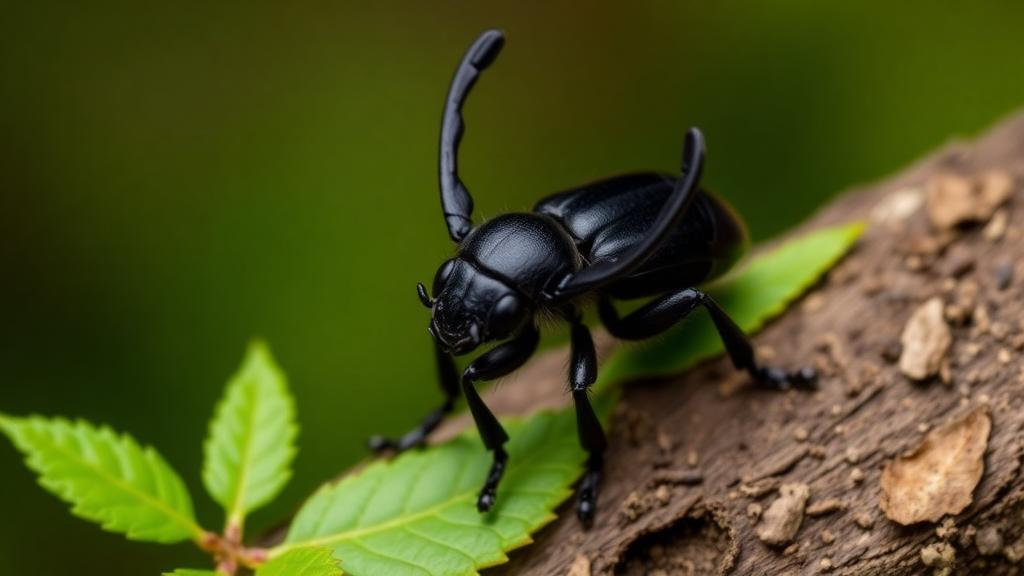
In the managed broadleaf forests of Hida, Japan, a small beetle with an unusual love life is changing how scientists keep tabs on woodland health. Researchers at Kyoto University have deployed a novel survey technique that turns the mating habits of Platycerus stag beetles into a monitoring tool, luring male beetles with traps baited by the presence of their own females. The approach, known as a female-attracted flight interception trap, or F-FIT, has now been applied for the first time to habitat assessment in working forests that are actively managed for timber, and the results suggest that these canopy-associated insects can reveal spatial patterns of habitat quality that ground-dwelling indicators simply cannot see.
Forest management is, at its core, a balancing act. Timber extraction alters habitat conditions in ways that vary enormously from place to place and from species to species, and managers must weigh the economic value of wood against the imperative to conserve biodiversity. Biological indicators have long been central to this effort: by repeatedly surveying organisms whose presence, absence, or abundance tracks environmental conditions, ecologists can capture both the spatial variation across a forest landscape and the changes that unfold over time. Ground-dwelling beetles have served this role well, offering a readable signal of what is happening on the forest floor. But the forest is a vertically structured world, and indicators that faithfully reflect conditions in the canopy have proven far more elusive.
That gap is what drew the Kyoto University team to Platycerus, a genus of stag beetles that inhabits broadleaf forests and lives a distinctly two-phase life. As larvae, these beetles feed on dead wood, tunneling through decaying branches and trunks whose availability depends directly on how a forest is structured and managed. As adults, they shift their diet to new leaf buds, tying them to the living canopy. This dual dependence on both dead wood and fresh foliage makes the genus a plausible sentinel for the vertical dimension of forest condition, complementing the ground-level perspective provided by their flightless, floor-dwelling relatives.
Conventional surveys of Platycerus, however, come with significant drawbacks. Traditional methods depend heavily on the skill of the observer, introducing a source of variability that can undermine comparisons across sites and years. Worse, some approaches risk damaging the very breeding sites that the surveys are meant to assess, an unacceptable trade-off when the goal is long-term monitoring of sensitive habitat. F-FIT was introduced only recently to address these limitations, offering a standardized, repeatable alternative that does not require an expert to find the beetles by hand and leaves breeding sites undisturbed.
The logic behind the trap is elegantly simple, and it is what earned the technique its nickname as a honey trap. Female Platycerus stag beetles attract males, and by positioning a flight interception trap around a female, researchers can capture the males that fly in to find her. In the forests of Hida, the team used this method to record captures of male Platycerus takakuwai, a species typical of Japan, with each capture georeferenced to the precise location of its trap. That georeferencing proved to be the crucial ingredient, transforming what might have been a simple count into a spatially explicit dataset.
With capture counts and locations in hand, the researchers analyzed how the numbers of beetles caught related to environmental variables measured at each trap site. These variables included weather conditions, elevation, forest structure, and the position of each trap relative to the forest edge. Rather than relying on a single statistical model, the team compared multiple candidate models to examine the relationships between differences in capture counts and the environmental conditions across locations, a comparative approach that allowed them to evaluate which explanations best fit the observed pattern of beetle distributions.
The results revealed a clear and telling pattern. Beetle capture counts increased toward the interiors of forest stands and declined toward open areas, indicating that the beetles respond to the gradient between enclosed, interior forest conditions and the more exposed conditions near edges. Just as importantly, the relationship between tree density and capture counts was characterized as varying across locations rather than holding uniformly across the whole forest. In other words, a single forest-wide average would obscure the very variation that matters most for assessing habitat quality, and the spatially explicit F-FIT data made that local variation visible.
This study represents the first application of F-FIT to habitat assessment in operational broadleaf forestry, a milestone that moves the technique from methodological development into practical use. The successful linking of capture counts to trap locations demonstrates the potential of the survey to provide spatial information on local forest habitat conditions, information that can feed directly into environmental assessment and the management of working forests. For managers who need to know not just whether a forest supports biodiversity on average, but which parts of a stand serve as habitat and which do not, that spatial resolution is a meaningful advance over conventional indicator surveys.
The researchers themselves emphasize the practical motivation behind the work. I’m interested in how forest resources can be used while maintaining habitats for wildlife, says first author Minori Tokito. It was rewarding to see F-FIT develop from a quantitative survey method into a source of information for considering how forests are used and managed. That trajectory, from a clever trapping idea to a decision-support tool, captures the broader promise of biological indicator research: turning the ecology of a single genus into actionable knowledge for land managers.
The work is not finished, and the team is careful about the limits of what a single survey can show. Larger-scale surveys are already underway, and future work will need to examine whether similar spatial patterns are observed across different forests, across years, and across survey dates, since a pattern seen once in one season may not hold everywhere or every time. Because Platycerus takakuwai is found in Japan, the scientists aim to develop locally useful indicators that can support forest management balancing timber use and biodiversity conservation, and to extend that approach to other regions. The paper describing the study, titled A honey trap for Platycerus (Coleoptera: Lucanidae): Georeferenced captures indicate forest-habitat patterns in operational broadleaf forestry, appeared on 6 September 2026 in the journal Forest Ecology and Management. If the pattern holds, the humble stag beetle, coaxed into a trap by the promise of a mate, may become one of forestry’s most informative witnesses to the health of the canopy above.
Subject of Research: Use of Platycerus stag beetle flight interception traps as biological indicators of forest habitat conditions in managed broadleaf forests
Article Title: A honey trap for protecting the forest
Article References: A honey trap for protecting the forest. (n.d.). Original publication
Image Credits: AI Generated
DOI: Not provided
Keywords: Platycerus, stag beetles, F-FIT, forest management, biological indicators, biodiversity conservation, broadleaf forests, habitat assessment, Hida Japan, Forest Ecology and Management, Kyoto University, canopy ecology
Cite Scienmag News
Gavin Prescott. (October 7, 2026). Stag Beetle Honey Trap Offers New Window on Forest Health. Scienmag. https://scienmag.com/stag-beetle-honey-trap-offers-new-window-on-forest-health/
Gavin Prescott. "Stag Beetle Honey Trap Offers New Window on Forest Health." Scienmag, 7 October 2026, https://scienmag.com/stag-beetle-honey-trap-offers-new-window-on-forest-health/. Accessed 7 October 2026.
Gavin Prescott. "Stag Beetle Honey Trap Offers New Window on Forest Health." Scienmag. October 7, 2026. https://scienmag.com/stag-beetle-honey-trap-offers-new-window-on-forest-health/


