


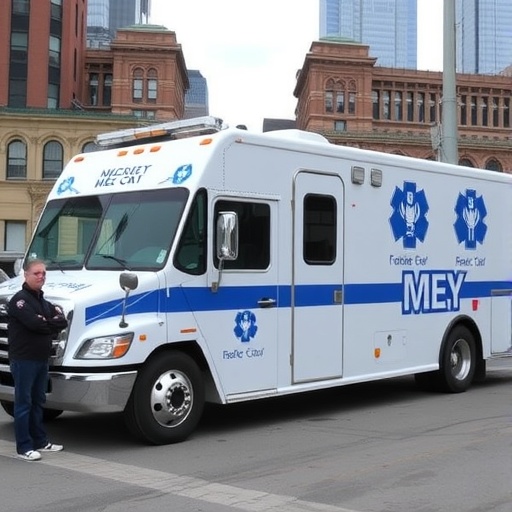
Mobile methadone clinics are moving from theory to reality across New York State, but a new study reveals that the road to bringing lifesaving treatment on wheels is paved with regulatory confusion, staffing shortages, broken-down vehicles, and stubborn community stigma. In one of the first large-scale evaluations of the early rollout of mobile medication units (MMUs) in the United States, researchers interviewed staff at four opioid treatment programs and a residential treatment facility about what it actually takes to dispense methadone from a van or bus. Their findings, published in Addiction Science & Clinical Practice, offer a candid, real-world portrait of both the promise and the friction points of mobile opioid use disorder treatment.
Methadone is widely considered the gold standard medication for opioid use disorder. It cuts the risk of fatal overdose roughly in half, reduces illicit opioid use, and lowers transmission of infections such as hepatitis C among people who inject drugs. Yet in the United States, methadone remains one of the most tightly restricted medications in medicine: it can only be dispensed through specially licensed opioid treatment programs (OTPs), which are currently located in just 20 percent of U.S. counties. Because most patients must visit an OTP daily to receive their dose, travel distance becomes a decisive barrier. In New York State, more than half of the counties in the upstate region have no OTP at all, meaning patients may spend hours each day simply getting to a clinic.
The 2021 federal rule change that opened the door to mobile units
That geography problem gained a new potential solution in July 2021, when the Drug Enforcement Administration finalized a rule allowing OTPs to establish and operate mobile medication units under their existing licenses. The rule lifted a moratorium on MMUs that had been in place since 2007. MMUs are motor vehicles outfitted to dispense methadone and buprenorphine and to provide counseling, physical exams, and other health services, subject to many of the same regulatory requirements as brick-and-mortar clinics.
New York State moved quickly to capitalize on the opportunity. In 2022, the New York State Office of Addiction Services and Supports (OASAS) awarded ten competitive grants to OTPs to support MMU adoption, one of the earliest coordinated statewide investments in mobile methadone in the country. The new study focused on four of those funded programs, capturing experiences from New York City to rural upstate counties.
The research team, led by investigators at NYU Grossman School of Medicine, Brown University, Johns Hopkins University, and partner institutions, conducted semi-structured interviews between June 2024 and June 2025 with 16 staff members, 13 from the OTPs and three from a residential treatment program served by one of the MMUs. Interviews lasted 45 to 60 minutes and were guided by the Consolidated Framework for Implementation Research, a widely used conceptual model for studying how new health interventions take root in real-world settings. The team then applied a hybrid deductive-inductive thematic analysis, combining predefined codes drawn from the framework with themes that emerged organically from the transcripts. Most participants were women (13 of 16), and roughly two-thirds held supervisory or administrative roles.
Two distinct models of mobile methadone emerged from the interviews
The programs studied deployed their units in markedly different ways. In upstate New York, where treatment deserts stretch across rural counties, MMUs were designed to shorten travel distances, effectively extending the reach of an existing clinic into communities that might otherwise never host a methadone provider. In New York City, by contrast, the challenge was not a lack of clinics but uneven access within a saturated treatment landscape. There, one OTP partnered with a residential substance use treatment program, parking the MMU at the facility so residents could receive methadone on-site rather than being bused daily to a clinic, a logistical burden that had previously limited how many residents the program could accept.
For the residential program, the partnership proved transformative. Staff described building deliberate one-to-one relationships across organizations, pairing program directors, nurses, MOUD coordinators, and recovery coaches so that clinical information flowed continuously between the MMU team and residential staff. One administrator called these relationships “one of the big successes,” noting that dose adjustments, cravings, and clinical status were communicated in real time, keeping patients safe and engaged.
Regulatory ambiguity emerged as a defining frustration
Yet the path to launch was far from smooth, and the single most persistent complaint concerned the federal government itself. Staff described inconsistent and opaque guidance from the Drug Enforcement Administration, whose local offices appeared to interpret federal requirements differently from place to place. One administrator noted that the DEA would define broad requirements and invite programs to request exceptions, but “it’s up to your local DEA office what they will actually be looking for.” That inconsistency translated into approval delays, stricter-than-necessary conditions, and uncertainty that programs had to absorb on their own.
Financial structures compounded the problem. Medicaid reimbursement, staff pointed out, was not designed with mobile care in mind. “You can’t reimburse mobile health the same way you reimburse brick-and-mortar,” one administrator explained. The initial state grant of $200,000 per program proved insufficient to cover vehicle purchase, retrofitting, security infrastructure, and staffing, although OASAS subsequently offered deficit funding that participants credited with easing sustainability concerns over the five-year grant horizon.
Operationally, the vehicles themselves became a source of chronic strain. Motors, generators, slide-out examination rooms, and heaters all required maintenance that brick-and-mortar clinics never confront. One unit’s sliding mechanism failed twice within its first few deployments. DEA rules also required the medication-laden vehicles to be parked overnight in secure, fenced locations, prompting one program to navigate city planning approvals, technical drawings, automated gate installation, and unexpected costs simply to satisfy storage requirements. Staffing shortages grounded at least one unit entirely; the vehicle was ready, but no staff were assigned to run it. Some frontline workers initially refused to work on the units, fearing break-ins or theft of methadone, even though prior research suggests actual security incidents involving MMUs are minimal.
Community resistance tested leadership persistence
Perhaps the most socially charged barrier was community opposition, rooted in longstanding stigma against methadone and the people who take it. Several programs reported approaching multiple county governments before finding one willing to host the unit. One administrator described the resistance bluntly: “Some communities just don’t want methadone treatment in their communities,” whether the treatment arrives in a building or on a bus.
The programs that succeeded tended to share a distinctive playbook. Leaders invested months in what they called a “soft rollout,” attending local meetings, inviting residents to tour the vehicle, issuing press releases, and building relationships with elected officials before the unit ever dispensed a dose. “I did a soft rollout for about six months before I put the unit out on the streets,” one administrator recounted, recommending the strategy to anyone attempting something similar. The study also found that programs with an organizational culture of innovation, and leaders willing to take risks that peer agencies declined, were far more likely to persist through setbacks.
Interestingly, patient demand did not always match the promise of convenience. Some existing clinic patients declined to switch to the MMU, reluctant to lose daily contact with the social networks and familiar staff of the brick-and-mortar clinic, an unexpectedly important psychosocial attachment that prior research has linked to treatment stability. Transportation also remained a stubborn obstacle in a different form: in upstate counties, patients relying on Medicaid-funded rides to reach the mobile unit found that cabs frequently failed to appear or canceled at the last minute, illustrating how mobile clinics can shift, rather than eliminate, transportation barriers.
The authors emphasize that their findings reflect early adopters in a single state and that most participants held supervisory roles, so day-to-day frontline experiences may be underrepresented. Still, the lessons are broadly applicable as MMUs, now present in only 17 states, begin to spread. The study concludes that mobile methadone can meaningfully expand access, particularly for populations never served by traditional clinics, but only when regulators provide consistent guidance, funders cover both capital and operating costs, workforce shortages are addressed, and communities are engaged early and honestly. As the overdose crisis continues to claim tens of thousands of American lives each year, the experience of New York’s first movers suggests that the hardest part of putting methadone on wheels is not the medicine, it is everything around it.
Cite Scienmag News
Ophelia Keating. (September 7, 2026). Staff describe early challenges launching mobile medication units in New York. Scienmag. https://scienmag.com/staff-describe-early-challenges-launching-mobile-medication-units-in-new-york/
Ophelia Keating. "Staff describe early challenges launching mobile medication units in New York." Scienmag, 7 September 2026, https://scienmag.com/staff-describe-early-challenges-launching-mobile-medication-units-in-new-york/. Accessed 7 September 2026.
Ophelia Keating. "Staff describe early challenges launching mobile medication units in New York." Scienmag. September 7, 2026. https://scienmag.com/staff-describe-early-challenges-launching-mobile-medication-units-in-new-york/


