
Sunday, March 22, 2026
Science
No Result
View All Result
  • Login
  • HOME
  • SCIENCE NEWS
  • CONTACT US
  • HOME
  • SCIENCE NEWS
  • CONTACT US
No Result
View All Result
Scienmag
No Result
View All Result
Home Science News Mathematics

Stacked up against the rest

August 1, 2024
in Mathematics
Reading Time: 2 mins read
0
Moiré excitons
66
SHARES
600
VIEWS
Share on FacebookShare on Twitter
ADVERTISEMENT

Quantum technology is quantifiable in qubits, which are the most basic unit of data in quantum computers. The operation of qubits is affected by the quantum coherence time required to maintain a quantum wave state.

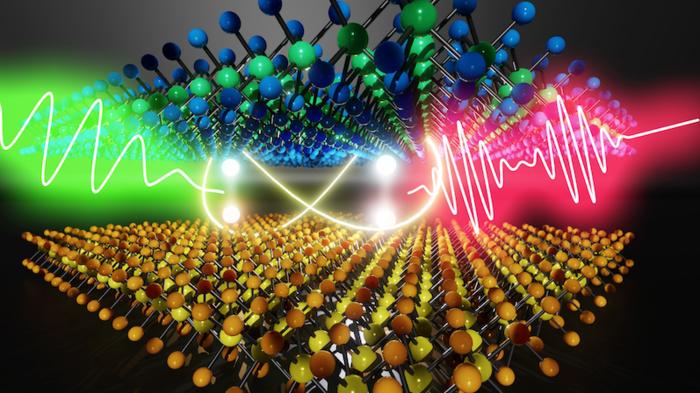
Moiré excitons

Credit: KyotoU/Matsuda Lab

Quantum technology is quantifiable in qubits, which are the most basic unit of data in quantum computers. The operation of qubits is affected by the quantum coherence time required to maintain a quantum wave state.

Scientists have hypothesized that moiré excitons — electron-hole pairs confined in moiré interference fringes which overlap with slightly offset patterns — may function as qubits in next-generation nano-semiconductors.

However, due to diffraction limits, it has not been possible to focus light enough in measurements, causing optical interference from many moiré excitons.

To solve this, Kyoto University researchers have developed a new method of reducing these moiré excitons to measure the quantum coherence time and realize quantum functionality. The team has observed changing photoluminescence signals of moiré excitons following the fabrication process.

“We combined electron beam microfabrication techniques with reactive ion etching. By utilizing Michelson interferometry on the emission signal from a single moiré exciton, we could directly measure its quantum coherence time,” Kazunari Matsuda of KyotoU’s Institute Advanced Energy explains.

The results show that the quantum coherence of a single moiré exciton remains steady at -269°C for more than 12 picoseconds, ten times longer than that of an exciton in the parent material, a two-dimensional semiconductor. The confined moiré excitons in interference fringes prevent loss of quantum coherence.

“We plan to establish a foothold for the next phase of experiments for advancing quantum computing and other quantum technologies in the next generation of nano-semiconductors,” adds Matsuda.

###

The paper “Quantum coherence and interference of a single moiré exciton in nano-fabricated twisted monolayer semiconductor heterobilayers” appeared on 8 June 2024 in Nature Communications, with doi: 10.1038/s41467-024-48623-4

About Kyoto University

Kyoto University is one of Japan and Asia’s premier research institutions, founded in 1897 and responsible for producing numerous Nobel laureates and winners of other prestigious international prizes. A broad curriculum across the arts and sciences at undergraduate and graduate levels complements several research centers, facilities, and offices around Japan and the world. For more information, please see: 


Journal

Nature Communications

DOI

10.1038/s41467-024-48623-4

Method of Research

Experimental study

Subject of Research

Not applicable

Article Title

Quantum coherence and interference of a single moiré exciton in nano-fabricated twisted monolayer semiconductor heterobilayers

Article Publication Date

8-Jun-2024

Share26Tweet17
Previous Post

Japan’s youth and climate change

Next Post

Scientists call on Government to change policies to boost nature on UK solar farms

Related Posts

blank
Mathematics

Gerd Faltings Awarded 2026 Abel Prize

March 19, 2026
blank
Mathematics

Physicists and Computer Scientists Combine Quantum and Classical Computing to Achieve Unmatched Accuracy

March 19, 2026
blank
Mathematics

A Decade of Baseball Data Reveals Designated Hitter System Has No Impact on Team Victory Outcomes

March 19, 2026
blank
Mathematics

From Bell-Bottoms to Miniskirts: Math Uncovers Fashion’s 20-Year Comeback Cycle

March 17, 2026
blank
Mathematics

Comparing Restrictive and Liberal Physical Restraint Approaches in Critically Ill Patients: Implications for Care

March 17, 2026
blank
Mathematics

Qubits Developed from Unconventional Materials

March 17, 2026
Next Post
solar

Scientists call on Government to change policies to boost nature on UK solar farms

  • Mothers who receive childcare support from maternal grandparents show more parental warmth, finds NTU Singapore study

    Mothers who receive childcare support from maternal grandparents show more parental warmth, finds NTU Singapore study

    27627 shares
    Share 11047 Tweet 6905
  • University of Seville Breaks 120-Year-Old Mystery, Revises a Key Einstein Concept

    1029 shares
    Share 412 Tweet 257
  • Bee body mass, pathogens and local climate influence heat tolerance

    671 shares
    Share 268 Tweet 168
  • Researchers record first-ever images and data of a shark experiencing a boat strike

    535 shares
    Share 214 Tweet 134
  • Groundbreaking Clinical Trial Reveals Lubiprostone Enhances Kidney Function

    520 shares
    Share 208 Tweet 130
Science

Embark on a thrilling journey of discovery with Scienmag.com—your ultimate source for cutting-edge breakthroughs. Immerse yourself in a world where curiosity knows no limits and tomorrow’s possibilities become today’s reality!

RECENT NEWS

  • Single-Cell Insights into Ginkgo’s Heart Therapy
  • Mobile Geriatrics Team Reduces Inappropriate Drug Prescriptions
  • Transforming Hawaiian Roads: Innovative Pavement Using Recycled Plastics and Abandoned Fishing Nets
  • Green Analysis of Diclofenac and Methocarbamol Tablets

Categories

  • Agriculture
  • Anthropology
  • Archaeology
  • Athmospheric
  • Biology
  • Biotechnology
  • Blog
  • Bussines
  • Cancer
  • Chemistry
  • Climate
  • Earth Science
  • Editorial Policy
  • Marine
  • Mathematics
  • Medicine
  • Pediatry
  • Policy
  • Psychology & Psychiatry
  • Science Education
  • Social Science
  • Space
  • Technology and Engineering

Subscribe to Blog via Email

Success! An email was just sent to confirm your subscription. Please find the email now and click 'Confirm Follow' to start subscribing.

Join 5,191 other subscribers

© 2025 Scienmag - Science Magazine

Welcome Back!

Login to your account below

Forgotten Password?

Retrieve your password

Please enter your username or email address to reset your password.

Log In
No Result
View All Result
  • HOME
  • SCIENCE NEWS
  • CONTACT US

© 2025 Scienmag - Science Magazine