

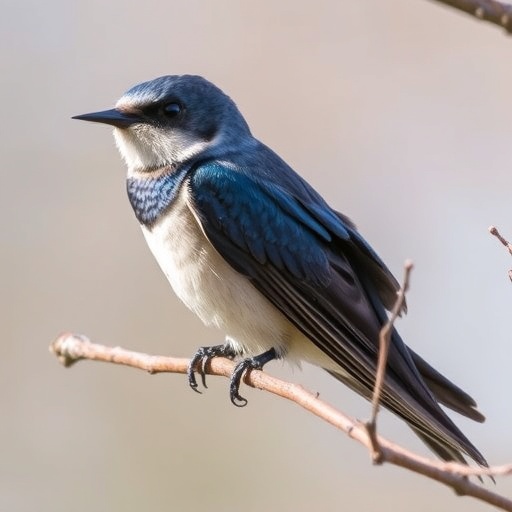
In the quiet woodlands of upstate New York, a small, iridescent bird is now offering researchers an illuminating glimpse into the complex impacts of climate change on animal behavior and survival. Tree swallows, known for their aerial acrobatics and vibrant plumage, have increasingly been observed to modify their nesting behaviors in response to warming springs. Yet, paradoxically, these climate-induced shifts expose their offspring to an insidious threat: sudden cold snaps that dramatically reduce fledgling survival rates. A groundbreaking study from Cornell University reveals how fluctuations in temperature—not just rising averages—can dictate the delicate balance of reproduction and survival in these aerial insectivores, showcasing the intricate interplay between environmental variability and organismal resilience.
For decades, the Cornell Tree Swallow Research Project has meticulously documented nesting patterns, parental behavior, and chick growth, amassing a dataset spanning more than forty years and thousands of nest observations. By integrating these long-term records with detailed environmental data, researchers, led by Conor Taff, have unveiled that tree swallows now commence nesting activities almost two weeks earlier than they did in the mid-1970s. This phenological shift aligns closely with warming spring temperatures, suggesting an adaptive response to altered seasonal cues. However, this apparent advantage masks a hidden risk: earlier breeding windows inevitably coincide with periods of greater temperature volatility, including episodes of sharp cold spells capable of undermining chick development.
The intricate dynamics of these cold snaps, as explicated in the study published in the journal Current Biology, challenge the conventional focus on gradual warming trends. Instead, short-term thermal fluctuations exert disproportionately large effects on reproductive success. Specifically, nestlings exposed to consecutive days of low temperatures during critical developmental phases exhibit stunted growth and increased mortality. These consequences emerge from a cascade of behavioral and physiological adjustments made by adult swallows trying to buffer their young against an inhospitable environment. The study’s fine-scale analysis reveals marked reductions in feeding rates by parents during cold intervals, an outcome of diminished insect availability and increased foraging effort.
Tree swallows subsist almost entirely on flying insects, whose activity dramatically diminishes when temperatures plunge. Consequently, adult swallows are forced to expend more energy traveling longer distances to locate adequate prey, thereby reducing the time spent incubating eggs and tending to hatchlings. Prolonged absences from the nest not only risk embryo viability—since cold exposure halts proper development—but also reduce the frequency of feeding visits once chicks have hatched. These behavioral constraints translate into a feedback loop where lower adult body mass correlates with decreased foraging efficiency, further jeopardizing offspring survival.
What sets this research apart is its unprecedented granularity in linking individual behavioral variability to reproductive outcomes. Not all tree swallows respond identically to these abrupt cold spells. The study identifies subsets of adults exhibiting remarkable robustness, maintaining higher feeding frequencies and incubation attentiveness despite temperature drops. These resilient individuals produce nestlings with superior growth trajectories and survival probabilities under harsh conditions, suggesting that behavioral plasticity or physiological adaptability may confer evolutionary advantages in fluctuating environments.
This resilience is quantified by evaluating parental responses to cold snaps, considering both their ability to sustain energetic demands and maintain nest care. The findings posit that such organismal robustness may become an increasingly critical determinant of reproductive success as climate variability intensifies. While the study cautiously refrains from asserting definitive evolutionary outcomes, it speculates that natural selection may favor traits enabling better coping mechanisms with thermal unpredictability. Over successive generations, these traits could shape population dynamics and distribution patterns of tree swallows, with broader implications for other species experiencing shifting climatic regimes.
Moreover, this study emphasizes a paradigm shift in climate ecology, urging a reevaluation of the relative importance of temperature variability versus mean changes in shaping animal behavior and survival. Whereas much prior research has concentrated on incremental warming effects, this evidence reaffirms that episodic weather extremes can be equally, if not more, influential. The capacity of organisms to endure these short-term stressors hinges on complex behavioral strategies and physiological flexibility, underscoring the need for multi-faceted approaches in ecological forecasting.
The interdisciplinary nature of this work, combining longitudinal field studies, behavioral ecology, and climate science, exemplifies a model for future biodiversity research under global change scenarios. By harnessing the power of extensive datasets and integrating them with refined environmental measures, scientists can decode the nuanced responses of wildlife to an increasingly erratic climate. This knowledge not only enriches fundamental understanding but also informs conservation strategies aimed at enhancing species resilience.
As policymakers and conservationists grapple with mitigating climate change impacts, studies like this highlight the urgent necessity to consider variability and extremes, not just averages. The fate of the tree swallow nestlings, fragile yet telling indicators of ecosystem health, propels a cautionary tale: adaptation to climate change is multifaceted, fast-evolving, and dependent on the intricate dance between animals and their shifting habitats. Protecting these dynamics requires a commitment to sustained monitoring and integrative research.
Ultimately, the Cornell study presents more than just a case of avian reproductive challenges; it offers a window into the broader ecological consequences of a warming, yet unpredictably fluctuating, world. The resilience of some tree swallows in the face of cold spring snaps sparks hope for adaptive potential, yet the overall vulnerabilities underscore the precariousness of life amidst rapid environmental change. As we continue to decode these biological responses, tree swallows may well become emblematic messengers on the front lines of climate biology.
Subject of Research: Behavioral and physiological responses of tree swallows to cold snaps during breeding season in the context of climate change.
Article Title: Organismal robustness and resilience to declining temperature predict reproductive outcomes.
News Publication Date: April 3, 2026.
Web References:
https://www.cell.com/current-biology/abstract/S0960-9822(26)00313-1
https://news.cornell.edu/stories/2026/04/spring-cold-snaps-harm-nesting-tree-swallows-some-show-resilience
Keywords: Climate change, tree swallow, behavioral ecology, reproductive success, nestling survival, temperature variability, phenological shifts, organismal resilience, breeding behavior, insectivorous birds, climate extremes, evolutionary biology


